Decide which biopharma assets to go after
Sleuth maps every program, deal, and company, then scores each one on criteria built for your question. It shows what made the list, what didn’t, and why.


What teams do with Sleuth

“All the strategy that used to be proprietary to pharma — the ‘game within the game’ that actually drives indication decisions — Sleuth made that accessible to a nine-person biotech. I think it’s the most disruptive, amazing thing for small organizations like us. A massive, massive unlock.”

Danny Wells
CEO, Epana Bio

“What makes Sleuth stand out is its rare combination of speed and credibility. The output is factual, well-structured, and decision-useful, making it a valuable input into internal discussions and executive conversations. It has raised our expectations for how quickly broad complexity can be translated into a clearer, more refined strategic narrative.”

Alex Cogdill
Head of Strategic Initiatives, Global BD, Daiichi Sankyo







Everything your database has, plus analysis and deliverables
Most teams license a database or two, search documents somewhere else, and then pull together a deliverable by hand. Sleuth puts all three in one account for less than the price of one database seat. Work with Sleuth’s analysis, data, and documents in Sleuth Studio or in AI tools like Claude.
Analysis built for your question
Sleuth builds deliverables to answer your question, backed by datasets built for your question.
An explorable knowledge base
Everything your database has, connected, so Sleuth can shape it to your question. Browsing Sleuth’s data is free and unlimited on all plans.
Searchable documents
Sell-side research, filings, press releases, conference abstracts, and more to read directly. Searching and reading documents is free and unlimited on all plans.
Start from the whole landscape
Sleuth pulls trials, drugs, companies, and deals from all the public sources you’d expect, plus analyst research, Chinese sources, and proprietary signals you can’t get elsewhere.
Public data
Registries, regulators, journals, and company filings across the US, Europe, and Asia, collected from the source and kept current.
Licensed research
Sell-side research from banks and brokers, included in every plan, searchable next to everything else, and ready to use in your own analysis.
China coverage
Chinese programs show up in the same search as everyone else’s. Sleuth collects them from China’s registries, regulators, exchanges, broker research, and WeChat accounts, and translates them.
Proprietary signals
Sleuth tracks which targets and indications are gaining attention across the bioeconomy, from signals only Sleuth has.
Who is running what study, where, and at what stage
- ClinicalTrials.govGlobal
- EU Clinical Trials Register (EudraCT)EU
- ISRCTNUK
- ChiCTRChina
- jRCTJapan
- ANZCTRAPAC
- ReBECLatAm
- CRISKorea
- IRCTMiddle East and Africa
- WHO ICTRPGlobal
- EU CTISEU
- China Drug Trial Registration Platform (CDE)China
- CTRIAPAC
- RPCECLatAm
- PACTRMiddle East and Africa
- and 6 more
Trial registries
Who is running what study, where, and at what stage
- ClinicalTrials.govGlobal
- EU Clinical Trials Register (EudraCT)EU
- ISRCTNUK
- ChiCTRChina
- jRCTJapan
- ANZCTRAPAC
- ReBECLatAm
- CRISKorea
- IRCTMiddle East and Africa
- and 12 more
Regulators and safety
What was approved, designated, delayed, or rejected, and what safety signals followed
- FDA drug labels (openFDA / SPL)US
- EMA CHMP opinions and meeting highlightsEU
- MHRAUK
- NMPAChina
- PMDAJapan
- Health Canada Drug Product DatabaseCanada
- TGA Australian Register of Therapeutic Goods (ARTG)APAC
- Project OrbisGlobal
- FAERS (via openFDA)US
- and 40 more
Literature and medical meetings
What the published science says, and what was presented before it reached a journal
- PubMed / MEDLINEGlobal
- Europe PMCEU
- Chinese-language journals, theses, and conference papersChina
- PubMed Central Open AccessGlobal
- Select peer-reviewed clinical papersGlobal
- bioRxivGlobal
- 364 medical meetings in 20 therapy areasGlobal
- NIH RePORTERUS
- EU CORDISEU
- and 5 more
Patients, treatment, and pricing
How many patients there are, how they’re treated, and what a drug costs
- SEERUS
- Eurostat health databaseEU
- China CDCChina
- WHO Global Health ObservatoryGlobal
- HHS HIV guidelinesUS
- CMS ASP pricing filesUS
- NICE technology appraisalsUK
- G-BA (AMNOG)EU
- China National Reimbursement Drug List (NHSA)China
- and 19 more
Company disclosures
What companies are required to disclose, and what they choose to say
- SEC EDGARUS
- HKEXnewsChina
- EDINETJapan
- DARTKorea
- Company pipeline pagesGlobal
- Company press releasesGlobal
- Corporate and investor presentationsGlobal
- Earnings call transcriptsGlobal
- Investor day and R&D day materialsGlobal
- and 11 more
Patents
Who owns what, and when exclusivity ends
- US Patent and Trademark OfficeUS
- European Patent OfficeEU
- Japan Patent OfficeJapan
- China National Intellectual Property AdministrationChina
- WIPO PCT applicationsGlobal
- Orange Book patents and exclusivitiesUS
- Paragraph IV certifications listUS
- Purple Book patent listsUS
News and social signals
What happened this week, and early signals outside formal disclosure
- Business WireGlobal
- PR NewswireGlobal
- GlobeNewswireGlobal
- Biotech and pharma trade pressGlobal
- WeChat official accountsChina
- Company job postingsGlobal
- People and executive movesGlobal
- Social posts from companies, KOLs, and analystsGlobal
- Biotech podcasts and webinarsGlobal
Sell-side research
How the Street sizes, forecasts, and values drugs and companies.
- Global investment banks
- US healthcare and mid-market banks
- European brokers
- Independent and sponsored research
- Consulting and industry research
- Historical archives
Biology and disease reference
What each disease, target, gene, and compound is, defined once for every record
- Disease OntologyGlobal
- ICD-10-CMUS
- MONDOGlobal
- NCI ThesaurusUS
- MeSHGlobal
- FDA Global Substance Registration System (UNII)US
- ICD-11Global
- RxNormUS
- Orphanet nomenclatureGlobal
- and 9 more
What teams use today
Build analyses like this one for your own landscape
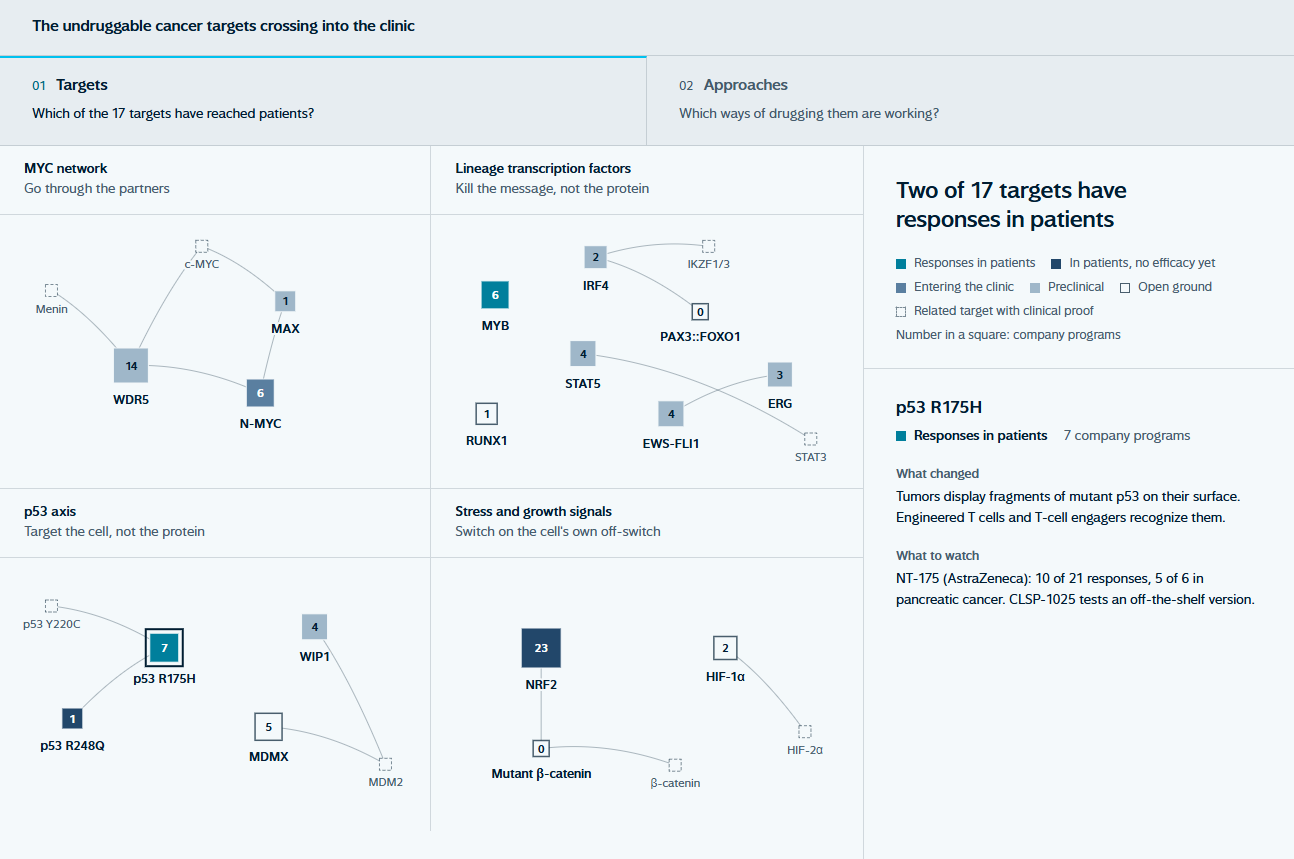
Explore our map of the cancer targets once called undruggable. Click any target to see the programs against it, which ones stalled, and the reasons on record.
Sleuth Intel Hub
New analyses, interactive landscapes, and quarterly reports, built with the same tools you can use with Sleuth.
Frequently asked questions
Sleuth gives ChatGPT and Claude the library they’re missing: a biopharma knowledge base, already matched and checked, with a source on every value. On their own, they’re strong analysts who rebuild each landscape from the open web, can’t reach sell-side research or China’s registries, and get some of it wrong. Connect Sleuth, and Claude, ChatGPT, or Copilot work from the same knowledge base. See how Sleuth compares with ChatGPT and Claude.
Yes, for most biopharma strategy work. Every plan includes the same kinds of records, connected in Sleuth’s knowledge base: programs by target, modality, and phase, with catalysts and sales forecasts; trials from registries worldwide; and deals with upfronts, milestones, and royalties where they’re disclosed. Sleuth adds sell-side research and China coverage, and browsing is free and never uses credits. Then Sleuth does the narrowing down you’d otherwise do in Excel. Compare Sleuth with your database.
Sleuth’s data comes from the organizations that publish it: trial registries, regulators, patents, journals, companies, news, and sell-side research from 35+ providers, including China’s sources in Chinese. Sleuth checks every record and keeps it current. Every source is listed on the Data page.
Every value in a Sleuth dataset links to its source and has a confidence score, based on how good its best source is, whether independent sources agree, and, where it matters, how recent it is. When Sleuth can’t find a source for a value, it marks it unknown instead of filling it in, so you can see what to trust and what to check. See how Sleuth scores every value.
Yes. Sleuth works with your own documents on any plan: upload your files, and Sleuth reads them alongside everything else, or start a project from your own spreadsheet. On Enterprise, Sleuth also connects to Drive, SharePoint, Box, or your data warehouse and matches your internal program names to the same records. Talk to us about connecting your systems.
Starting Sleuth costs nothing: the free trial gives you 14 days of everything in Starter, with 2,500 credits for analysis and no card. After that, plans start at $249 a month, and browsing the knowledge base never uses credits. See every plan on the Pricing page.