
Biopharma world models are further along than the conversation suggests
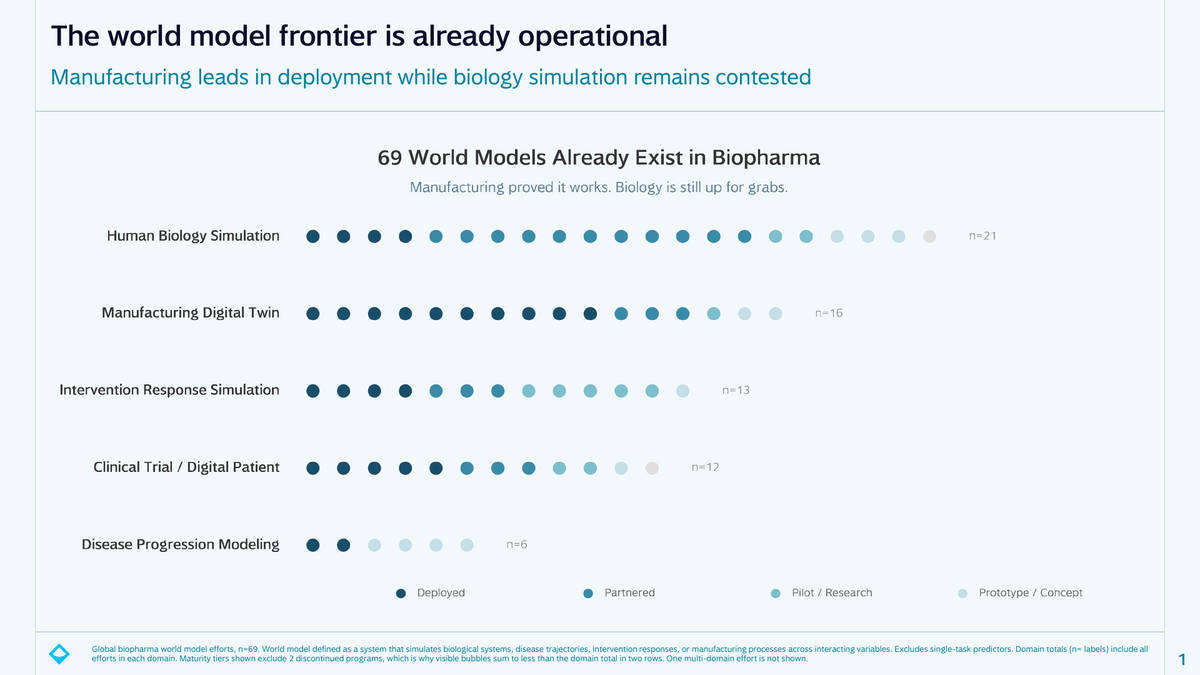
“World models” in biopharma sound like a frontier that is years away, but Sleuth mapped 69 of them as of May 2026, and two-thirds are already deployed or partnered. Alongside them, Sleuth documented 29 foundation model deployments. The pattern that matters is who builds what: large pharma licenses foundation models from outside partners but builds world models internally, and only where regulatory returns are already clear.
Manufacturing digital twins are the most mature world models
Manufacturing digital twins lead on maturity, with 10 of 16 efforts already in production. Process physics and sensors are observable in ways biology is not.
Manufacturing is where world models proved the concept works, and it is the lowest-risk place for pharma to adopt them.
Biology simulation is the largest domain, and it is still open
Biology simulation is the largest domain, with 21 efforts, but most are partnered rather than deployed. The companies racing to own a defensible platform are AI-native biotechs such as Recursion, Bioptimus and CytoReason, not large pharma.
The window to own a biology world model is still open, and the capability is more likely to enter pharma through acquisition than internal builds.
Pharma builds narrow world models and buys the rest
Large pharma’s internal world models cluster in quantitative systems pharmacology and manufacturing. No large pharma company in Sleuth’s dataset is attempting a broad biology world model.
The category is still being defined, so the competitive advantage lies not only in building a world model but in shaping what the term means.
How Sleuth built this analysis
What counts as a world model
Sleuth defined world models strictly as systems that simulate biological processes, disease trajectories, intervention responses or manufacturing operations across interacting variables. Single-task predictors are excluded, so the 69 efforts are a conservative count.
Foundation model deployments
The 29 deployments are publicly documented multimodal foundation model deployments and advanced pilots, each with a named deployer, a named model, multimodal inputs and evidence of active use. The two landscapes use different inclusion criteria, so their counts are not directly comparable.
Deployments and world model efforts mapped as of May 2026.
Frequently asked questions about AI world models in biopharma
What is a world model in biopharma?
A system that simulates biological processes, disease trajectories, intervention responses or manufacturing operations across interacting variables, rather than predicting a single outcome.
How many biopharma world models exist?
Sleuth mapped 69 world model efforts as of May 2026, about two-thirds of them deployed or partnered, alongside 29 documented foundation model deployments.
Which companies are building biology world models?
AI-native biotechs such as Recursion, Bioptimus and CytoReason. No large pharma company in Sleuth’s dataset is attempting a broad biology world model.
Where are world models already in production?
Manufacturing digital twins are the most mature, with 10 of 16 efforts in production.
