Choosing a Lead Indication: Indication Selection as Deselection
Biotechs rarely have too few indication options. In this post, we walk through a funnel for making defensible cuts, from hundreds of candidates to one lead indication.


Download Companion Slides
Episode 2 of Sleuth's Biotech Strategy Series
Indication selection is one of the earliest major commitments a drug developer makes, and an existential one: it shapes the company for five to ten years or more. Companies build KOL relationships, patient networks, clinical infrastructure, commercial capabilities, and even their identities around the diseases they pursue.
Once an indication is chosen, a patient enters the center of the equation. You now have to understand that patient's disease, treatment options, physicians, endpoints, payers, and more.
Ultimately, the job is to match three things: the molecule or platform you believe you have, the patients who can receive meaningful benefit, and a development and commercial path that makes serving those patients feasible.
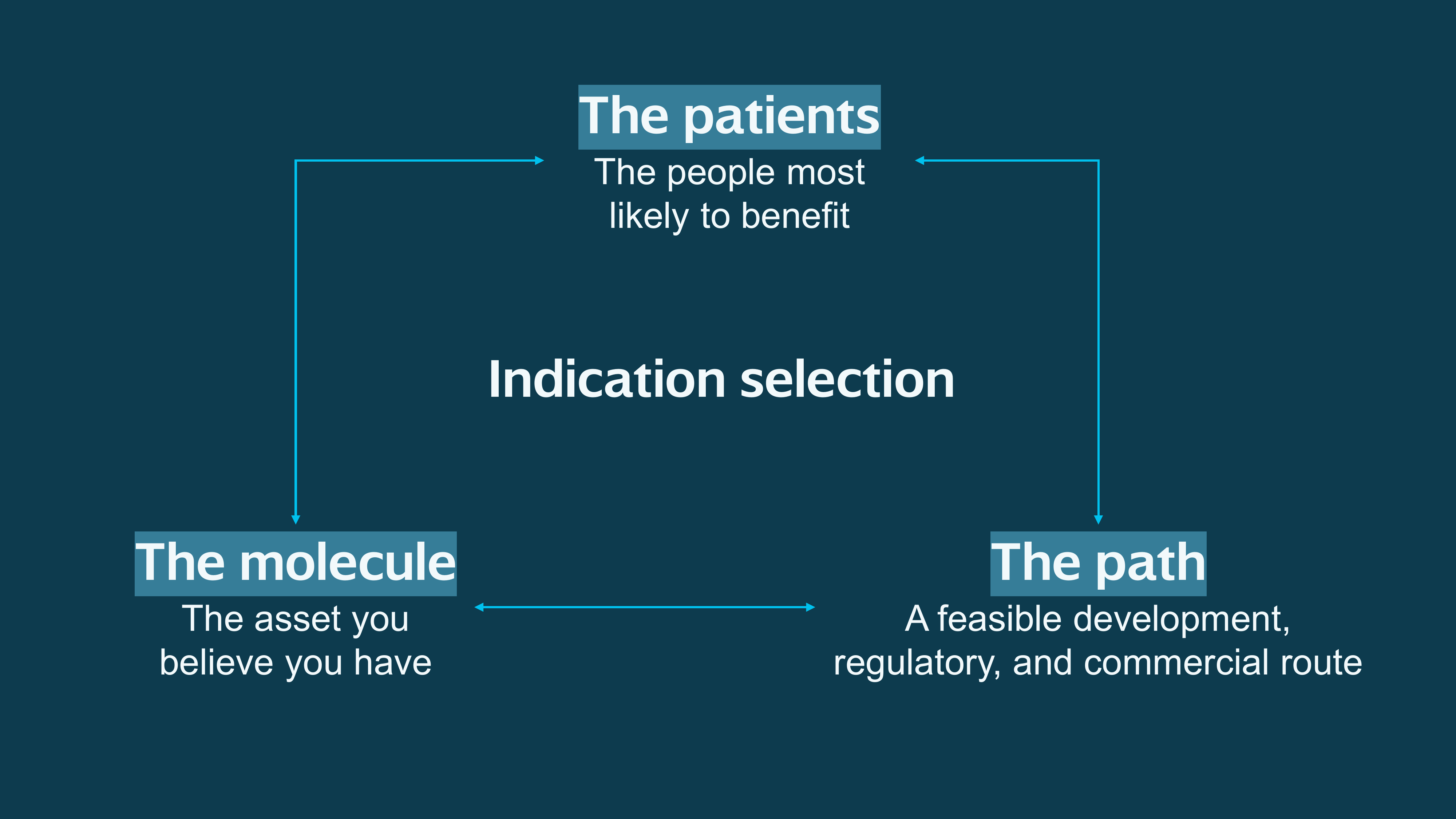
This is difficult, but not in the way many people think. It's less like finding a needle in a haystack, and more like sifting through a haystack made of needles. Biotechs tend to have too many options, not too few.
Indication Selection Is Really Deselection
Because the problem is too many options, indication selection ends up being an exercise in indication deselection: making a series of defensible cuts that take you from hundreds or thousands of options down to one indication you have conviction on.
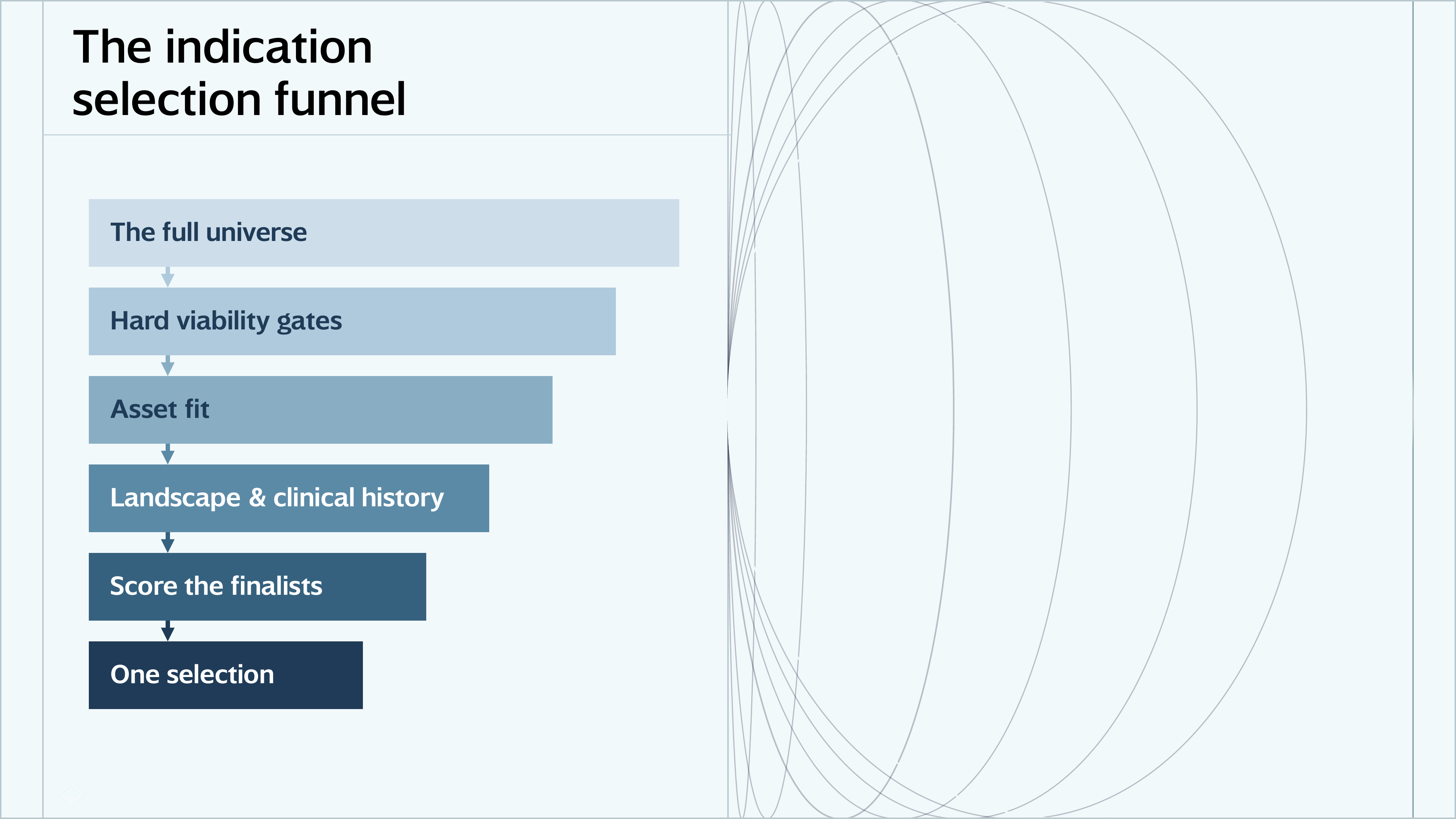
We think about this deselection process as a funnel that helps you make and explain your choice.
Why a funnel? Indication selection is unusually difficult because doing it correctly requires both immense breadth and extreme specificity. A funnel lets you achieve both without deeply analyzing hundreds of candidates. Ask cheap questions of everything, and ask the expensive questions only of the survivors.
First, Decide What You're Selecting For
Before designing a funnel, you need to make one central decision: what are you trying to achieve with your indication choice?
What you're trying to accomplish shapes how you design the funnel, and it can lead to drastically different, sometimes even opposite, decisions.
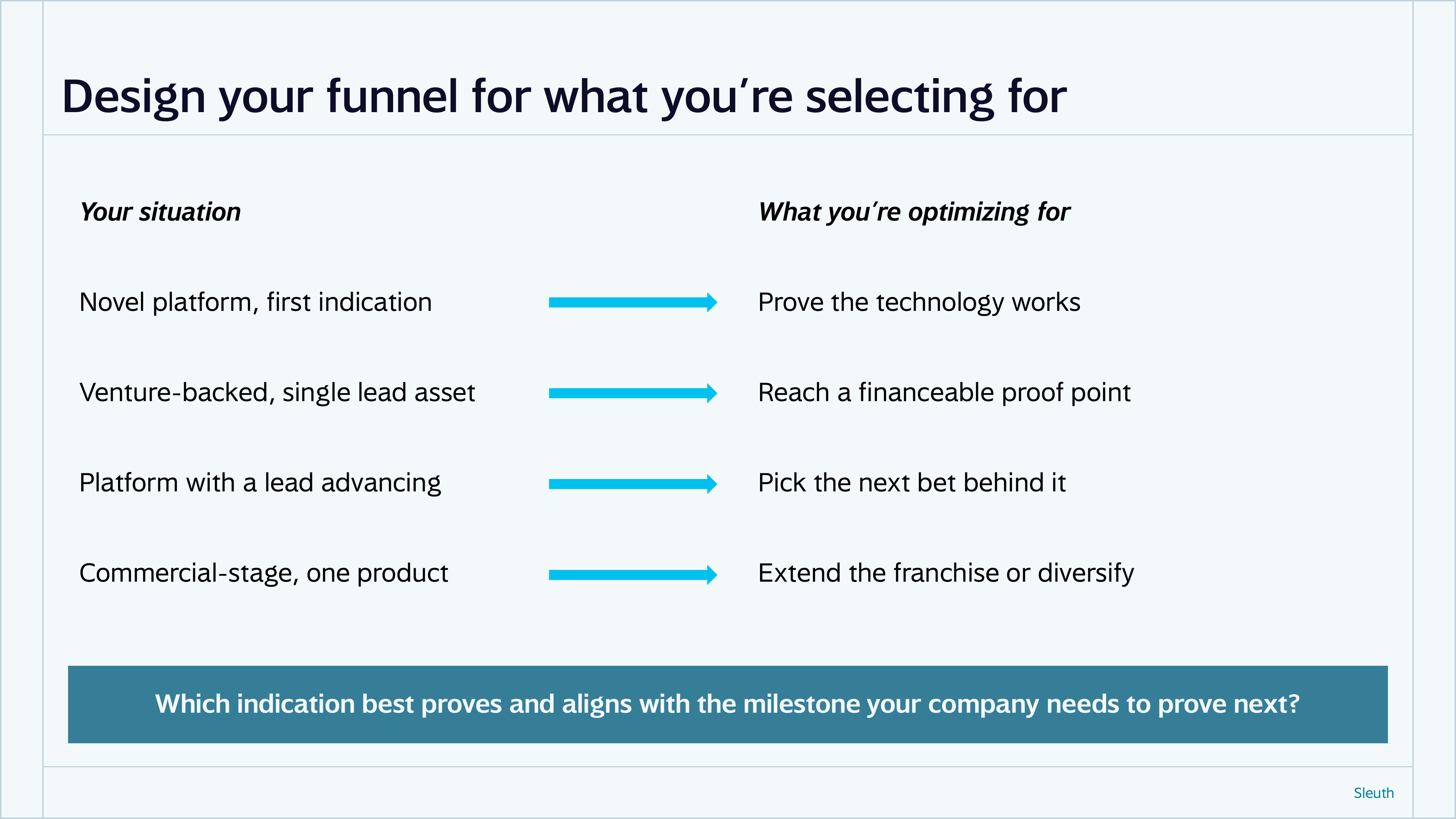
Novel platform, first indication. If you're a novel platform picking your first indication, the job is to prove the technology works. In that case, it can make sense to choose a well-validated or even crowded disease. The objective is to isolate the platform risk, not stack unproven tech on top of novel biology and an uncertain clinical path all at once. Your indication choice may not be your biggest commercial opportunity, and that's fine.
Venture-backed, single lead asset. If you're a venture-backed company with a single lead asset, you're optimizing for a clean, financeable milestone: the indication that gets you a readable clinical signal your next round can be built on. Speed and de-risked development paths matter much more than raw market size.
Platform with a lead advancing. If you're a platform company whose lead asset is already moving forward, the technology has been validated, and the question becomes where to place the next bet behind it. That frees you to reach for diseases with greater commercial upside than your proof-of-concept indication. It also means choosing with the whole portfolio in mind, including what happens to the story if a molecule dies on the vine.
Commercial-stage, one product. If you're a commercial-stage company with one product on the market, an established revenue base lets you take a longer view and accept more development risk. The choice is usually between extending the franchise and diversifying. Franchise expansion means an adjacent disease treated by the same specialists, so you reuse your KOL relationships, sales infrastructure, and patient networks, which creates operating leverage and a durable position in the therapeutic area. Diversification means entering a new therapeutic area to reduce reliance on a single franchise: a larger future opportunity, but one that requires building new capabilities and relationships.
This is far from exhaustive, but the crux of it is: which indication best proves and aligns with the milestone your company needs to prove next? And you'll rerun this exercise every time that milestone changes.
The Funnel, Stage by Stage
Every indication selection process will be a little different, but here is a common shape for one of these funnels, starting at the top.
The Full Universe
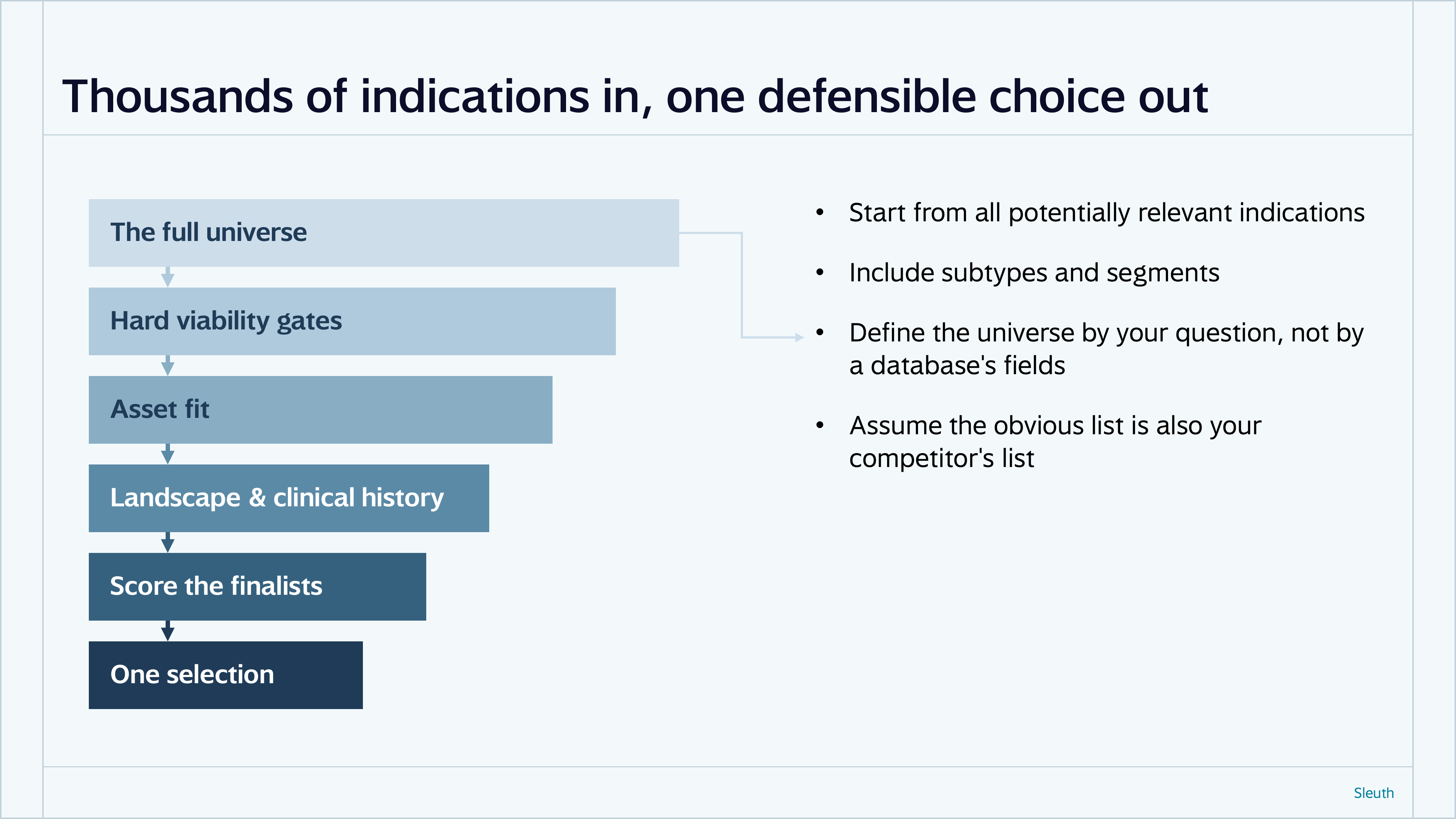
Always start with the complete landscape that might be relevant. The common mistake here is narrowing your list too early to just the obvious possibilities.
Standard databases reinforce this because they generally return diseases already linked to a target, rather than helping identify less obvious biological connections. For example, we recently had a client ask for every disease where sleep disruption that shows up on a brain scan is part of the clinical picture. That's not a single filter in any database, so you have to piece it together intentionally.
Hard Viability Gates
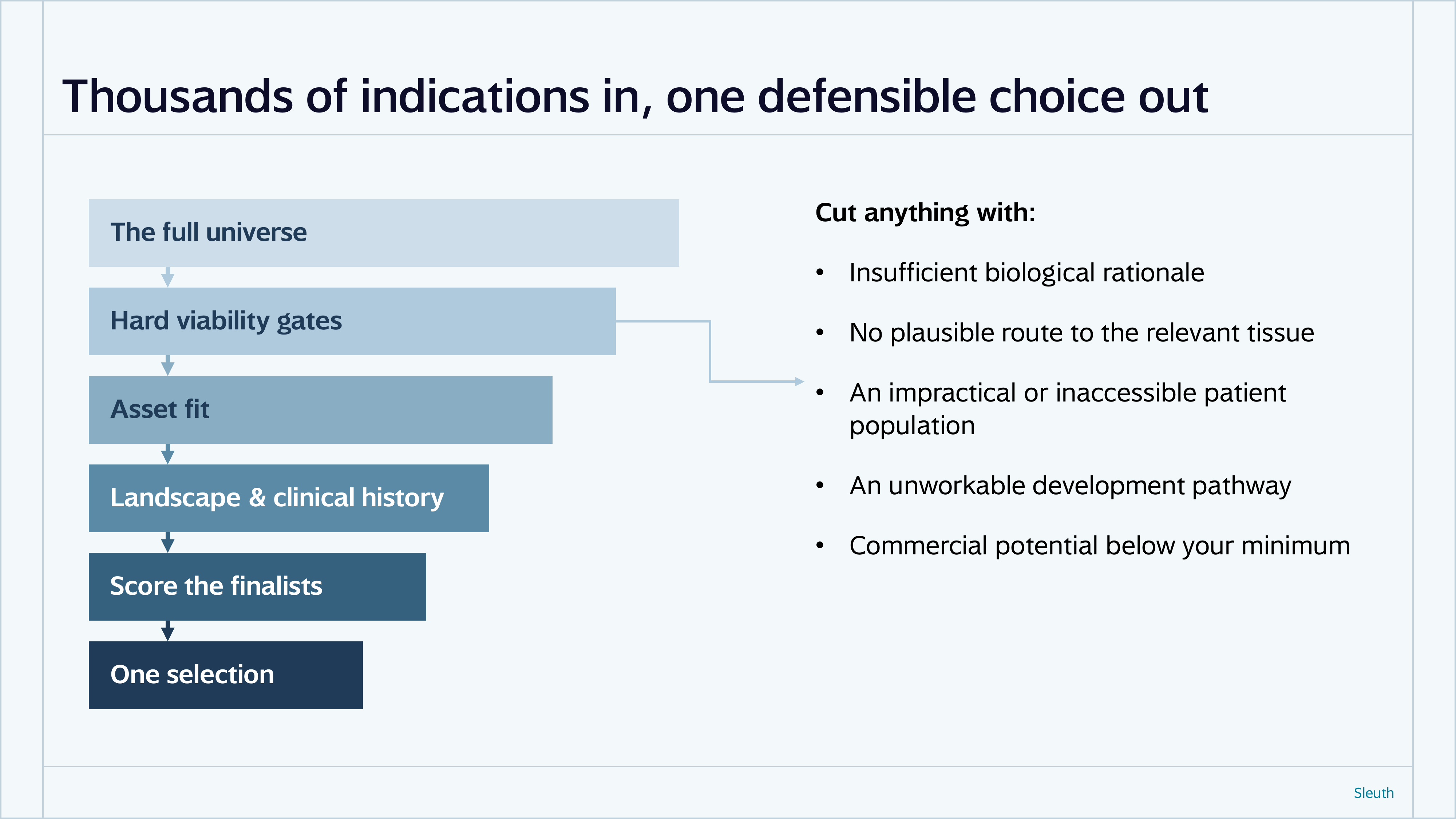
These should be true gates, not just weighted scores. If the program can't reach the relevant biology or the trial can't feasibly be run, an attractive market size shouldn't compensate for that.
The mistake at this stage is cutting on lazy proxies. One example is using today's drug revenue as a stand-in for your future market potential.
Asset Fit
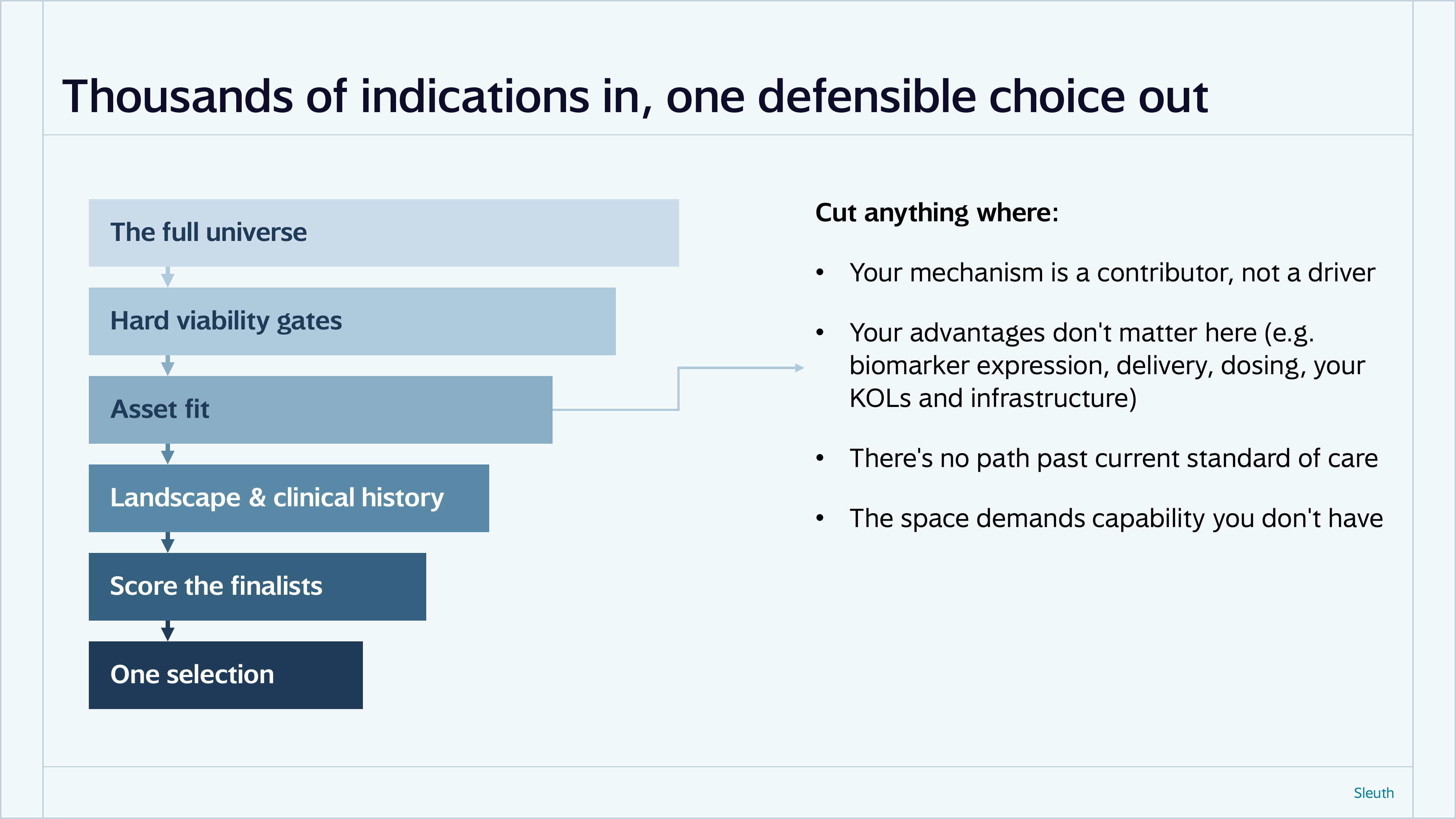
Next, the survivors get tested against you. Is your mechanism the driver here? And do your specific advantages matter to these patients?
The mistake is running this stage too late, after generic screens have already killed the indications where you had a non-obvious edge. If you do that, your funnel produces the same ranking any competitor would generate from prevalence and market size.
Existing tools struggle here as well, because the decisive parameters often don't exist as standard database fields. This requires a custom dataset built around the company's thesis.
Landscape and Clinical History
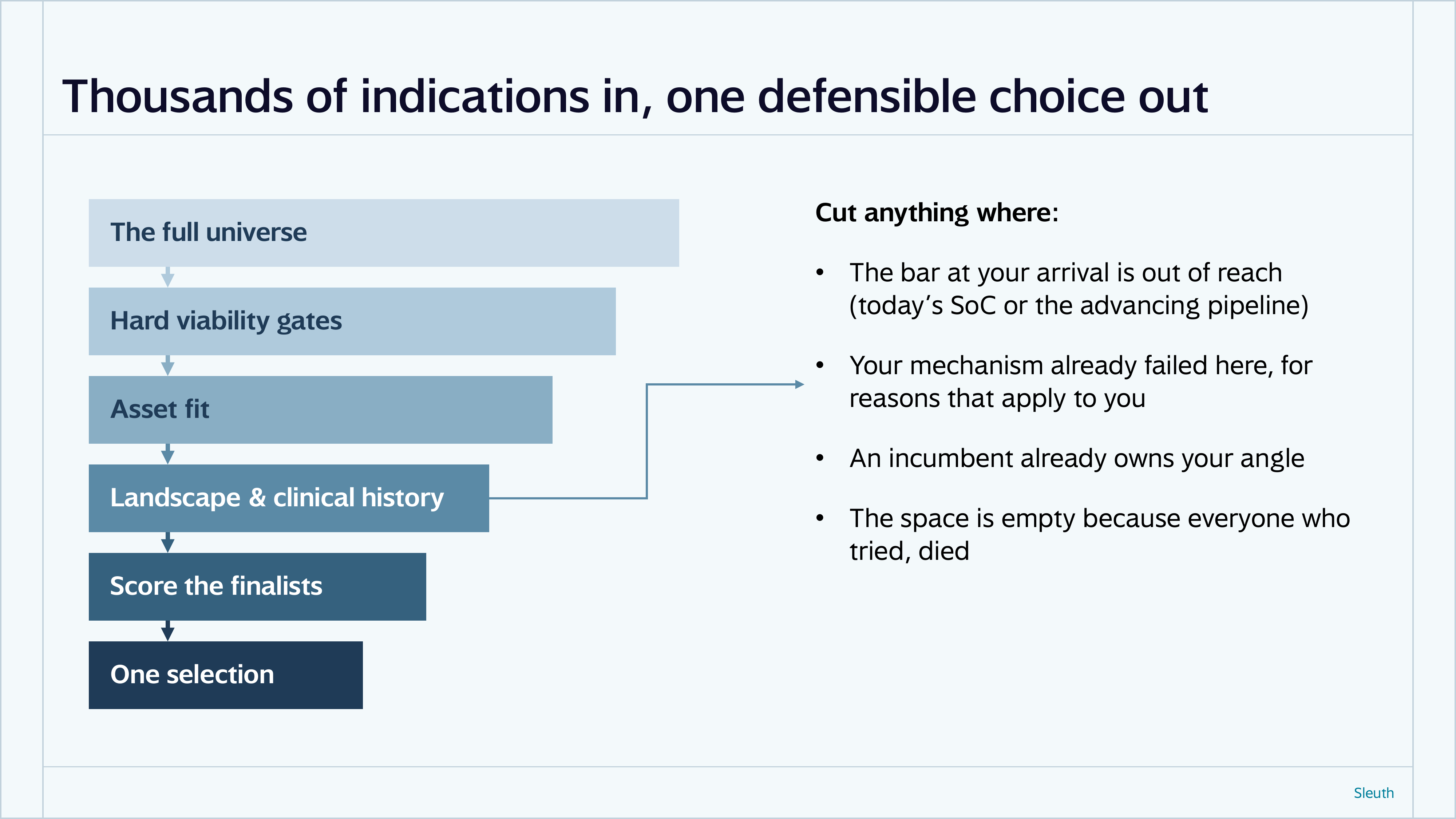
Next, look at what happened to everyone who tried before you. A field's history is some of the highest-value intelligence you're going to find.
A big mistake here is treating the landscape as a static picture. A disease with nothing approved can look commercially meaningless until the first disease-modifying therapy arrives and creates the market. And the attractive market of today may be unrecognizable by the time your drug reaches it. Judge every landscape at your arrival date, not today's.
Score the Finalists
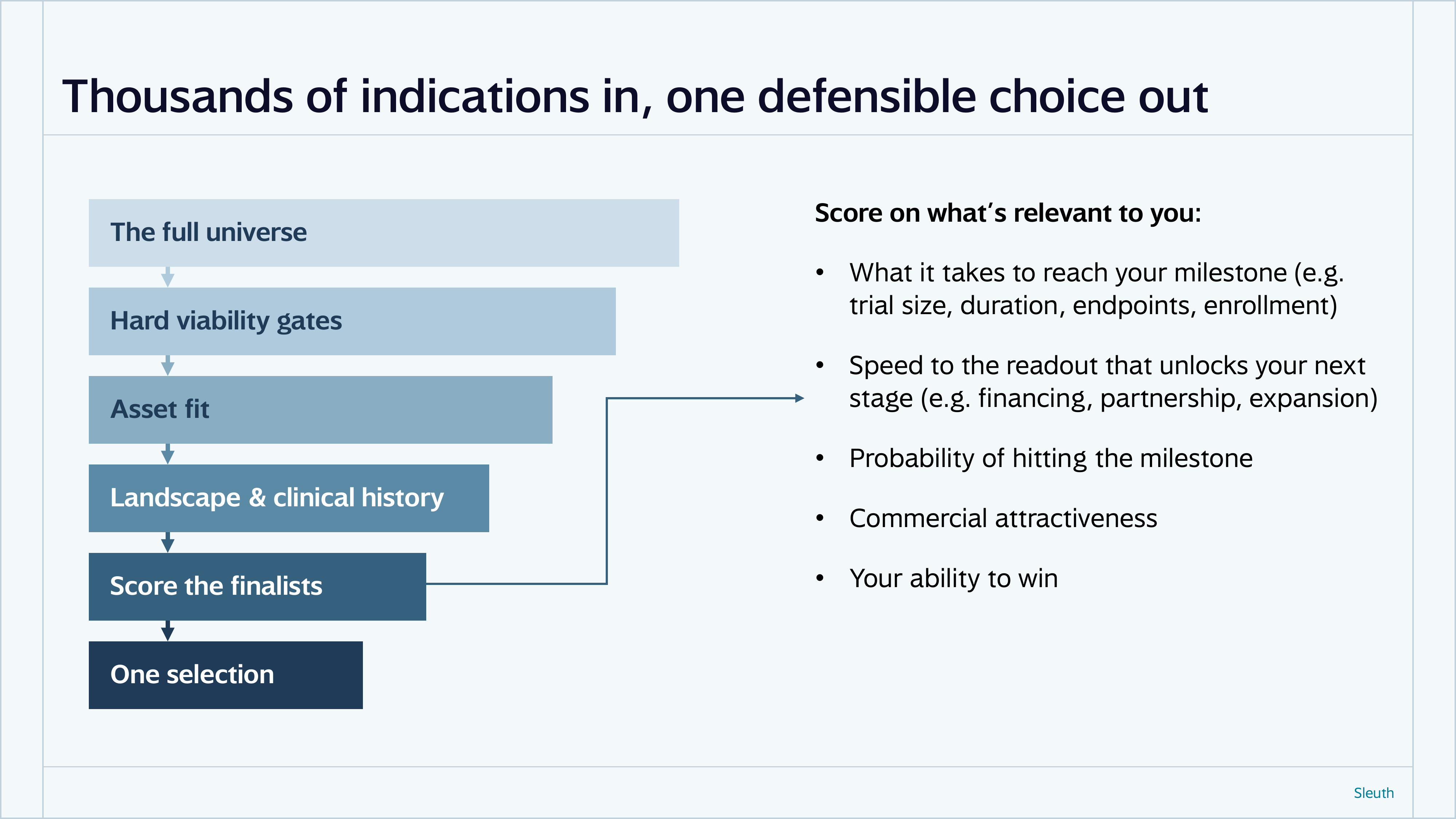
By now you know what each finalist is worth, so the last stage is: what would it actually take? Trial size, endpoints, time and cost to a readout. This is where a theoretically attractive indication becomes impractical.
Two mistakes to avoid at the finish. First, false precision: a rubric should expose your assumptions and disagreements, not bury them. Second, failing to keep the rationale for every cut you made along the way. When your board asks why a disease isn't on the list, you should have a concrete, evidence-backed reason.
Example: SLU-003, an Oral Selective TYK2 Inhibitor
The funnel above is a general shape. In practice, the stages will look a little different to fit each situation. To show how, we'll use a fictional asset in a real landscape: SLU-003, an oral, selective TYK2 inhibitor, IND-ready, from a seed-stage biotech.
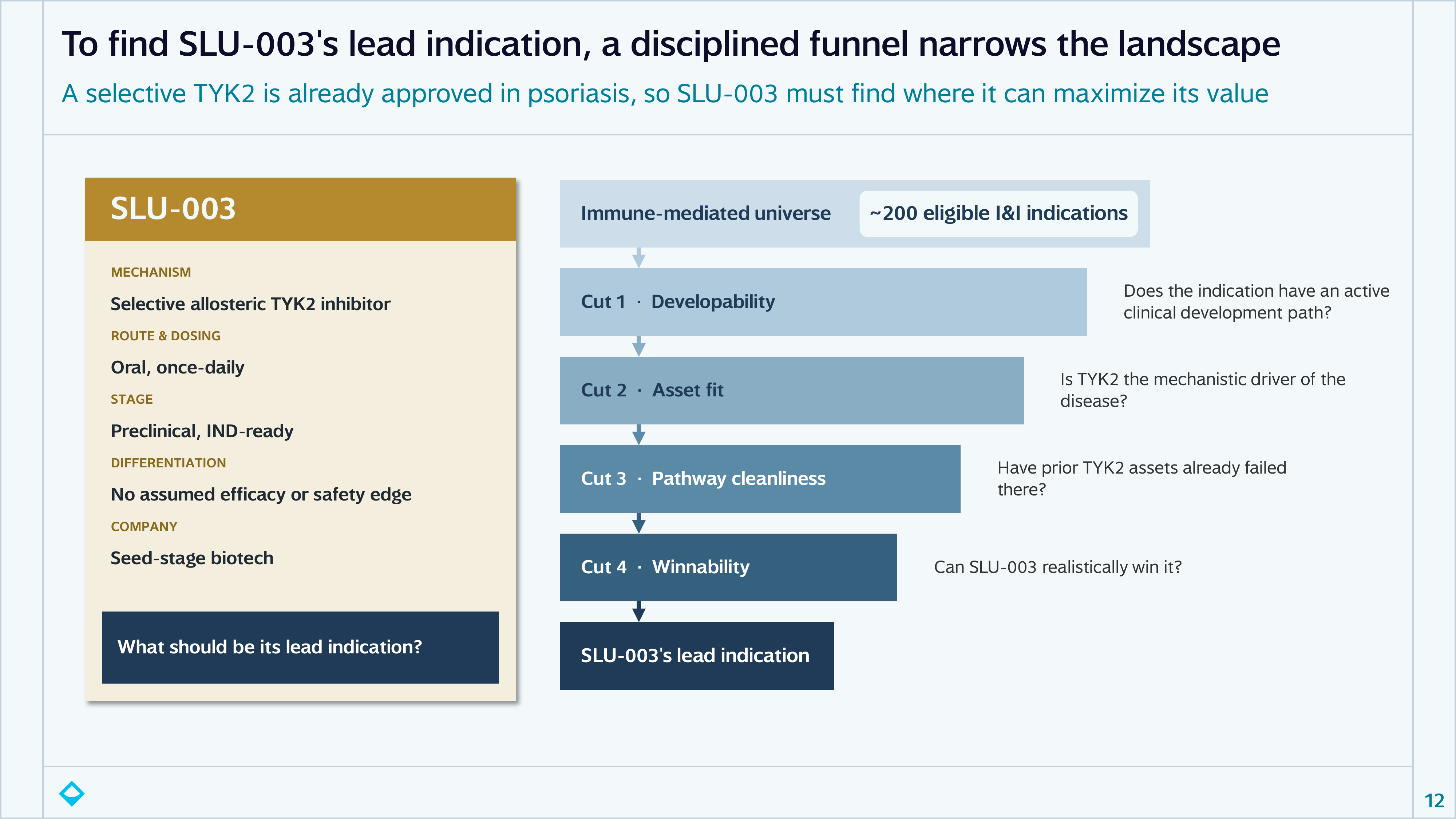
TYK2 biology touches around 200 immune and inflammatory diseases. For this asset, the funnel is four questions. Does the indication have a development path? Is our mechanism the driver of the disease? Is the TYK2 path still open there? And can we actually win it?
Cut One: Development Path (~200 to 41)
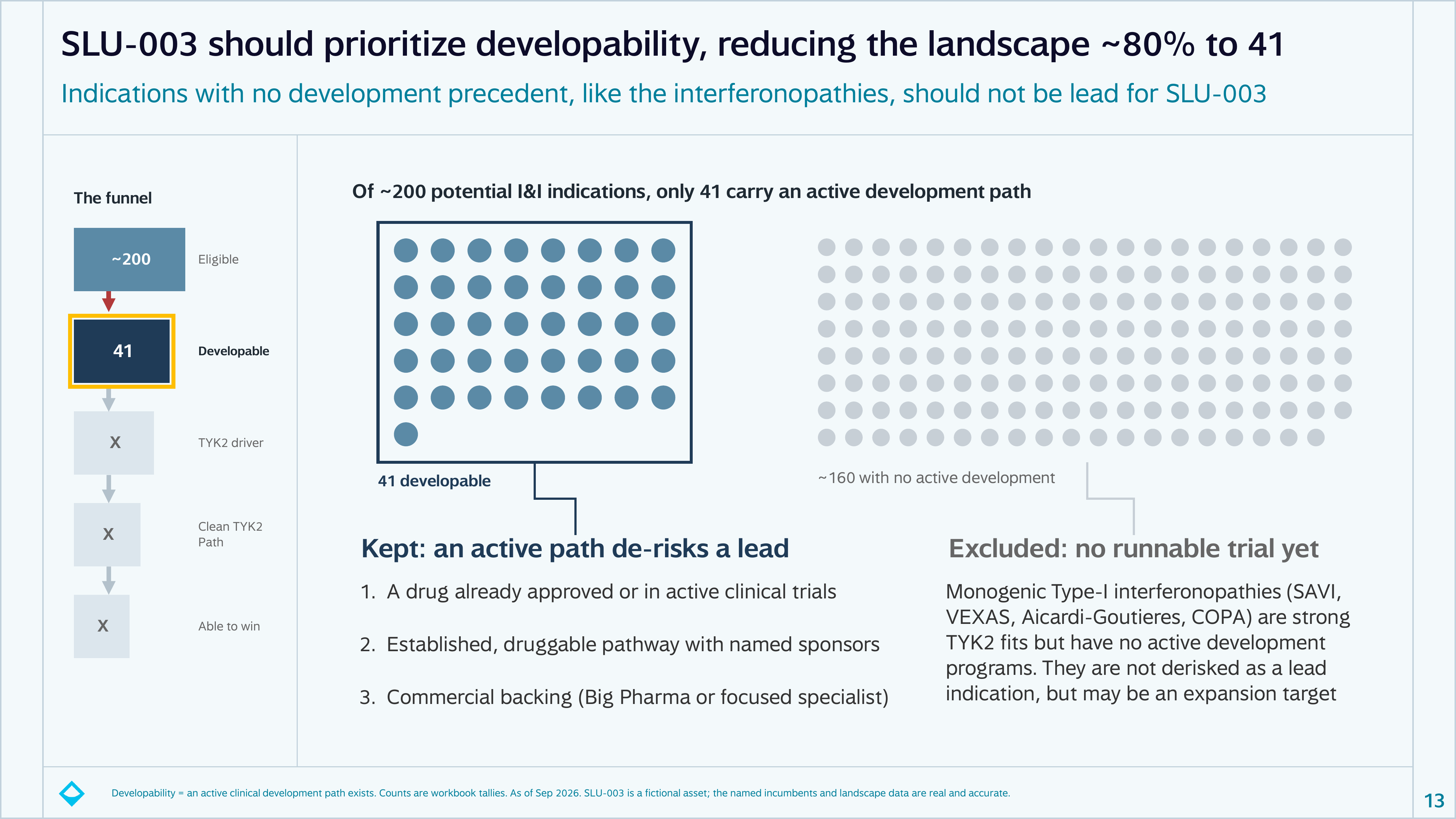
The first cut kills every indication without some active development. We want pre-built infrastructure and conviction: trialable patients, workable endpoints, a regulatory path, and sponsors who believe.
This cut is specific to SLU-003, a ten-person biotech that needs a de-risked path. A company with the balance sheet to create the precedent itself might run this exact cut in reverse and go own the empty space. Here, we can't afford to be first.
However you look at it, it's a broad, cheap screen, run before we spend real analytical cycles.
The monogenic interferonopathies get dropped here. They're strong fits with TYK2 biology, but not with the strategy of the company, which matters as much as the science. They go in our log as defensible cuts and potential expansion targets.
This cut gets us to 41.
Cut Two: Mechanism (41 to 9)
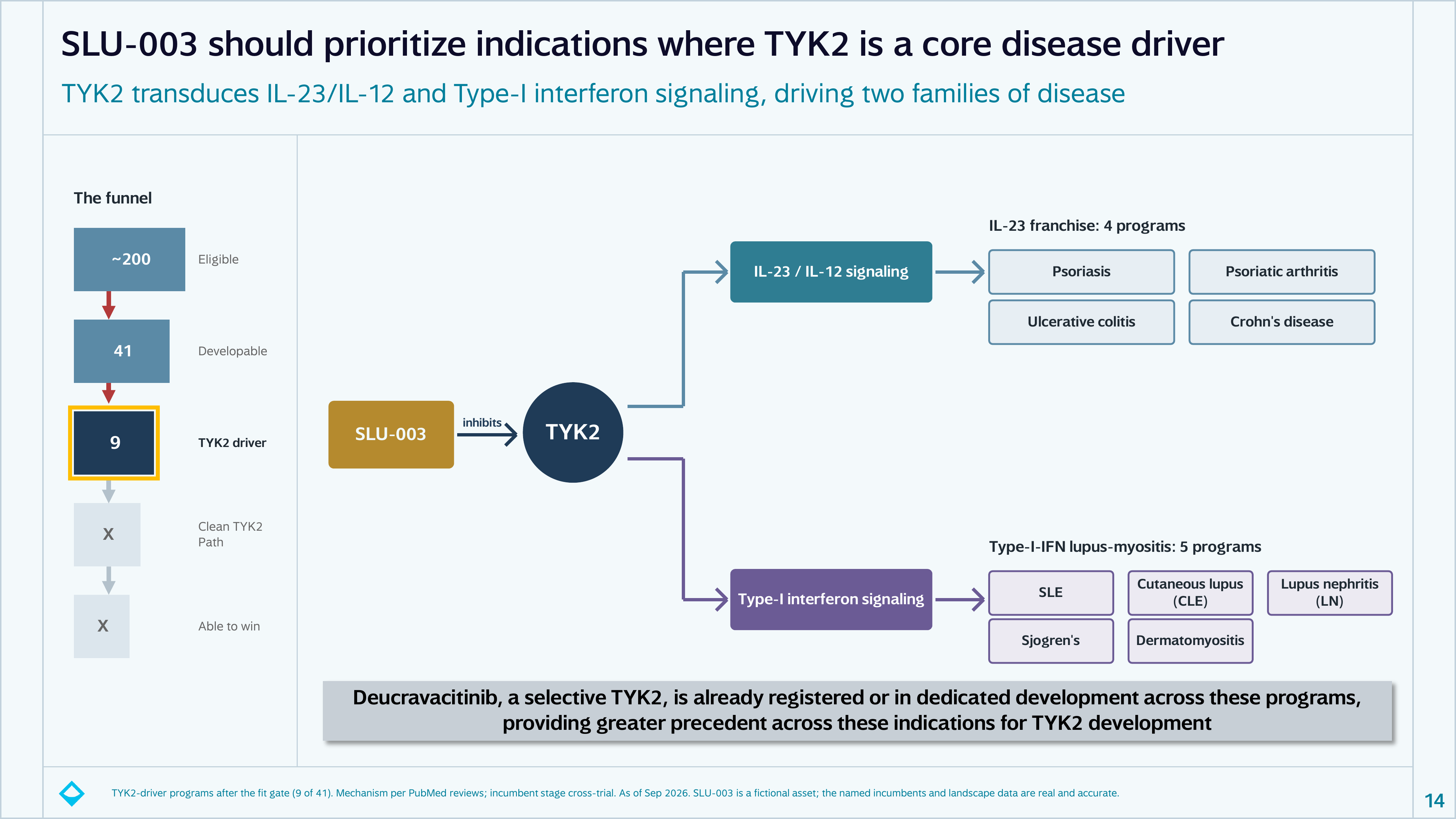
For the next cut, we move from looking at just the landscape to matching our asset to the landscape. Here, we're asking whether our mechanism is a driver of disease or just a contributor. Two key signaling families that TYK2 transduces are the IL-23 axis and type-I interferon. Where one of those actually drives the disease, SLU-003 might be a fit.
Any good scientist can run this test for a disease they know. The problem is running it for 41. The evidence lives in a different literature for every indication: pathway biology, human genetics, the trial record of pathway drugs.
It's also tempting to let pre-existing biases guide the call: real rigor on the five diseases you know, gut feel on the other 36. Letting what you already know drive the decision defeats the purpose of the exercise.
So the standard here is: same driver test, same evidence bar, all 41 indications, with the reasoning recorded for each one so you can trace it.
That leaves nine developable indications where TYK2 signaling is a disease driver.
Cut Three: Is the Path Still Open? (9 to 5)
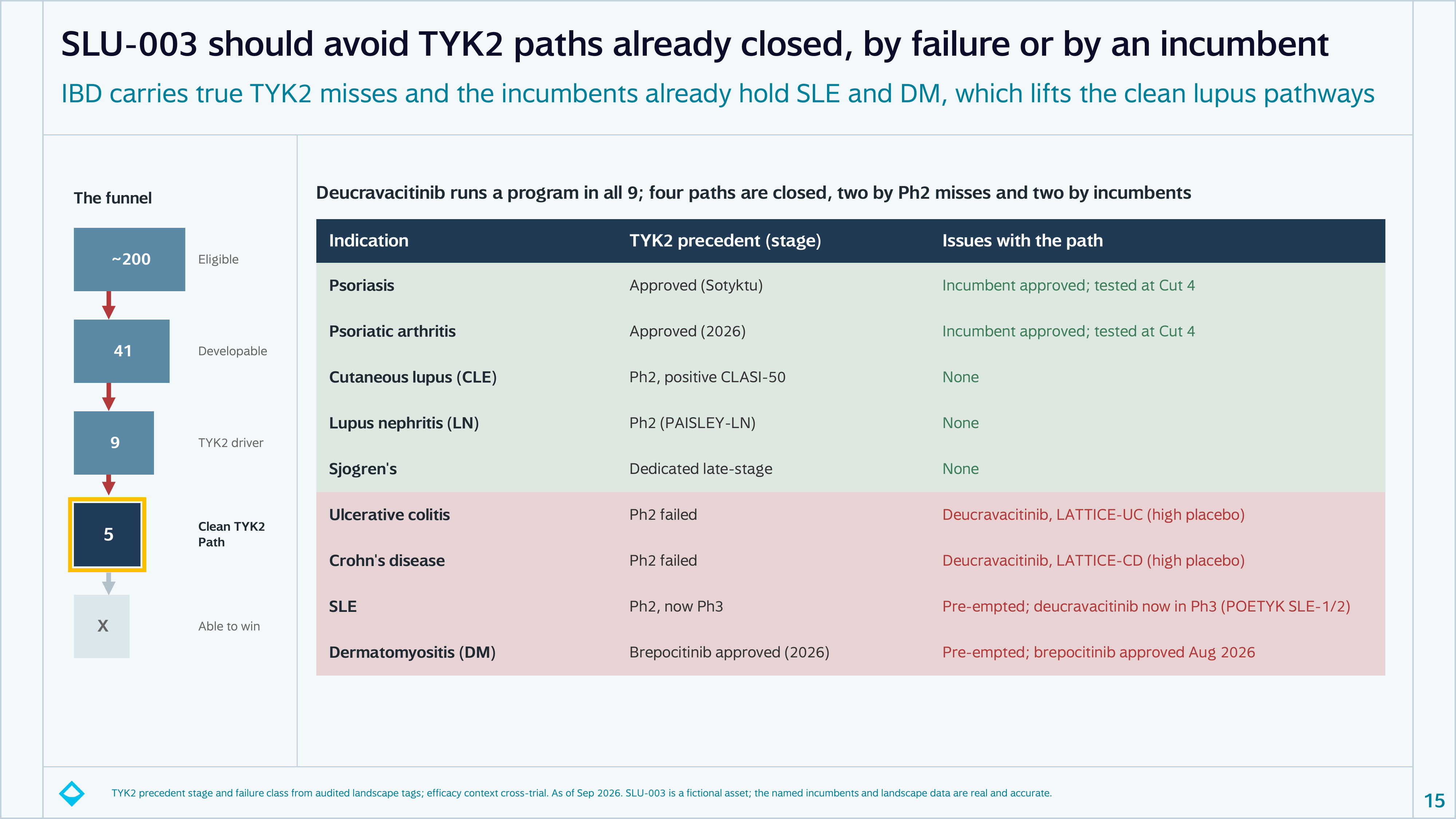
The third cut asks whether there's still an open path for our mechanism. This shows the value of running the cheap, hard cuts first, because now we have to look at each survivor with real scrutiny.
A path can close in two ways. The mechanism has been tried and missed, whether that's a true biological miss or a trial design problem. Either way, it's a headwind. Or it worked, and someone already owns it. Either one exceeds SLU-003's risk appetite.
Four of our nine are closed: two by Phase 2 misses, and two by incumbents who have already claimed the space for a company our size. Psoriasis also has an approved selective TYK2, but it's an $18 billion market, so it gets a closer look at the next cut.
Notice the flip in logic. At cut one, development activity was a green light; it proved an indication had potential. Now, development with our mechanism specifically closes the door: a selective TYK2 already missed there, or already won and owns the space.
That leaves five clean paths.
Cut Four: Can We Win It? (5 to 2)
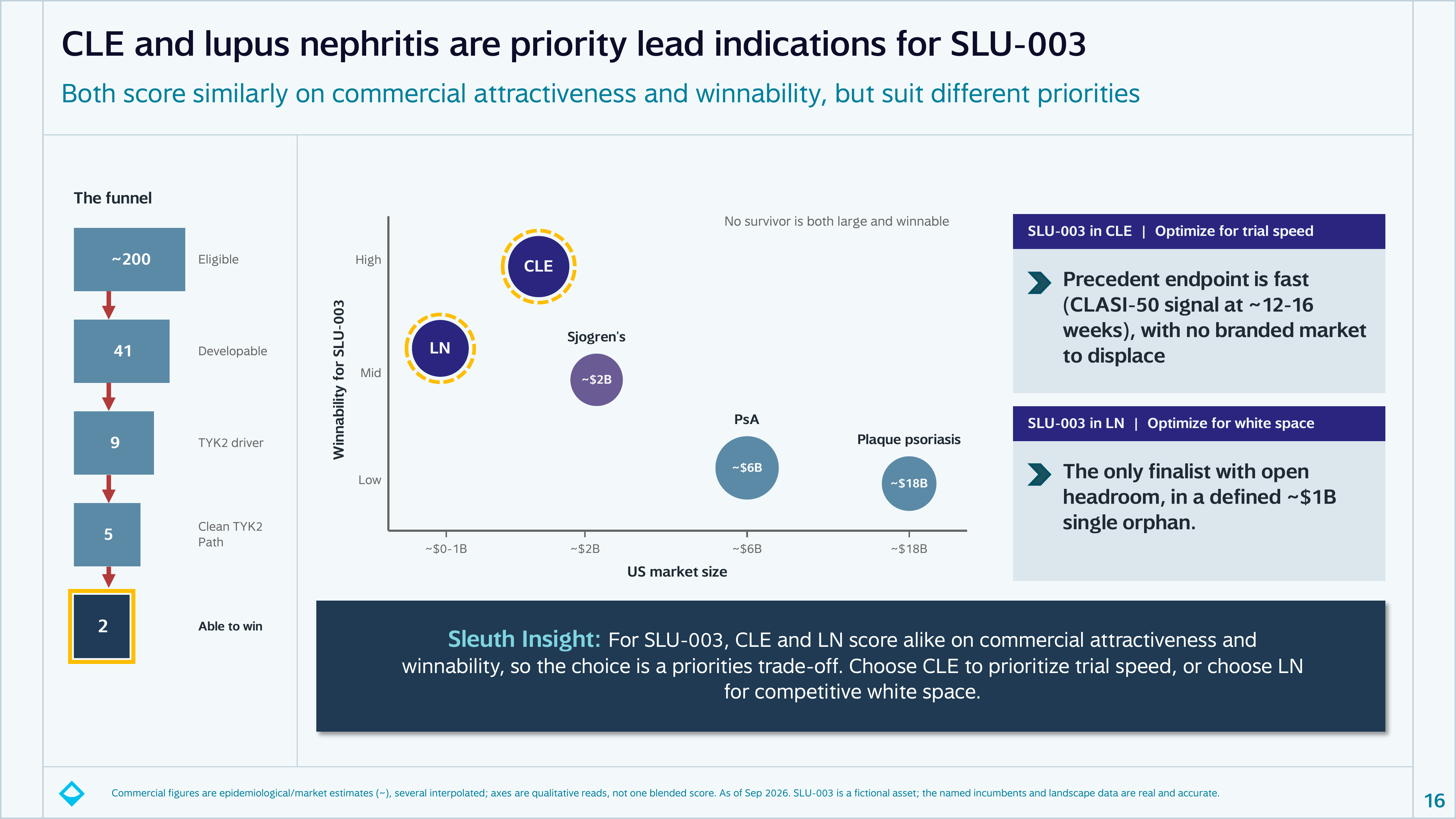
The last cut is winnability. We score the finalists on separate axes: commercial attractiveness on one, our ability to win on the other.
Psoriasis survived the last cut because it's an $18 billion market, but it dies here. It's one of the most contested battlegrounds in I&I: big pharma titans with multiple mechanisms and deep entrenchment. It's not a fight a seed-stage biotech wants to pick.
No indication is both a massive market and a clear win, but two real contenders sit in the sweet spot: large enough to build a company on, winnable enough to get there.
Cutaneous lupus (CLE) has a fast, precedented endpoint, a readable signal in 12 to 16 weeks, and no branded market to displace.
Lupus nephritis (LN) is the inverse: activity all around it, but headroom that's real when you look at the incumbents' actual data, in a defined orphan market.
The analysis got us from 200 down to two. For this company, a seed-stage biotech that needs a clean Series A story, we optimize for trial speed, so CLE is the lead. LN stays on as an expansion candidate once CLE delivers a clinical signal.
That's the key output: not just the winner, but a documented rationale for every cut along the way. You can answer your board when they ask why psoriasis isn't on the list, and you know what to watch as the landscape moves.
How This Gets Built
Even with an intelligently designed funnel, this exercise involves a massive amount of data analysis and literature review. Sleuth is built to give you both the breadth and the depth you need:
- Broad, continuously refreshed coverage across active programs, failed assets, trials, treatment paradigms, and other evidence
- Custom datasets built around your scientific and strategic criteria
- Source-level evidence and traceability for every cut you make in the funnel
Our Concierge team can perform the full exercise or act as an independent second opinion, delivering outputs like the example slides above. Our software, Sleuth Studio, lets a team build and interrogate this analysis themselves, including highly customized scoring rubrics and iterative follow-up questions.
Here's a quick look at the driver test from cut two, which took SLU-003 from 41 indications to nine, run in Studio. You can see this process in more detail in the video above.
One Workspace per Cut
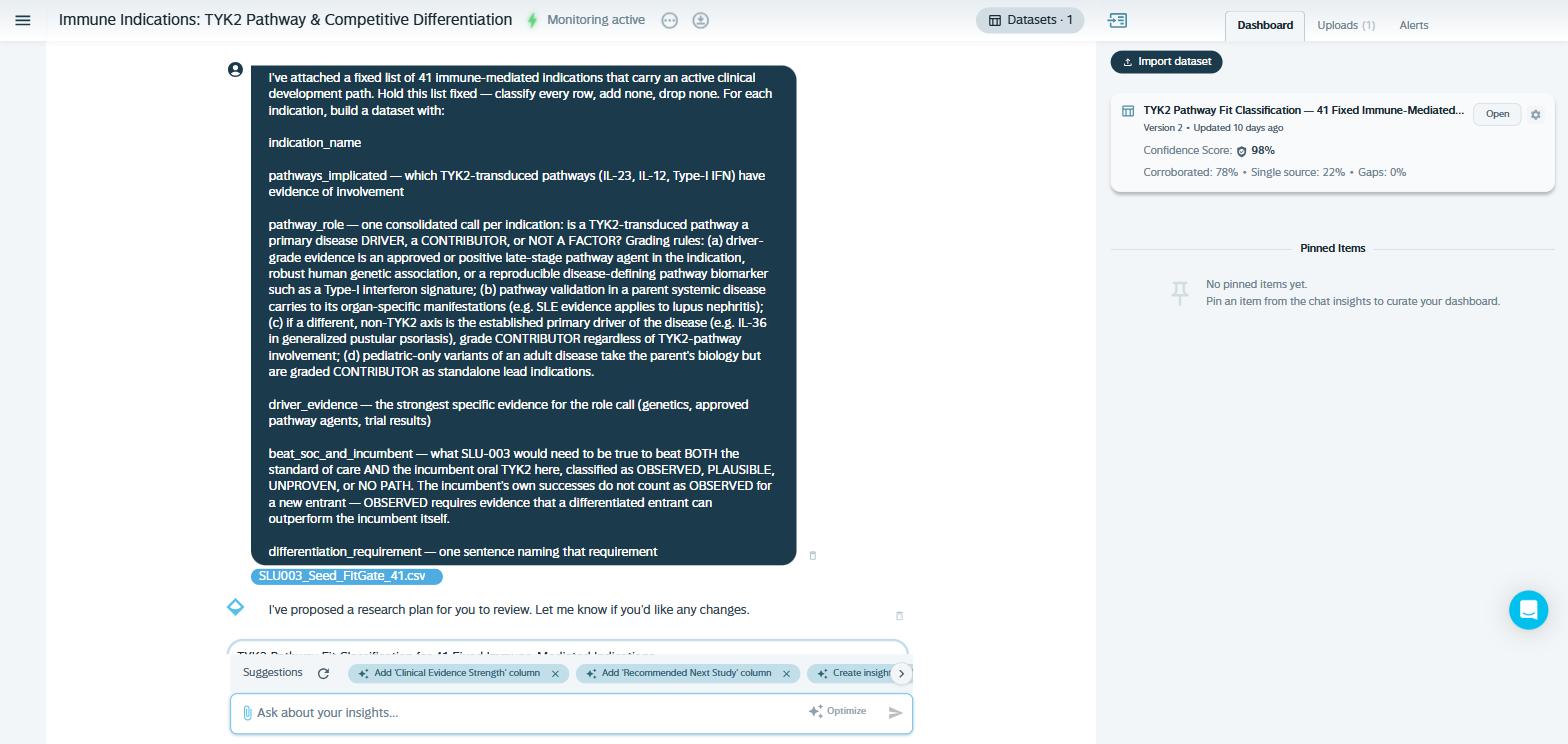
We like to use one Studio workspace for each cut in the funnel. For the driver test, we seeded the analysis with the 41 indications from the previous cut, then gave detail on how we wanted drivership scored. That ensures the literature is reviewed consistently and the same bar is applied to every indication.
The Same Nine Indications
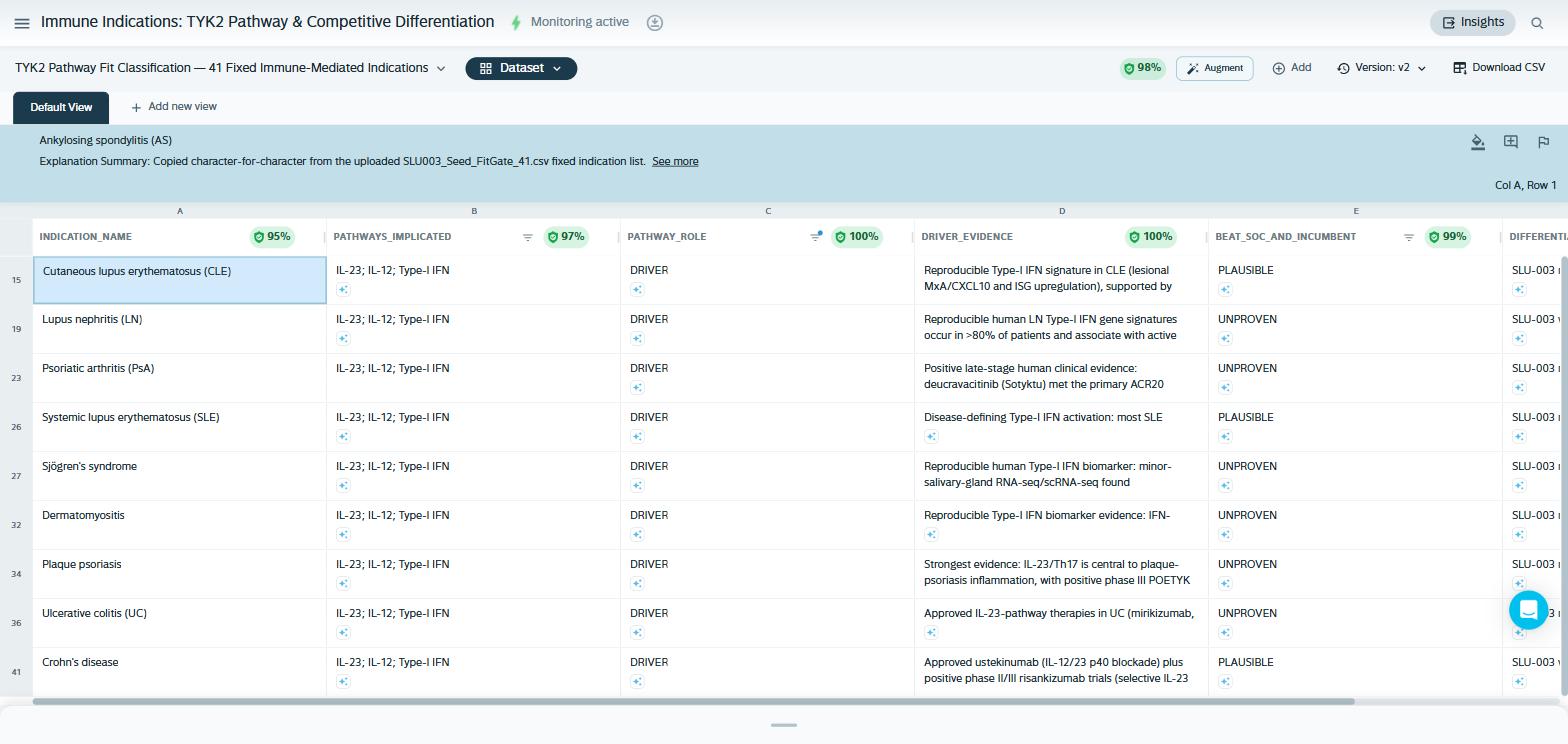
All 41 indications are in the dataset. Filtering on the driver test returns the same nine indications from the example above.
Evidence Behind Every Call
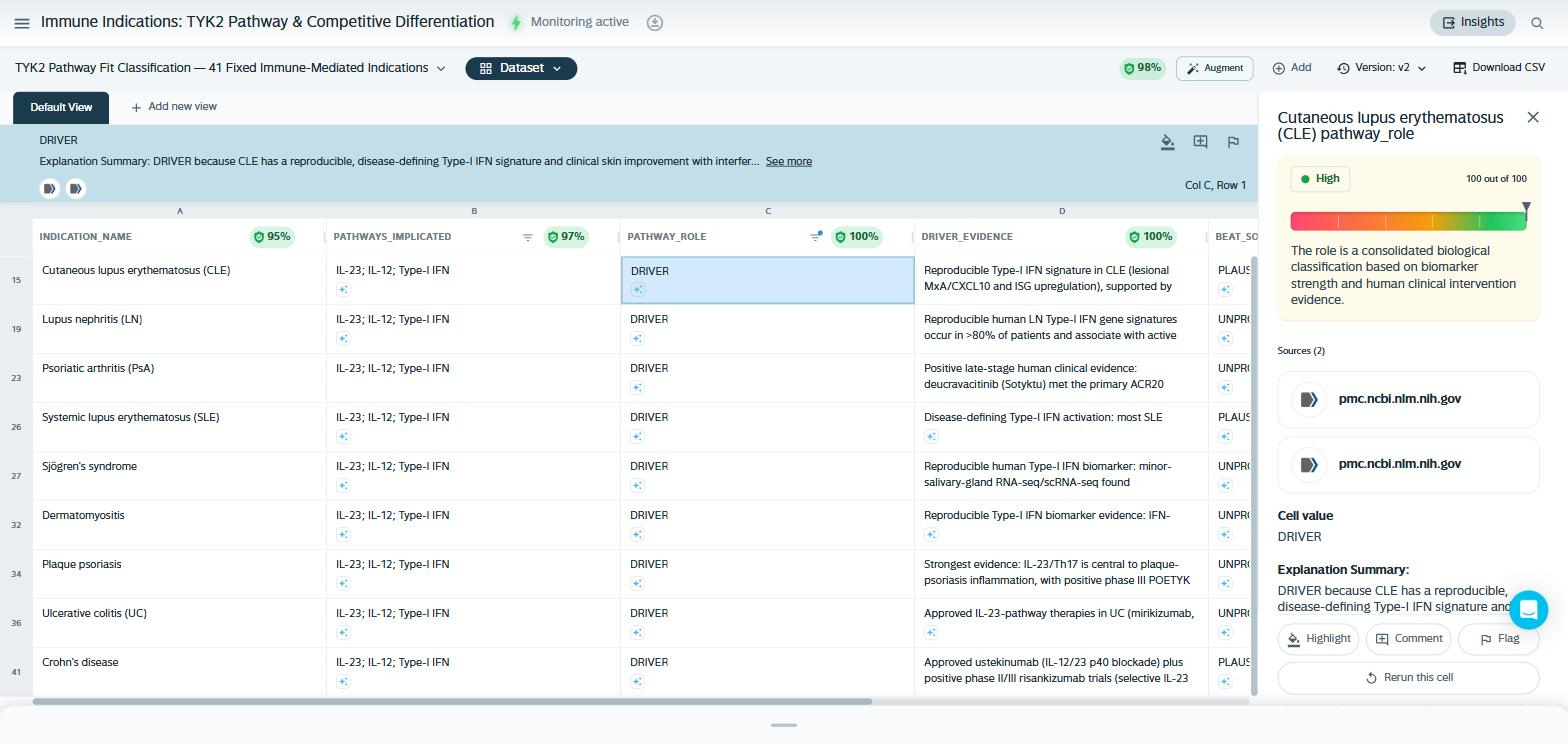
Clicking into CLE shows two linked PubMed articles and clear reasoning: CLE has a reproducible type-I interferon signature in the skin, and clinical improvement when you block that pathway.
Contrast that with an indication that didn't make the cut. Atopic dermatitis is a big disease with lots of activity, and TYK2 pathways are involved. But the evidence shows the primary driver is IL-4 and IL-13, not TYK2. The dominant biology is somewhere else, so it's classified as a contributor, and it's out.
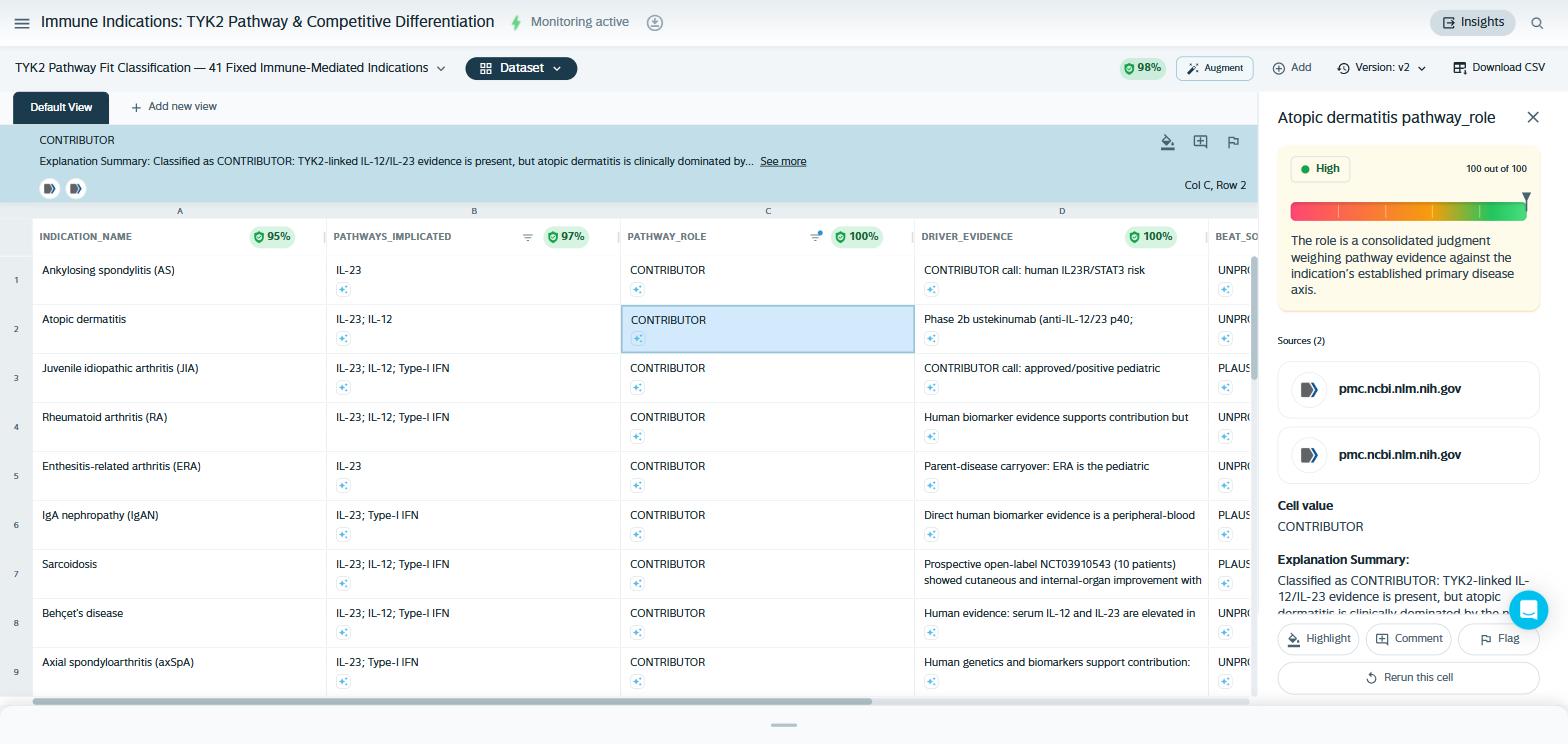
That's the kind of call you need to make 41 times. Finding and reviewing all of that literature could have taken weeks, and it would have been extremely difficult to stay consistent across those reviews. Sleuth Studio does it in about 20 minutes.
Monitoring
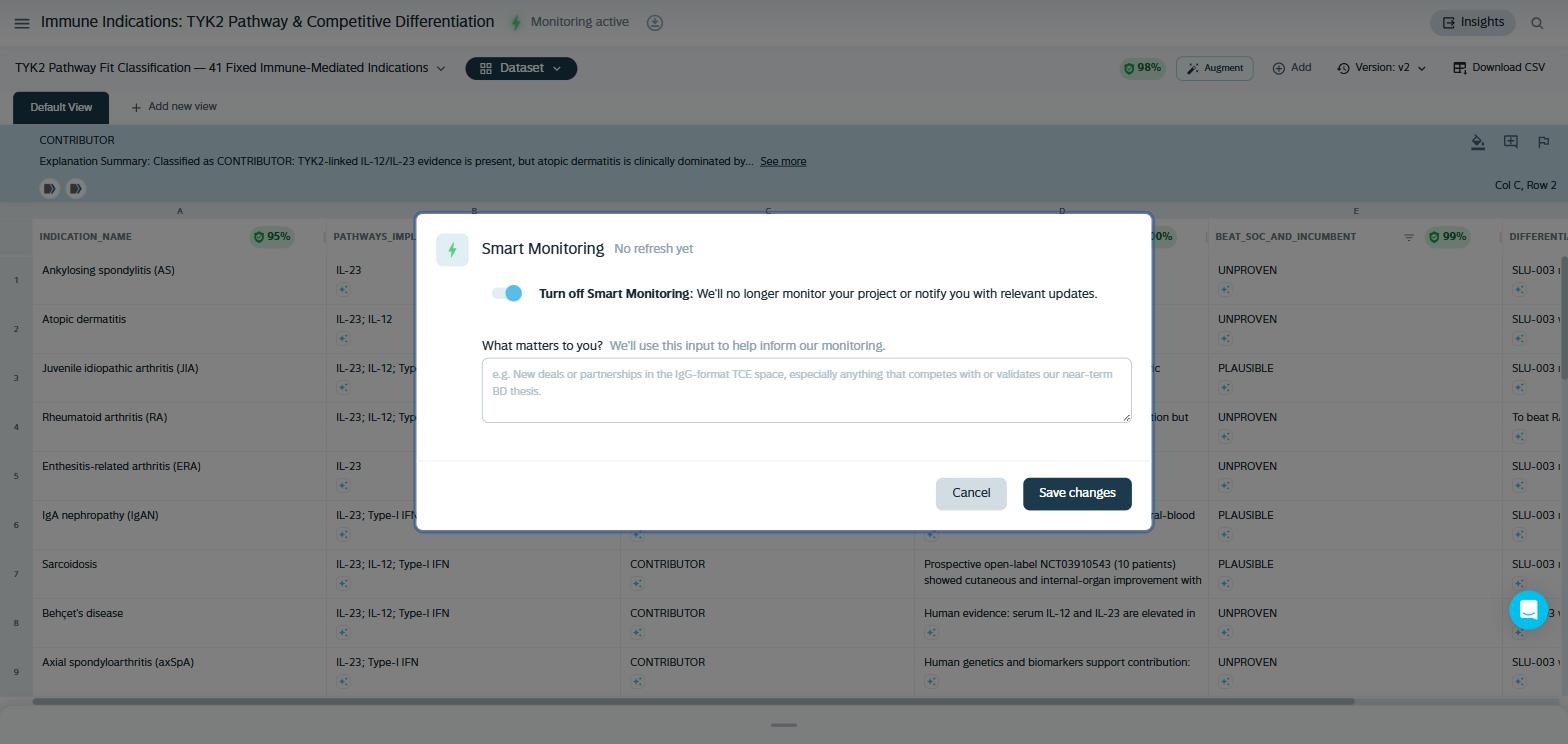
You can also turn on monitoring for the workspace. The driver test is only as good as the evidence at the time you ran it. A new genetics study, or a drug reading out in a disease where the biology was previously only implicated, can flip a call. When that happens, you'll get an alert and an updated dataset.
What's Next
That's indication selection as deselection: start with everything, make evidence-backed cuts, keep all the reasoning, and monitor the decision, because you'll have to defend your choice over and over as the market and the science move.
The status quo for this work is months of consultant time or a quarter of your own team's bandwidth. With Sleuth, you can run the analyses in minutes and the whole process in days.
This post is part of Sleuth's Biotech Strategy Series. Next time, we'll look at something that comes up once you've had some success in your indication: how to position your asset to pharma.
Want to talk to Sleuth about your indication selection? Reach out to schedule a call.