

Download Companion Slides
Episode 1 of Sleuth's Biotech Strategy Series
The competitive landscape is often overlooked by early-stage biotechs who might look at it as window dressing or just checking a box in a pitch deck, but thinking of it that way is a mistake.
Everyone is rightly passionate about their science, but investors will want to see that you understand more than just your science. You need to know: are you first in your mechanism, or are you the eleventh PD-1 inhibitor entering a market where nobody will use your product?
The competitive landscape isn't just a slide in a deck. It should inform every decision you make. Indication selection, trial design, pharma partnership strategy. If you aren't making these decisions with this level of rigor, investors will notice. They're going to want to understand: are you aware of the Chinese asset that's also going after your mechanism? Have you studied the failure of competitors in your space to look for signals about biology and regulatory path?
Your competitive landscape is where you get ahead of these questions, and the fundraise is a great forcing function to build one.
How Do Investors Look at Competitive Landscapes?
When investors are evaluating you, we know that they're looking at the science first, but a credible positioning story helps them understand why the asset matters, which will be an important anchor as the science inevitably evolves. Most investors already have a view of your landscape. This is your chance to shift it.
Market position. If you can start by showing investors an understanding of who your competitors are, you can take control of the narrative. This is much better than fielding questions in the room about "what about such and such company" and playing defense.
Differentiation. If you've identified the axes that you'll win, you can give your investor the argument they need to defend you to their investment committee. Don't forget that they still need to sell you internally.
Credibility. This will be an undercurrent of the whole discussion. As an investor is reviewing your materials, the entire time they'll be thinking about what they know about the space and what they've seen from other companies and they'll be trying to poke holes in it. You need to be airtight, because once you've lost trust it's hard to win it back.
What Do People Do Wrong?
Seeing the landscape through the wrong lens. First and foremost we see people look at their landscape fundamentally incorrectly. Many people are mapping their science. I'm going after this specific mechanism, so I'll list other drugs with that mechanism, done. That's one frame, but it's incomplete. Patients don't care what modality they get. They just want to get better. If you're a fancy cell therapy, you're competing against the small molecules, the antibodies, the therapeutic cancer vaccines, all of it. Patients take one drug at a time, and everything going after your disease is potentially competitive. This is a common mistake when you rely on databases. You can filter those standard databases however you want, but the actual strategic axis that defines your market is often not captured at all by those databases.
Treating the landscape as static. In some spaces, the field is moving week to week. At minimum you should be refreshing for every board meeting, and in a high-velocity area it should update whenever new data shows up. Don't show up to a fundraise without a refresh.
Geographic blind spots, mainly China. This is where the most dangerous missed competitors come from. It's difficult: you have to get behind firewalls, translate sources at scale. But it's a necessary effort.
Ignoring the graveyard. Almost nobody does graveyard analysis. Knowing what failed in your space is arguably as valuable as knowing what's active. It requires digging beyond standard sources, but it's worth it.
Using tools that confirm instead of challenge. The value of competitive intelligence is inversely correlated with how easy it is to find. The buried assets and the non-obvious connections across sources are where you get a competitive edge.
Example One: SLU-001, a Phase 1 TROP2 ADC
To illustrate these principles, we're going to walk through two fictional assets positioned in real competitive landscapes. The first, SLU-001, sits in a seemingly crowded space where we need to filter down to find our lane. The second, SLU-002, sits in a seemingly narrow space where we need to broaden the landscape to show investors the full picture.
First, SLU-001, a Phase 1 TROP2 ADC.
The Broad Landscape
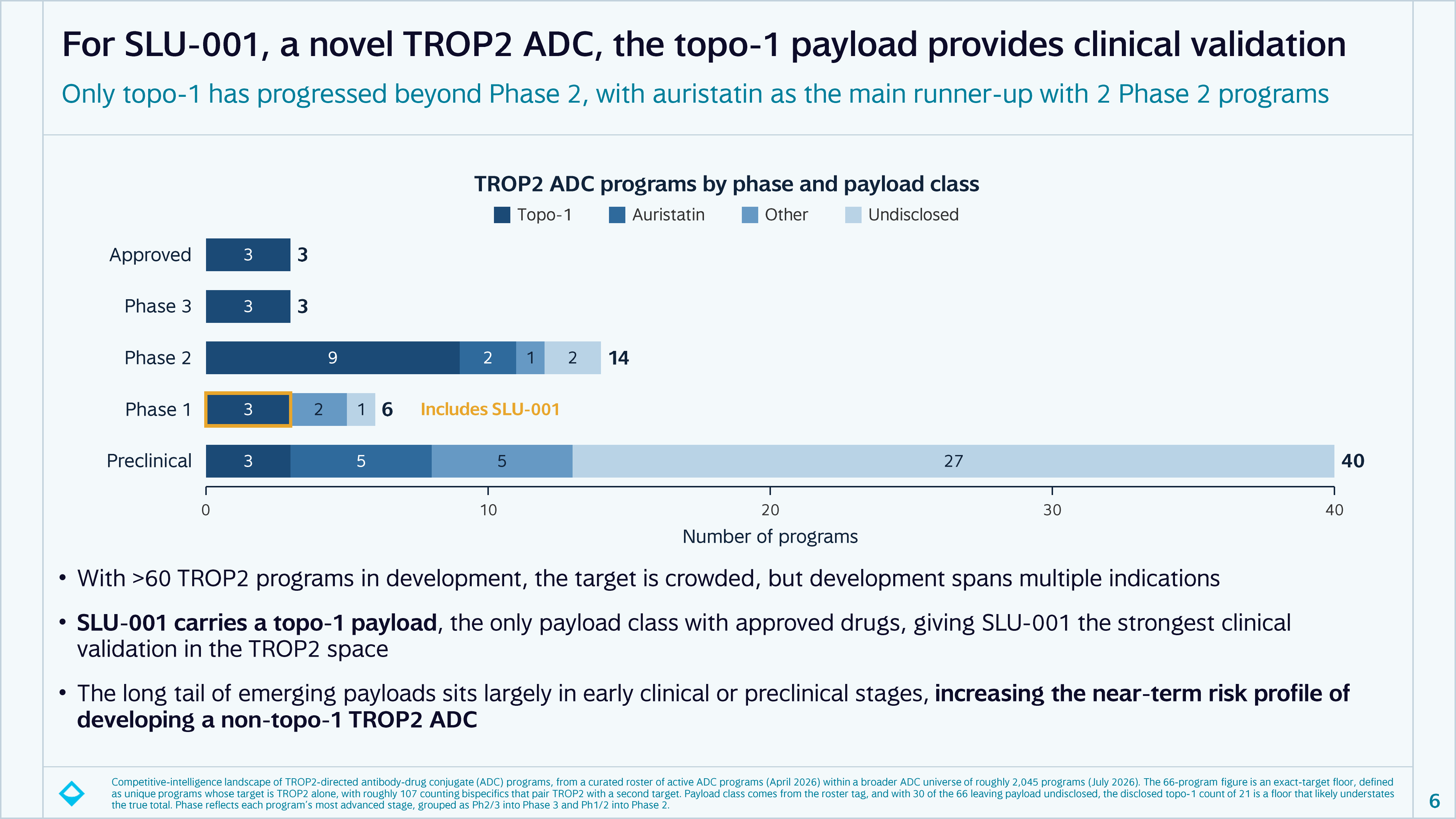
Our first look is the broad TROP2 landscape. This is the slide many founders stop at, a program count that shows you did a database pull. On its own, this will make investors glaze over.
We didn't include this to show it's crowded. We organized it by payload class, and what jumps out is that topo-1 is the only class with approved drugs. So we're making the point that this class has clinical validation.
The takeaway is that you shouldn't just count programs. You should find the axis that reveals structure. Here it was payload class. In your landscape, it might be mechanism, line of therapy, or patient population. Find the organizing dimension that drives insight.
But this is insufficient. This is cross-indication. Some of these programs are in breast cancer, some are in lung. We've told an investor that we did our homework and there are signs of clinical validation, but we don't see who we're really competing with.
Narrowing to the Indication
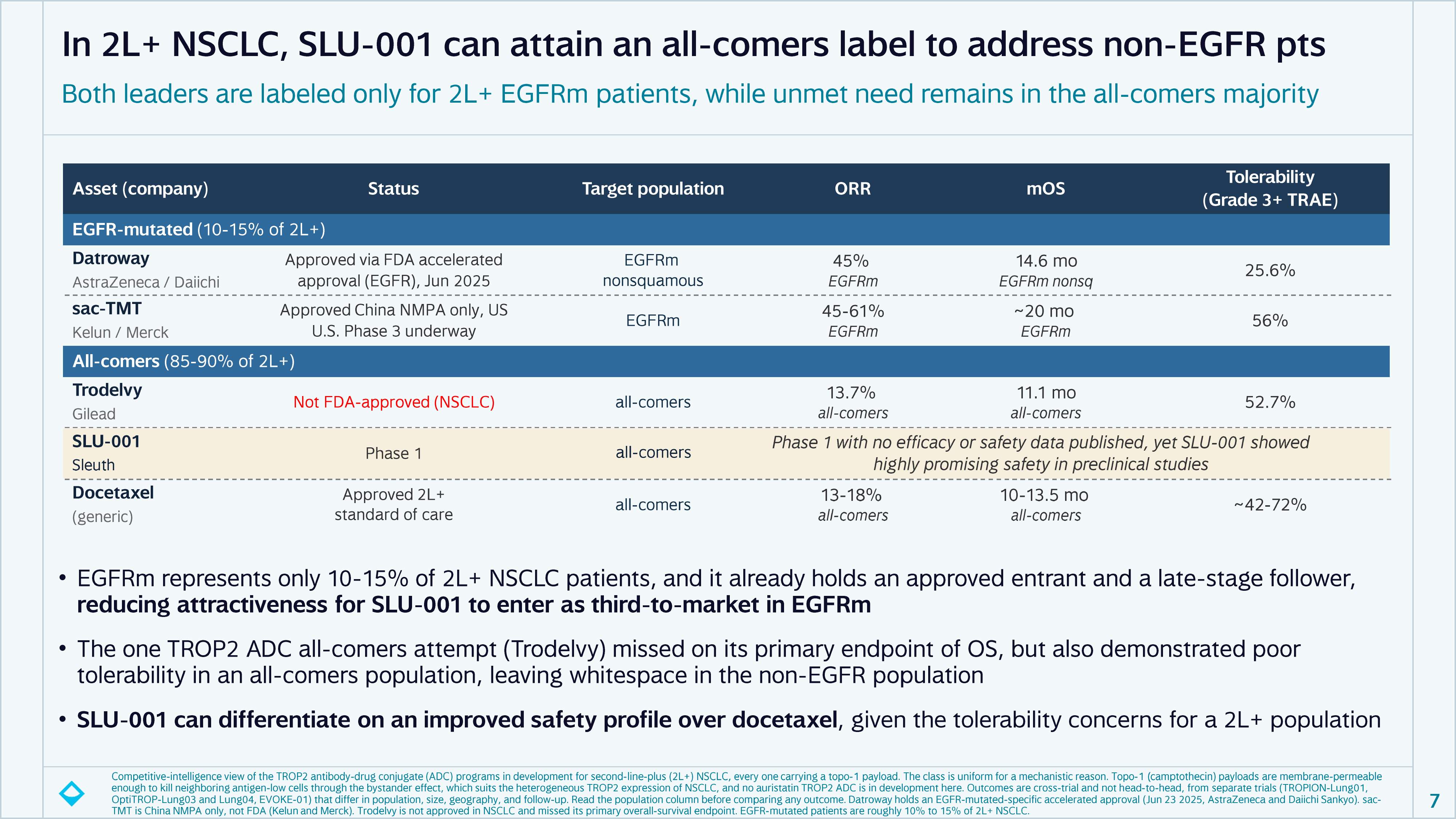
Next, we've narrowed the landscape down to where SLU-001 competes: second-line-plus NSCLC. We're no longer just looking at who's ahead of us clinically. We're looking at how patients are treated.
A few things jump out. The two leaders are for a very small patient population, just 10-15% of second-line lung cancer patients. Those in the all-comers lane either failed or have brutal side effects. So we've clearly shown a gap in this market for an all-comers drug with good tolerability.
For your landscape: don't just frame the market as a clinical horse race. Filter out irrelevant competition, frame it around the patient, and show where you fit in. This lets you shift from playing defense to controlling your narrative to investors.
But there is still a final open question to answer with competitive intelligence: why will SLU-001 succeed where these assets didn't?
Why SLU-001 Wins
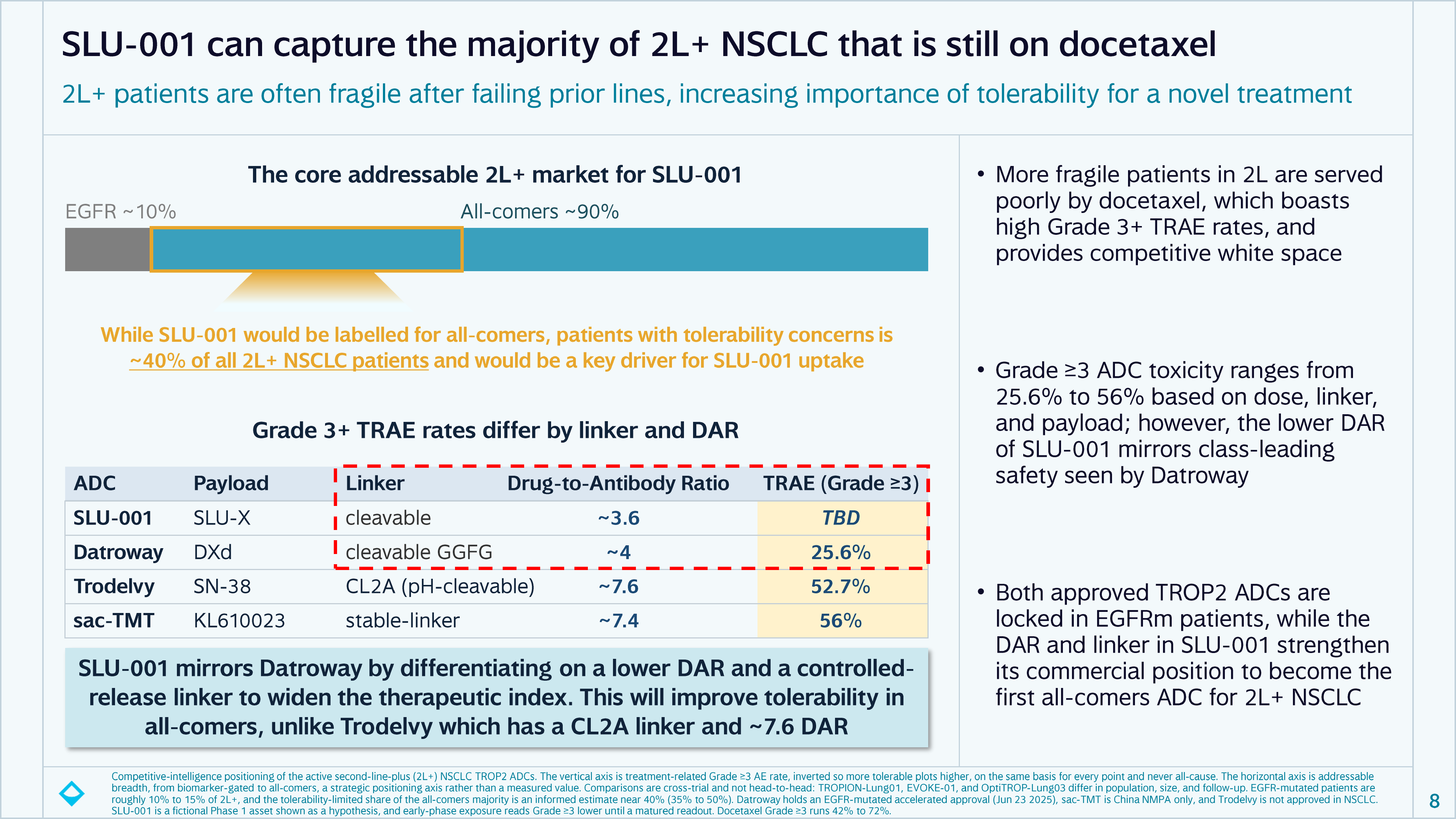
Now we'll bring it home by going one level deeper to show our thesis on why SLU-001 will win.
The thesis is the linker and the drug-to-antibody ratio. We're using the same linker as the market leader in the 10% of the market that is EGFR-mutated, but doing it for the all-comers patients who have tolerability concerns.
So we've closed the arc: our thesis is that we'll get the Datroway safety profile for the 85 to 90 percent of patients no one is serving well.
To generalize for your landscape: size the opportunity, show the mechanism, and be honest about what's hypothesis versus what's proven. SLU-001 doesn't have safety data, but we've shown the investor exactly why we believe our construct will deliver. That's what a competitive landscape in a fundraise deck should do.
Example Two: SLU-002, a CDK4/6 Inhibitor
SLU-001 was broad-to-narrow: a crowded space where we filtered down to find our lane. SLU-002 works the other direction. It starts in a seemingly narrow space, first-line HR+/HER2- breast cancer, where only three CDK4/6 inhibitors are approved. If you only map your mechanism class, you'll miss the combination regimens that are reshaping the treatment paradigm. And that gap in your own understanding will show when investors start asking questions.
The question this example answers: is winning within your mechanism class enough to win the market?
Winning Within the Class
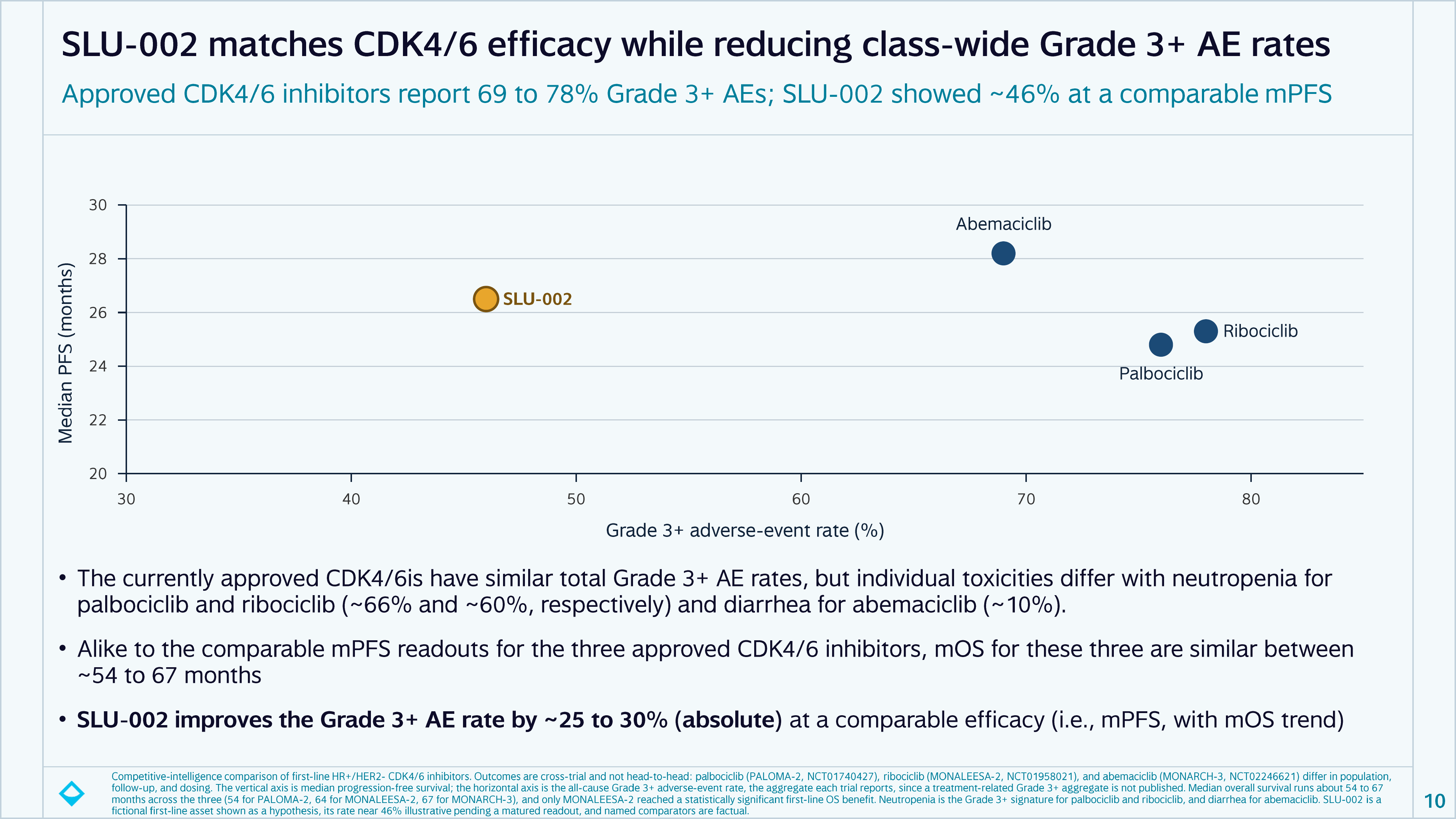
At first glance, SLU-002 looks like a clear winner. The three approved CDK4/6 inhibitors, palbociclib, ribociclib, and abemaciclib, all report Grade 3+ adverse event rates between 69% and 78%. The signature toxicity is neutropenia for palbociclib and ribociclib (roughly 60-66% Grade 3+) and diarrhea for abemaciclib. Their efficacy is broadly comparable, with median PFS in a similar range and median overall survival between roughly 54 and 67 months.
SLU-002 matches that efficacy while reducing the Grade 3+ AE rate to about 46%, an absolute improvement of 25 to 30 percentage points. On a scatter plot of efficacy versus safety, SLU-002 sits in a quadrant by itself.
This is the kind of slide that feels like a win. And if you stopped here, you'd walk into a fundraise thinking you just need to be a better CDK4/6 inhibitor. But that's the narrow view, and investors will see through it.
When your asset looks dominant in a narrow mechanism-class comparison, don't stop there. That's a comfortable but incomplete picture, and it's the kind of framing that erodes credibility when an investor asks the next question.
The Real Competition
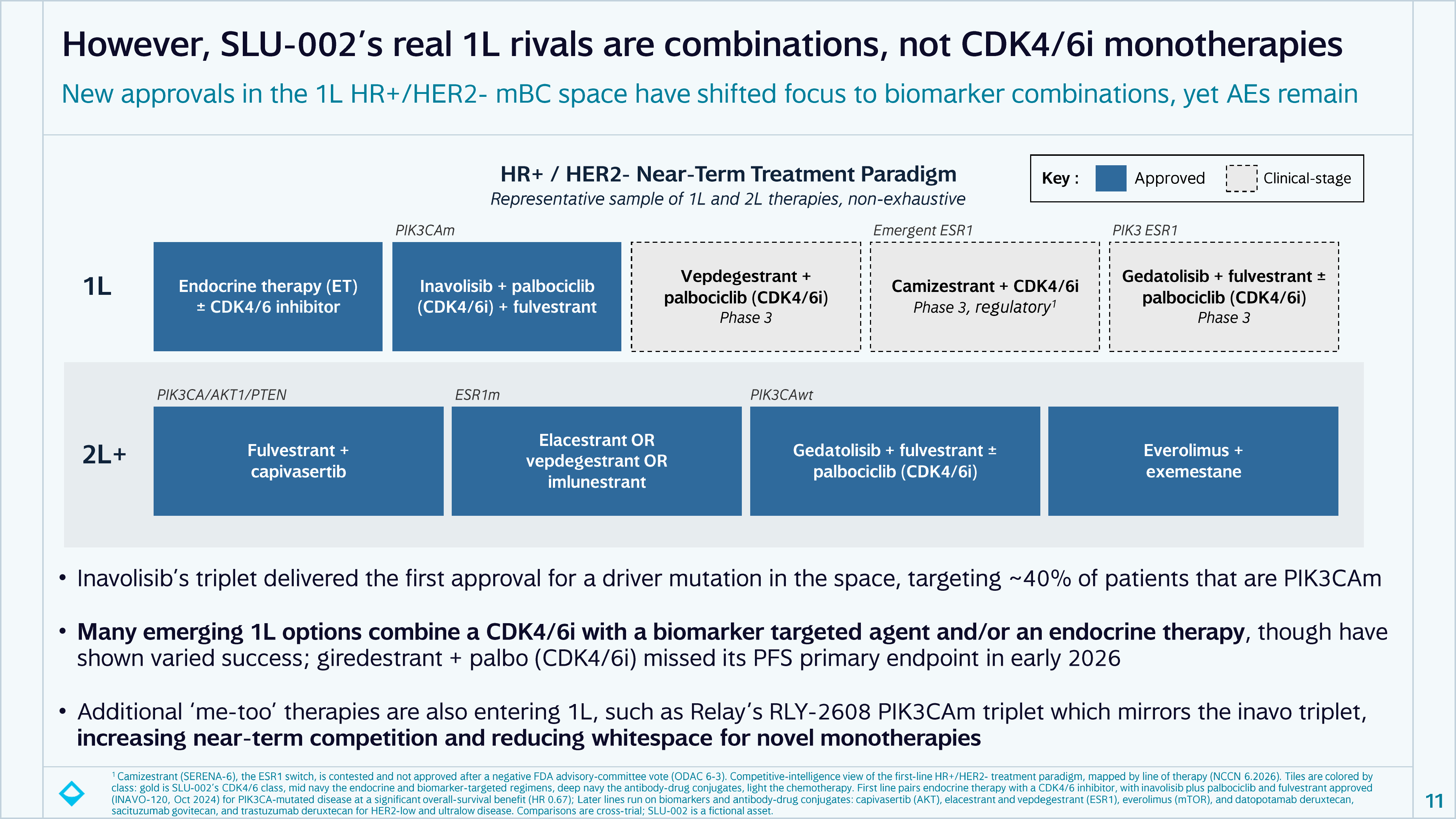
The real first-line rivals for SLU-002 aren't CDK4/6 monotherapies. They're combinations. The treatment paradigm in 1L HR+/HER2- has shifted. Inavolisib's triplet (inavolisib plus palbociclib plus fulvestrant) delivered the first approval for a driver mutation in this space, targeting the roughly 40% of patients with PIK3CA mutations. Other combinations are entering: giredestrant plus palbociclib (which missed its PFS primary endpoint in early 2026), and RLY-2608's PIK3CA-mutant triplet, which mirrors the inavolisib approach.
The landscape isn't three CDK4/6 inhibitors anymore. It's a web of combination regimens layering CDK4/6 backbones with PI3K, AKT, mTOR, and endocrine-targeted agents. Each of those combinations carries the CDK4/6 backbone's neutropenia on top of the partner agent's own toxicity.
If your narrow competitive slide showed three approved drugs and your asset was better, the investor is going to ask: "What about inavolisib? What about the combinations in Phase 3?" If you don't have an answer, you've lost credibility, exactly the mistake we talked about earlier.
Broaden your competitive frame beyond your mechanism class. Your real competition might come from adjacent classes, combination regimens, or entirely different approaches. The investor will ask.
Why SLU-002 Wins
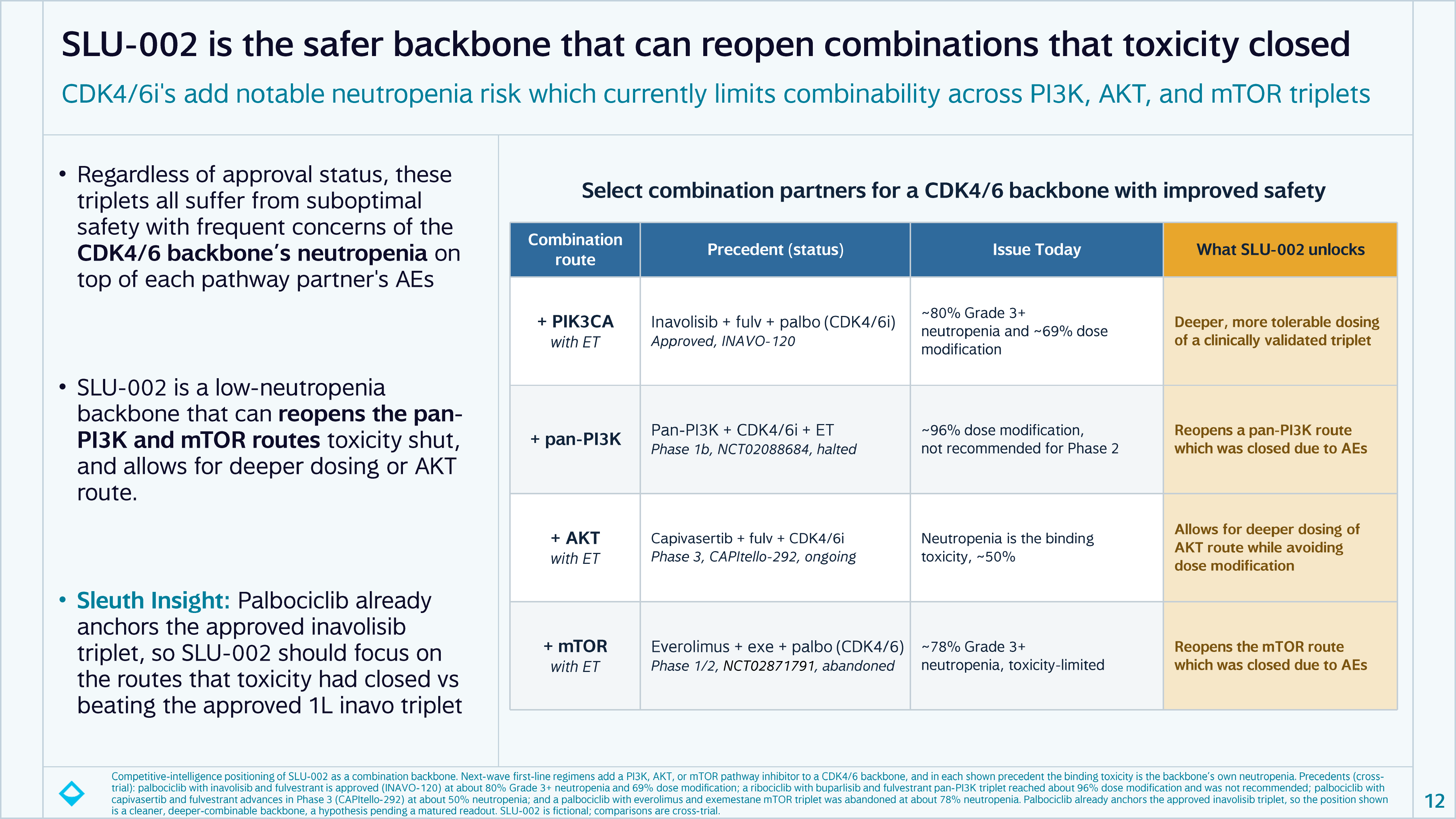
Once you've broadened the landscape, the question changes. You're no longer asking whether you're a better CDK4/6 inhibitor. You're asking what role your asset plays in the combination regimens that define the treatment paradigm.
For SLU-002, that role is the backbone. CDK4/6 inhibitors anchor first-line combination regimens, but backbone neutropenia is the limiting toxicity in every major triplet. The precedents are sobering: palbociclib plus inavolisib plus fulvestrant runs about 80% Grade 3+ neutropenia with 69% dose modification. A pan-PI3K triplet with ribociclib and buparlisib hit 96% dose modification and was not recommended for further development. A palbociclib-everolimus-exemestane mTOR triplet was abandoned at about 78% neutropenia.
These are routes that toxicity closed. SLU-002, as a low-neutropenia CDK4/6 backbone, can reopen them. Instead of competing head-to-head against the approved inavolisib triplet, where palbociclib already has a locked-in position, SLU-002 should be positioned as the backbone that allows deeper dosing and enables the combination routes that the current CDK4/6 inhibitors can't tolerate.
That's a different story than "we're a better CDK4/6 inhibitor." It's a competitive position that acknowledges the real landscape instead of hiding from it.
Once you've broadened the landscape, show how your differentiation works in the broader context. SLU-002's safety advantage isn't about being a better monotherapy. It's about being the backbone that makes the next generation of combinations viable.
How This Gets Built
Building what I just showed you is difficult. The status quo is a database tool plus people, bankers, consultants, in-house analysts, and it's expensive, slow, and they're still going to miss things. LLMs can give you a decent first pass, but the obvious stuff is obvious and not that valuable, sometimes even counterproductive since those are the facts everyone knows. The real value is in the non-obvious layer: connections across sources, data that doesn't exist anywhere until someone processes it at scale. That's what we built Sleuth to do.
Our concierge team works with biotech CEOs all the time to build landscapes like the ones above. Or you can use our software, Sleuth Studio.
Here's a quick look at what this looks like for SLU-001. You can see this process in more detail in the video above.
Query-Driven, Not a Data Dump
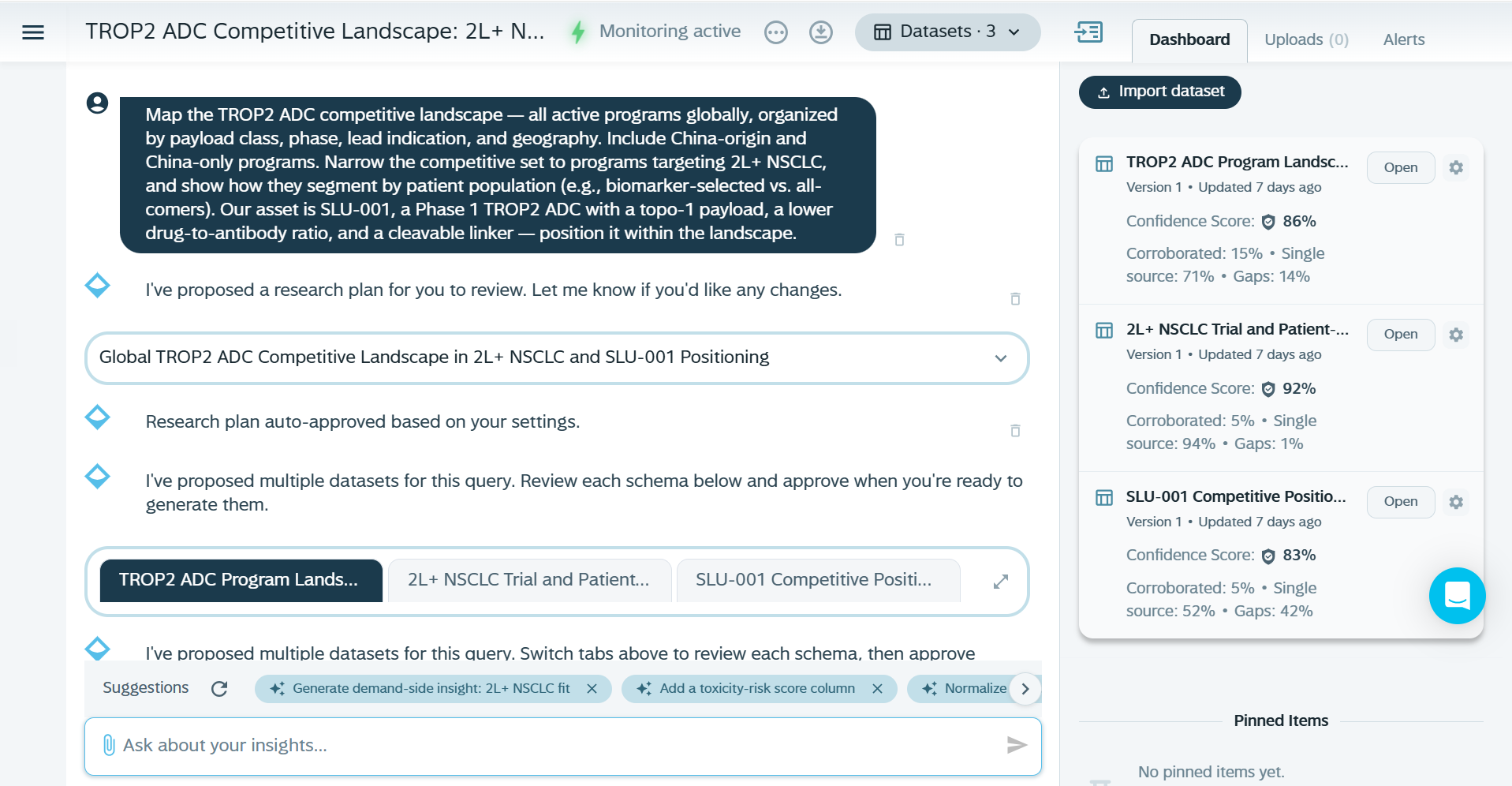
Starting with the query: you'll notice that we included strategic detail about the asset and what we're trying to do. All of the data and insight is shaped around this, not just a generic database pull.
This query generated three datasets that map cleanly to the three slides above: the full landscape, patient segmentation, and the competitive positioning matrix.
Structured Data That Doesn't Exist Elsewhere
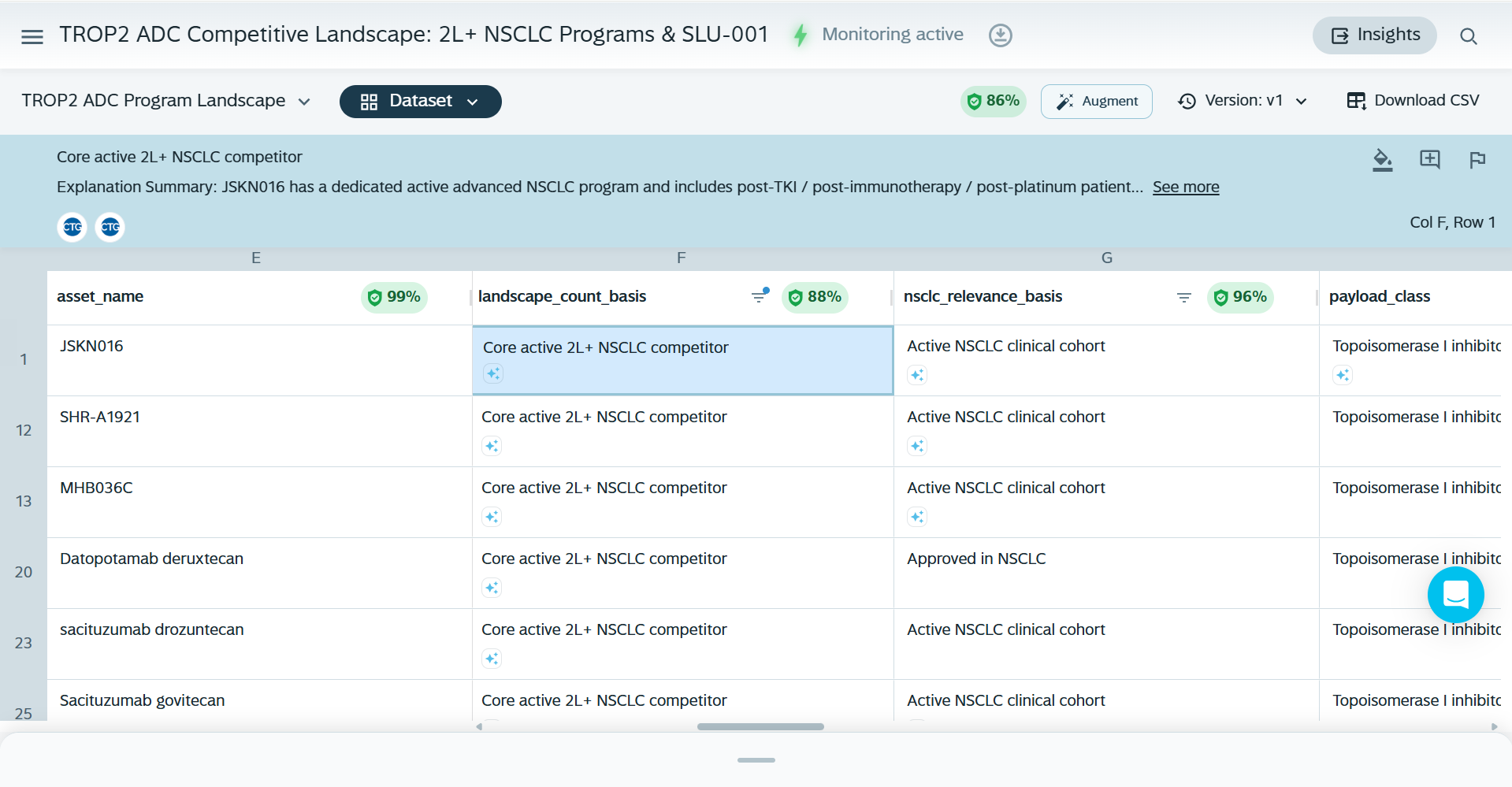
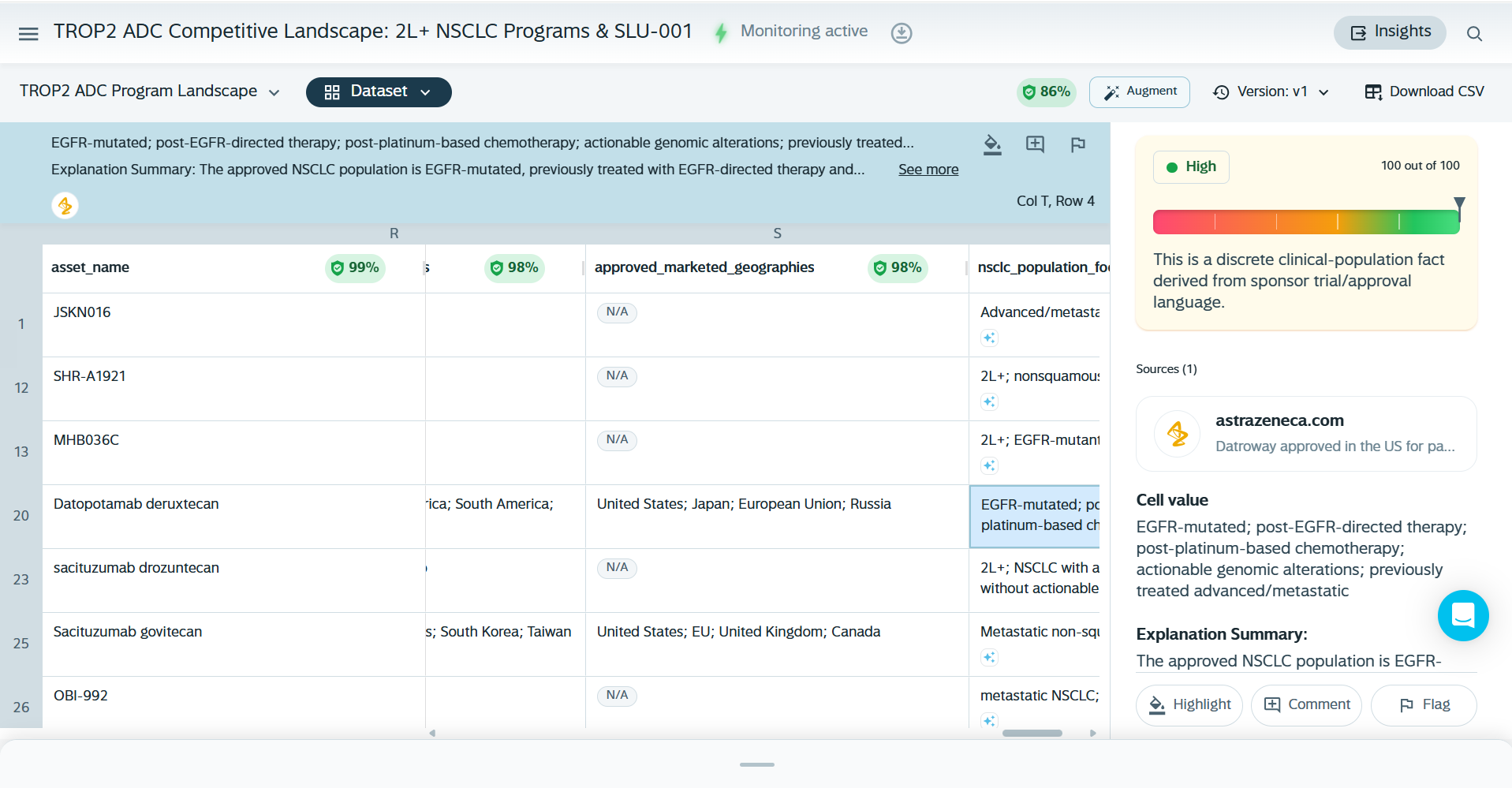
In the landscape dataset, we can filter to core active 2L+ NSCLC competitors, which narrows the field to eight assets, including Trodelvy and Datroway from the slides, as well as six China-rooted assets that you'd want to be ready to speak to if investors ask, but that probably wouldn't show up in a standard database search.
The population focus column doesn't exist as a structured field in any database. We built that as a structured column from primary sources, and you can click into any cell to see exactly where it came from. Datroway's EGFR-mutated focus, the same 10-15% population from the slides, was pulled from a press release. The platform indicates its confidence in each value, and if there's conflicting information, it gets surfaced to you before you decide what to present to investors.
Strategic Recommendations
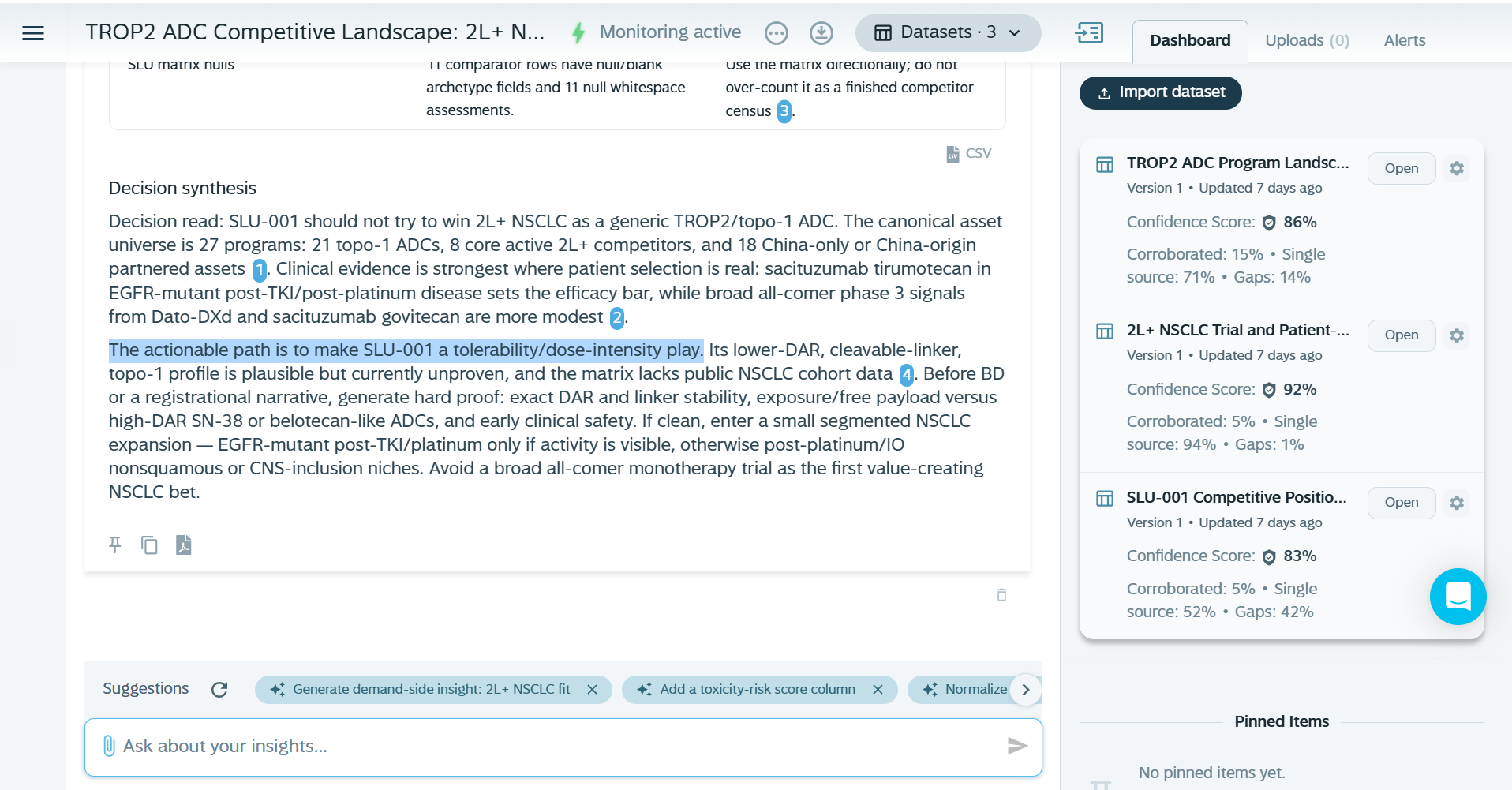
These datasets feed into a series of strategic artifacts, culminating in strategic recommendations. Here we see the exact conclusion we built to in the slides, the SLU-001 tolerability play, produced from a simple query with some strategic context.
Monitoring
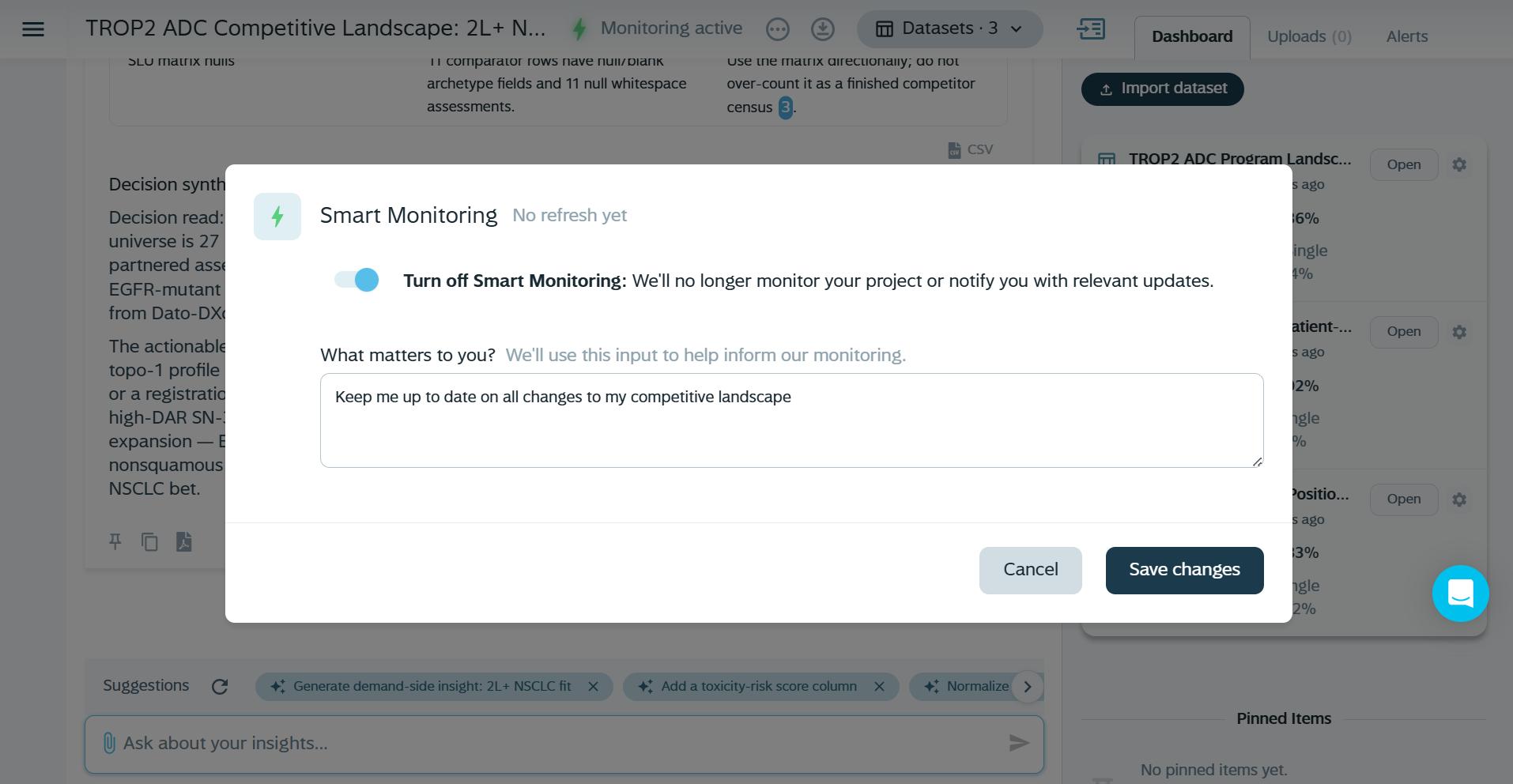
And you can turn on monitoring within the workspace. You'll get email alerts and an updated dataset whenever a competitor drops new data, a deal is made in the space, or a new trial is registered in your indication. So after you've had a successful fundraise, you can keep your board up to date as the market moves.
What's Next
This post is part of Sleuth's Biotech Strategy Series. Next time, we'll talk about how to use your competitive landscape to drive your indication selection strategy.
Want to talk to Sleuth about building your competitive landscape? Reach out to schedule a call.