Find the asset worth licensing first
Sleuth scores every asset that fits your brief on your own criteria and checks who still holds the rights, so your team knows which company to call first, and why.
Free to try on your own brief
Every asset that fits, who holds its rights, and how it scores
What’s out there that fits?
Every asset in your scope, at companies of every size and in every region, each counted once with its development stage checked.
Is it still available?
Each asset’s partnering status, checked at the source: unpartnered, licensed out, held with shared rights, or looking for a partner.
How does it score on what we care about?
Your criteria, in your own words where you want, with set levels behind each score and the fact behind it.
Which one do we call first?
A ranked shortlist with a recommendation, what other buyers paid for assets like these, and what to ask each company before talks start.
Write your brief, and Sleuth builds the shortlist
Describe what you’re looking for
Say what you want (the modality, stage, indication, and rights), the decision it feeds, and what matters most to your team.
Decide what counts
Pick the criteria, such as white space, target validation, early efficacy and safety, and deal comps, and how much each one counts.
Shape the plan
See the three steps Sleuth will run: build the landscape, define the criteria, and score and rank. Narrow the scope or change a criterion before it runs.
Get the analysis
A ranked shortlist and a recommendation, the score behind every asset, and the full landscape as a dataset.
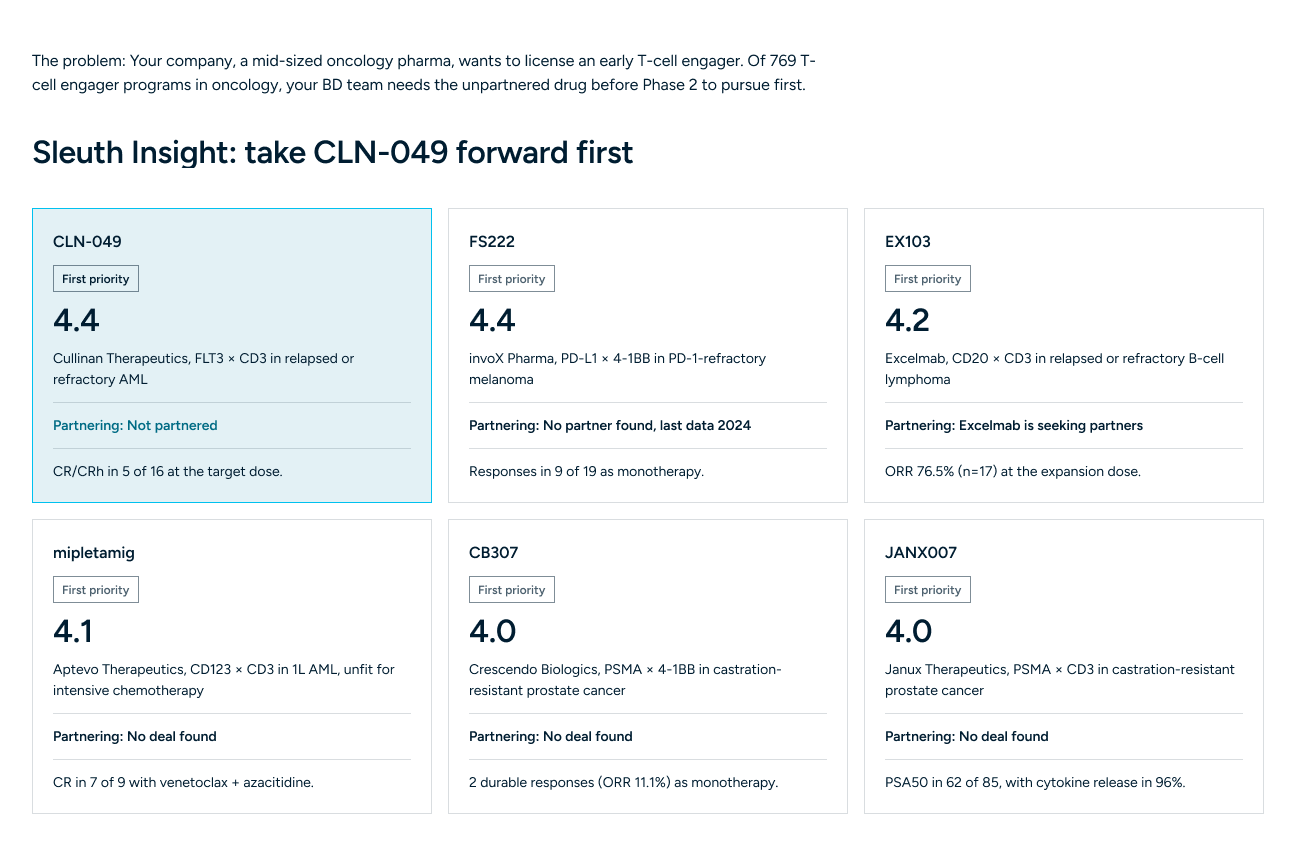
Which early T-cell engager should a mid-sized pharma license first? Sleuth says CLN-049.
Sleuth scored 150 early T-cell engagers in oncology on seven criteria and checked who holds the rights. Four of the top ten were already taken.
Asset Scouting: early T-cell engagers
How a top-10 pharma chose 20 meetings from 412 exhibitors
A search and evaluation team had 412 exhibitors at a partnering event and 20 meeting slots. Studio matched each exhibitor to its pipeline, deals, and financing, and found six strong fits with unpartnered assets and no recent financing.
Questions
Yes. Sleuth searches companies of every size, including private companies and programs out of China, and counts each asset once.
Yes. Name them in your own words, set what each score level means, and choose how much each one counts.
Sleuth leaves that score blank instead of scoring it low, so missing data doesn’t push an asset down the list.
Yes, marked as licensed out or held with shared rights, so you can see what’s taken before you call. In the example, four of the top ten were.
You set the stages in your brief. The example covers first-in-human to Phase 1/2.
Yes. Deal comps can be one of your criteria, with the deals done on each target and the largest upfront paid.