
Download the Report
At AAIC 2026, Alzheimer’s pipeline breadth was running ahead of proof
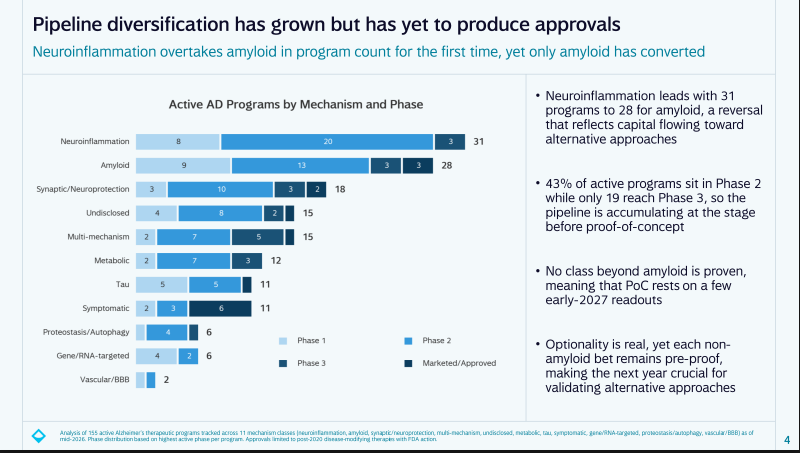
AAIC 2026 was a mechanism-selection meeting, not an amyloid update: the two readouts that mattered most came from tau and neuroinflammation programs. Neuroinflammation now leads amyloid in the Alzheimer’s disease pipeline by program count, 31 to 28 of 155 active programs in Sleuth’s mid-2026 count, yet every FDA-approved disease-modifying therapy (DMT) targets amyloid: lecanemab, donanemab and the since-withdrawn aducanumab.
A handful of readouts between the Alzheimer’s Association International Conference (AAIC) in July 2026 and early 2027 will show whether any non-amyloid class can turn breadth into approvals.
Amyloid and tau drugs clear Phase 1 easily, then stall before approval
In Sleuth’s historical analysis of Alzheimer’s DMTs, amyloid and tau programs both advanced from Phase 1 at 70% (7 of 10 each), 22 percentage points above the 48% CNS benchmark from BIO, Informa and QLS (2011 to 2020). Amyloid then advanced from Phase 2 at 59% (13 of 22) and from Phase 3 to approval at 25% (3 of 12), against a 53% CNS benchmark. Tau advanced from Phase 2 at only 14% (1 of 7), and its only Phase 3 program, TauRx’s LMTM, did not reach approval. Each rate uses its own cohort of programs that reached that gate, so the counts don’t chain from phase to phase.
Metabolic drugs have the weakest record: 1 of 7 advanced from Phase 1, then 0 of 6 from Phase 2 and 0 of 3 from Phase 3, with failures spanning GLP-1, insulin, SGLT2 and PPAR-gamma drugs. The latest was Novo Nordisk’s semaglutide, whose EVOKE and EVOKE+ Phase 3 trials were negative in November 2025.
Early safety data flatter Alzheimer’s programs. Phase 3 decides a class, and outside amyloid the Phase 3 record is thin or negative, which Sleuth reads as a biology limit for tau and metabolic drugs rather than a trial-design problem.
Ten non-amyloid programs show signals, but none has Phase 3 proof
Sleuth’s mid-2026 review found positive clinical or biomarker signals in ten non-amyloid programs, including Annovis Bio’s buntanetap, AriBio’s AR1001, AB Science’s masitinib, INmune Bio’s XPro1595, Biogen and Ionis’s diranersen, the tau antibodies etalanetug and MK-2214, and Longeveron’s laromestrocel (Lomecel-B).
Two of them led AAIC. Diranersen, a tau-lowering antisense oligonucleotide, missed the primary endpoint of its Phase 2 CELIA trial, a dose response on CDR-SB at 76 weeks. At AAIC on July 14, 2026, Biogen reported that the 60 mg regimen slowed decline on CDR-SB by 26% against placebo in secondary analyses and cut cerebrospinal fluid (CSF) total tau by 50% to 65%, and said it would start confirmatory Phase 3 development. Tau has been one of the hardest targets for CNS oligonucleotides, as Sleuth’s RNA Intelligence Report shows.
For XPro1595, a selective soluble TNF inhibitor, INmune Bio reported a statistically significant week-24 effect on an MRI measure of white matter myelin in its Phase 2 MINDFuL trial and plans a combined Phase 2b/3 program. Buntanetap’s cognitive benefit came from a pTau217-positive subgroup found post hoc, so it needs prospective proof.
These are real signals, but none is the clinical proof a Phase 3 trial provides.
The catalyst calendar runs into 2027, and two dates have moved
Sleuth’s mid-2026 calendar listed eight binary catalysts from AAIC into early 2027, six of them non-amyloid: four AAIC readouts, including Cognito Therapeutics’ Spectris AD neuromodulation device, plus AR1001’s POLARIS-AD Phase 3 topline in the third quarter of 2026 and buntanetap’s Phase 3 readout in the first quarter of 2027. The amyloid events were an FDA decision on subcutaneous lecanemab, expected in August 2026, and Lilly’s remternetug TRAILRUNNER-ALZ 1 topline, pending at the mid-2026 cut.
On July 13, 2026, the FDA approved Eisai’s subcutaneous Leqembi Iqlik as an at-home starting dose, so lecanemab can be started and continued without infusions. In September 2026, AriBio said AR1001’s topline results will be presented at the CTAD conference in mid-November. Annovis expects buntanetap’s six-month symptomatic readout in the first quarter of 2027 and its 18-month disease-modifying readout in the first quarter of 2028.
AR1001 and buntanetap are the oral tests. All six amyloid-pathway oral drugs in Sleuth’s review that reached Phase 3, including semagacestat and the BACE inhibitors verubecestat, lanabecestat and atabecestat, failed, and no oral DMT is FDA-approved for Alzheimer’s. An oral win could open treatment to primary-care prescribing, although lecanemab’s at-home subcutaneous start has already narrowed the convenience gap.
Program counts, transition rates and the catalyst calendar are from Sleuth’s mid-2026 Alzheimer’s pipeline cut, and the AAIC slate was confirmed as of June 2026. Diranersen, XPro1595, lecanemab, AR1001 and buntanetap updates are current as of September 2026. This page is a dated snapshot.
Frequently asked questions about the AAIC 2026 Alzheimer’s landscape
How many Alzheimer’s drugs are in development?
Sleuth tracked 155 active Alzheimer’s programs across 11 mechanism classes as of mid-2026, 144 of them disease-modifying. Neuroinflammation led with 31, ahead of amyloid with 28 and synaptic or neuroprotective approaches with 18.
Which Alzheimer’s disease-modifying drugs are approved?
As of Sleuth’s mid-2026 pipeline cut, the FDA-approved disease-modifying drugs for Alzheimer’s were amyloid antibodies: lecanemab (Leqembi) and donanemab (Kisunla). Aducanumab had been withdrawn, and no non-amyloid or oral disease-modifying drug was FDA-approved.
What did diranersen show at AAIC 2026?
Biogen and Ionis’s tau-lowering antisense drug missed the primary endpoint of its Phase 2 CELIA trial, but in secondary analyses presented in July 2026 its 60 mg regimen slowed CDR-SB decline by 26% against placebo. Biogen plans confirmatory Phase 3 development.
