Novel Depression Mechanisms Keep Dying at Phase 3
122 novel-mechanism depression drugs mapped since 2015. 68 with a Phase 2 or Phase 3 readout. The mechanisms tested at Phase 3 keep dying, and the one with a clean sheet has barely sat the exam.

Download the Visual
Navacaprant was supposed to be the depression drug that finally made a novel mechanism work. Its Phase 3 program failed. It was not the first.
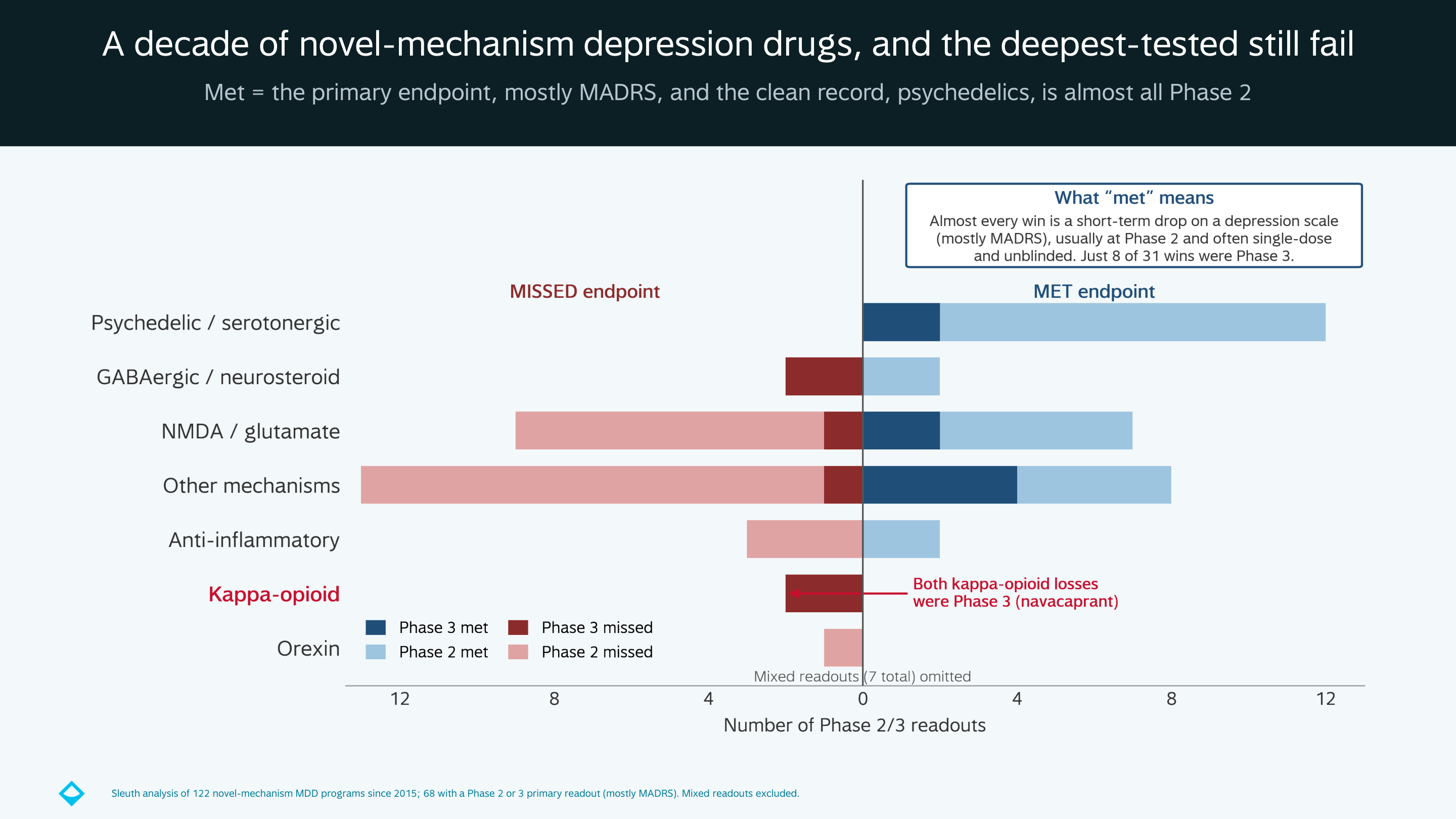
We mapped every novel-mechanism depression drug that entered the clinic since 2015: 122 programs after collapsing duplicates, 68 with a Phase 2 or Phase 3 readout. Sorted by mechanism, the record is hard to look at.
Kappa-opioid, navacaprant’s class, went 0 for 2 at Phase 3. Both it and J&J’s aticaprant died there. Glutamate, the mechanism pharma keeps paying up for, hits its endpoint about one time in three. Anti-inflammatory and orexin are underwater.
The one class that looks unbeatable is serotonergic psychedelics: 12 readouts, 12 wins. Then you read what was measured. Almost every win is a short-term drop on a depression scale, usually at Phase 2, often after a single dose, in trials where patients know what they took. Only two have cleared a Phase 3 readout.
So the honest read is not that psychedelics work and everything else fails. It is that the mechanisms tested at Phase 3 keep dying, and the one with a clean sheet has barely sat the exam.
If you are underwriting an MDD asset, a Phase 2 win on a new mechanism is not proof the mechanism works. It is proof it cleared the easy bar.