Parkinson's Cell Therapy: A Partnering Window Between Phase 1 Data and Class Validation
~21 clinical-stage dopaminergic cell replacement programs mapped in Parkinson's disease. BlueRock's Phase 3 is validating the class. The partnering window for a differentiated second entrant with scalable iPSC manufacturing is 6–12 months, before class validation gets priced in.

Download the Report
Note: This analysis was prepared by Sleuth as an independent external read. Kenai Therapeutics is not a Sleuth client, and nothing here is based on proprietary or internal company information. This is an abridged example of a Sleuth analysis for biotech CEOs.
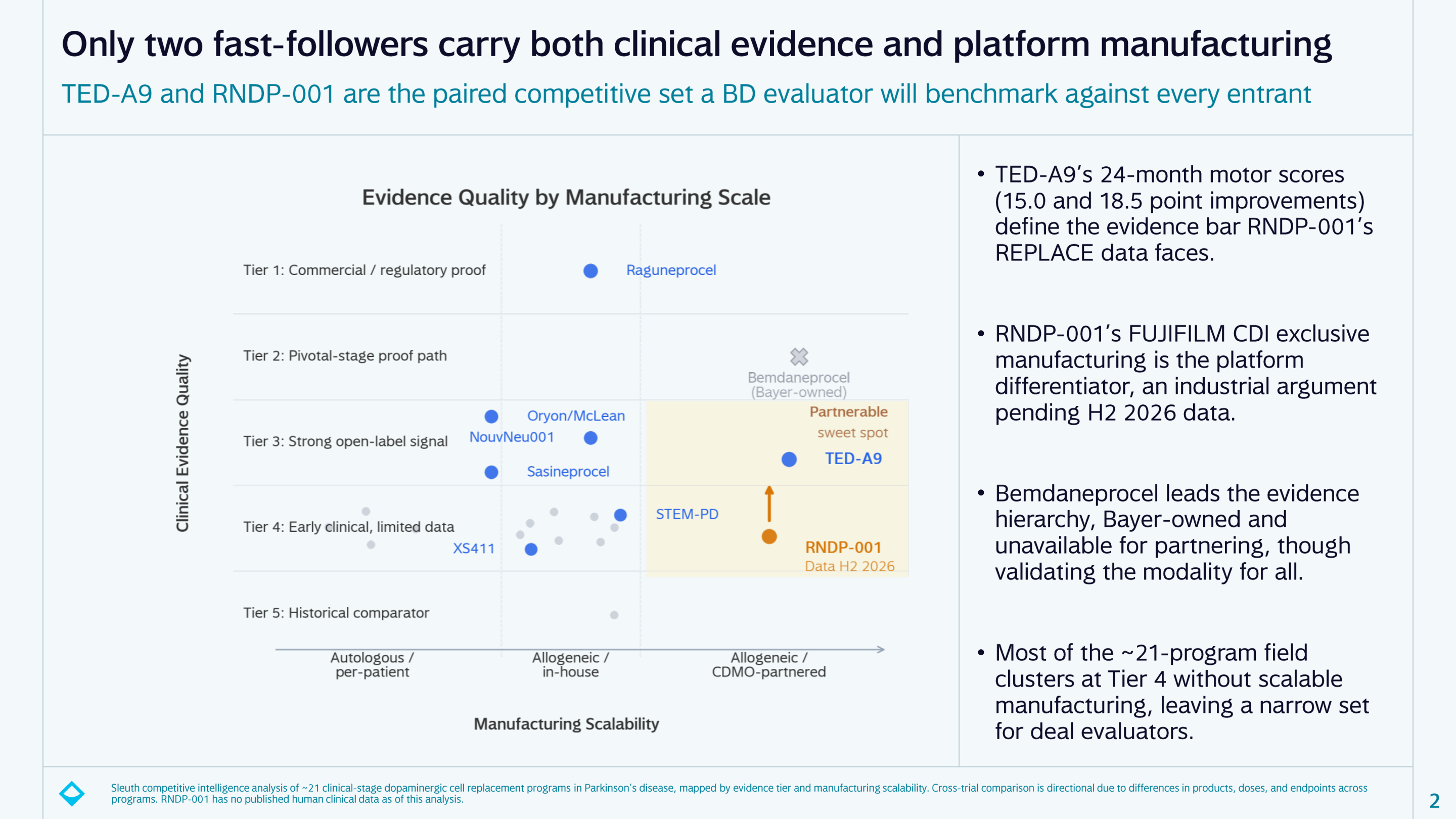
The dopaminergic cell replacement field in Parkinson's disease has reached an inflection point. ~21 clinical-stage programs are now active, spanning iPSC, ESC, and primary tissue sources across allogeneic and autologous donor models.
BlueRock (Bayer) entered Phase 3 with bemdaneprocel in September 2025, the first pivotal cell therapy trial in PD. Aspen Neuroscience posted positive 12-month autologous iPSC data in March 2026. The class is being validated in real time.
But the field is structurally fragmented by manufacturing approach. Only a handful of programs combine both clinical evidence and scalable platform manufacturing. The deal precedents reflect this: BlueRock commanded ~$1B in total company value at Phase 1, while Novo Nordisk divested its STEM-PD program when it lacked manufacturing differentiation. Pharma pays platform premiums for manufacturing control and data signal, not stage alone.
For a BD evaluator, the timing calculus is specific. Phase 1 data reading out in H2 2026, ahead of BlueRock's Phase 3 readout in 2027, creates a 6–12 month window where a differentiated iPSC-allogeneic platform can be positioned as the validated-class second entrant before competitors commoditize the space.