
Download the Report
I&I is moving from chronic suppression toward durable remission and immune reset
The chronic-suppression model behind immunology and inflammation (I&I) franchises such as Humira and Dupixent is reaching its limits: in the most mature diseases, today’s biologics are good enough that extra efficacy is hard to sell, and biosimilars are compressing prices. Sleuth’s August 2026 dataset counts about 15,400 active I&I programs, including about 2,300 approved products, and 2026 is on track to set the record for I&I M&A. The next source of value is durability: longer dosing intervals, remission that holds off drug and, for the most refractory patients, a one-time immune reset.
For two decades, chronic suppression meant a biologic taken indefinitely and expanded across indications until each drug became a pipeline in a product. Oncology’s tools, including CD19 cell therapy, T-cell engagers, degraders and predictive biomarkers, are now being redeployed to deliver durability instead. Because I&I diseases are heterogeneous, no single mechanism is likely to win. Large pharma is assembling mechanism stacks, a ladder of interventions that runs from convenient chronic control to precision biologics to reset, and matching patients to each rung. I&I is starting to fracture the way oncology did.
15,400 programs and a record M&A pace show how contested I&I has become
The pipeline is crowded on every axis
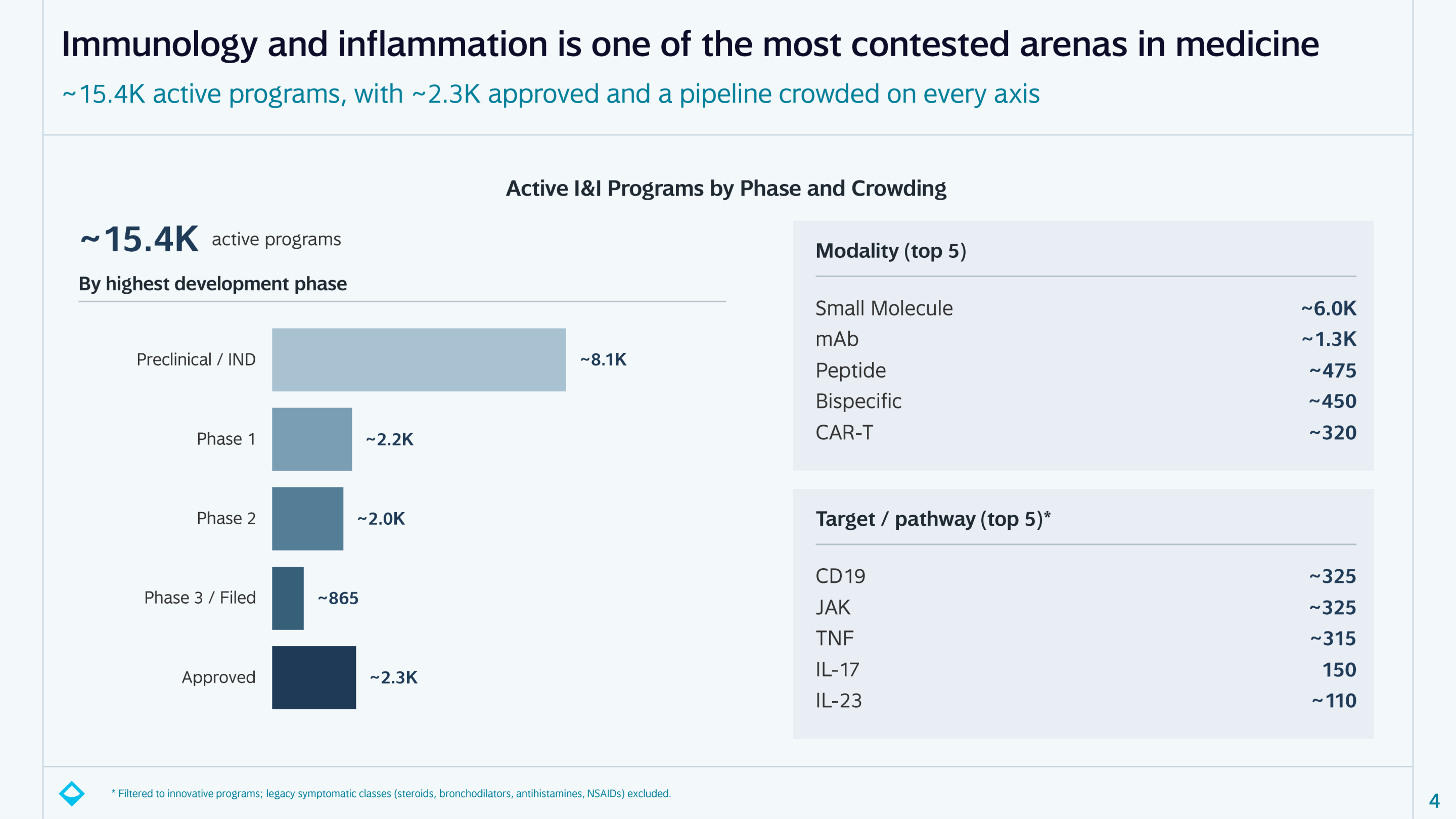
Of the roughly 15,400 active programs, about 8,100 are preclinical or at IND, 2,200 in Phase 1, 2,000 in Phase 2, 865 in Phase 3 or filed and about 2,300 approved. Small molecules lead at about 6,000 programs, followed by monoclonal antibodies (about 1,300), peptides (475), bispecifics (450) and CAR-T therapies (320). Among innovative programs, CD19 and JAK are the most crowded targets at about 325 programs each, ahead of TNF at about 315, IL-17 at 150 and IL-23 at about 110.
CD19 drawing as many programs as JAK is the clearest sign of the shift: a B-cell depletion target borrowed from oncology now rivals the oral suppressants that defined the last decade. Sleuth’s map of how pharma I&I evolved into a mechanism stack shows top pharma companies building across 36 of the 41 mechanisms it maps rather than defending a single target.
2026 is on track for a record year of I&I M&A
Disclosed I&I M&A value reached about $325 billion across 172 deals from 2021 through August 2026. The previous peak was 2023, at $88.1 billion across 28 deals, including Merck’s $10.8 billion Prometheus buyout and Roche’s $7.25 billion Telavant acquisition. Through August, 2026 had already reached $70.9 billion across 36 deals, an annualized run rate of about $106 billion. The marquee 2026 deal was AbbVie’s $10.9 billion acquisition of Apogee Therapeutics, announced in June and closed on September 3.
The targets of these deals say what buyers are paying for. Prometheus brought Merck a TL1A antibody for inflammatory bowel disease, and Apogee brought AbbVie a long-acting IL-13 antibody. Both are bets on a new mechanism or a longer dosing interval, not on more of the same.
Each I&I landscape is contested in a different way
Type-2 and allergic disease is the most franchise-concentrated
Dupixent generated about $14 billion across indications in 2024 and leads a biologics-dominated field. Estimated 2026 US markets are about $7.0 billion in atopic dermatitis, $6.2 billion in asthma, $1.5 billion in COPD, $1.2 billion in chronic rhinosinusitis with nasal polyps, $0.8 billion in eosinophilic esophagitis and $0.6 billion in prurigo nodularis. Durability is emerging as the next axis: Sanofi’s amlitelimab maintained response for about 28 weeks off drug through week 52 of the Phase 2 STREAM-AD study, the cleanest off-drug signal in the class.
Psoriatic and axial disease has the deepest oral lane
IL-23 and IL-17 biologics such as Skyrizi, Cosentyx, Tremfya and Taltz deliver high skin clearance in a field of more than 100 approved plaque psoriasis products. Estimated 2026 US markets are about $24.9 billion in plaque psoriasis, $8.6 billion in psoriatic arthritis, $4.8 billion in axial spondyloarthritis and $3.2 billion in hidradenitis suppurativa. Orals take 29% of new psoriasis prescriptions, led by Otezla and Sotyktu, and Johnson & Johnson’s icotrokinra became the first approved oral IL-23 drug in March 2026. With efficacy near its ceiling, differentiation has moved to route and dosing interval, such as the twice-yearly schedule Oruka is pursuing with ORKA-001.
IBD is where a new mechanism is entering
About 1,800 programs target inflammatory bowel disease, yet approvals remain concentrated in Crohn’s disease (an estimated $11.4 billion US market in 2026) and ulcerative colitis ($8.3 billion). Orals have taken about 45% of new ulcerative colitis prescriptions but only about 11% in Crohn’s, because more oral mechanisms are approved in UC and Crohn’s biology keeps prescribers on biologics. TL1A is the mechanism to watch: Merck’s tulisokibart met its primary endpoint in the Phase 3 ATLAS-UC induction study in June 2026, and the ARES-CD study in Crohn’s is ongoing. Sleuth’s integrin α4β7 landscape covers another oral race in IBD.
Rheumatology splits between crowded RA and open lupus
Rheumatoid arthritis, an estimated $13.3 billion US market with about 1,300 programs, is crowded and exposed to biosimilars. Lupus, at about $2.5 billion, has few approvals and remains poorly managed, and Sjögren’s disease has only symptomatic treatment. That gap is where CD19 cell therapies from Cabaletta, Kyverna and Novartis are testing whether a single course can reset the disease.
Neuro-inflammatory disease is anchored by MS and antibody-driven conditions
Multiple sclerosis is the largest neuro-inflammatory market, an estimated $8 billion to $10 billion in the US, led by Roche’s Ocrevus. Antibody-driven diseases are the growth edge: generalized myasthenia gravis at about $3.5 billion to $4.5 billion, CIDP at $2.2 billion to $2.5 billion and NMOSD at $0.7 billion to $1.0 billion. Argenx’s Vyvgart, approved in both myasthenia gravis and CIDP, has shown that one FcRn mechanism can travel across diseases that share an antibody-driven biology.
Across the five landscapes, the biggest markets are the most defended. The openings sit in diseases that are still poorly managed or where a new mechanism can travel across a shared biology.
Biosimilars and efficacy ceilings decide where the white space is
Humira shows that biosimilar erosion follows PBM economics, not list price
Adalimumab biosimilars launched at list prices up to 85% below Humira’s, yet held under 2% of the US market a year after entry. AbbVie’s contracting leverage kept Humira on 98.9% of Part D plans, and patients were reluctant to switch. Humira held about 95% of adalimumab prescriptions through 2023. Its share fell only after the three largest pharmacy benefit managers (PBMs) replaced it with their own private-label biosimilars: CVS Caremark with Cordavis in April 2024, then Express Scripts with Quallent and OptumRx with Nuvaila in January 2025. By May 2026 Humira’s share was about 40%, and AbbVie’s US Humira net revenue fell 49% in the first half of 2026.
Biosimilar uptake stays low until a PBM makes a cheaper product its own. For Dupixent, whose loss of exclusivity is expected around 2031, forecasts of share erosion should model PBM private-label economics rather than the number of biosimilar entrants or their list-price discounts.
Efficacy headroom, not market size, marks the open lanes
Sleuth scored select indications on efficacy headroom, meaning how much room a new entrant has to beat today’s standard of care, and on biosimilar risk. The two largest markets are the hardest to enter. In plaque psoriasis ($24.9 billion), IL-23 and IL-17 drugs already approach total skin clearance. In rheumatoid arthritis ($13.3 billion), cheap TNF and JAK drugs control most patients and Humira biosimilars anchor pricing. Hidradenitis suppurativa ($3.2 billion) has the widest efficacy gap in immunology, few incumbents and only Humira facing biosimilars. Lupus and atopic dermatitis also have room on efficacy, though once Dupixent goes biosimilar, expected near 2031, low-cost dupilumab is likely to become the default in atopic dermatitis.
New therapeutics should be screened on efficacy headroom first and biosimilar risk second. The real openings sit in smaller, still poorly managed diseases, while many larger markets offer little headroom or little price tolerance once the leading incumbent goes biosimilar.
Durability is replacing efficacy as the axis of differentiation
A four-rung ladder runs from chronic suppression to one-time reset
As treatment classes approach their efficacy ceiling, durability adds the value. Sleuth maps four rungs. Chronic suppression, as in rheumatoid arthritis, means weekly or every-other-week dosing. Durable long-interval dosing is where psoriasis is heading, from Skyrizi’s every-12-week schedule toward six- to 12-month intervals with long-half-life antibodies such as ORKA-001. Off-treatment remission is the goal in atopic dermatitis, where amlitelimab has shown response holding off drug. One-time immune reset is the endgame in refractory lupus and myositis.
The top rung is gaining validation. At EULAR in June 2026, Cabaletta reported that six of eight lupus patients reached DORIS remission while off immunomodulators at 12 months, and 15 of 18 remained off them on no or low-dose steroids at latest follow-up. Lymphodepletion, manufacturing and cost still confine CD19 cell therapy to the sickest patients, and off-the-shelf T-cell engagers are emerging as an alternative. Sleuth tracks the in-vivo route in its in-vivo CD19 competitive map.
As biosimilars spread across I&I, a new therapy may need a meaningful durability advantage, because incremental efficacy or safety gains over a cheaper standard of care will be harder to sell.
Orals win only when they match biologics and keep safety clean
A novel oral needs three things: biologic-level efficacy, no boxed-warning safety signal and the convenience of a pill. Missing either of the first two cancels the third. Rinvoq and Xeljanz matched biologic efficacy, but boxed warnings pushed both to later lines. Otezla reached about $2.2 billion in 2020 sales on clean safety despite weaker efficacy, an opening later orals are unlikely to inherit. Sleuth places Sotyktu and the newly approved icotrokinra in the win zone of clean safety and biologic-like efficacy.
An oral’s prize scales with the dosing burden of the injectable it replaces. The real opportunities sit against high-frequency, titrated or cold-chain biologics and shrink to almost nothing against an already clean injectable dosed every eight to 12 weeks.
Patient selection and cascade position are the new sources of advantage
Tulisokibart gave I&I its first response biomarker
In the Phase 2 ARTEMIS-UC study, tulisokibart produced clinical remission in 26% of all-comers versus 1% on placebo (135 patients), and 32% versus 11% in biomarker-positive patients (75 patients) identified with an investigational companion test. Merck nonetheless took a broad, all-comer population into Phase 3 ATLAS-UC, which met its primary endpoint in June 2026, and kept the biomarker as a future option.
I&I now has oncology’s patient-selection tool, but unlike first-line oncology regimens gated by PD-L1 or MSI status, its first use chose breadth. The open question is whether a validated companion diagnostic returns after approval to defend a premium responder segment.
Cascade depth shapes how far a molecule migrates
How widely a drug travels across indications depends on where it sits in the immune cascade. Type-2 disease has a drug at every depth of its cascade, which makes it a clean test. The mid-cascade IL-4/IL-13 receptor, targeted by Dupixent, reached 13 indications, against 4 for upstream TSLP, 3 for IL-13 alone, 5 for IL-5 and its receptor and 4 for IgE. Proximity to the effector cell is not validation: in eosinophilic asthma, Dupixent has outpaced the IL-5 drugs that act directly on eosinophil recruitment.
In any broad effector pathway, the position that unlocks the widest migration may not be obvious from biology, and neither the most upstream nor the most effector-proximal target is a safe default.
What the I&I findings mean for developers and buyers
These implications are Sleuth’s interpretation of the data above.
For developers, choose the rung and the lane before the molecule. Parity with a biologic that is headed for biosimilars is not a product. A new program needs efficacy headroom in its indication and a clear claim on the ladder, whether a longer interval, off-drug remission, a single-course reset, an oral that replaces a burdensome injectable or a selection rule that finds the responders.
For buyers, value the stack, not the asset. Large pharma is building portfolios that combine convenient chronic control, precision biologics and reset therapies. Diligence should ask which rung an asset fills, how exposed its market is to PBM private-label biosimilars, and whether its durability or biomarker claim will hold up in a broad population.
What Sleuth expects in immunology and inflammation
These predictions are Sleuth’s analytical interpretation, looking beyond what the data shows today.
- Value will migrate to patient selection rather than the molecule. The next franchise-scale winners will be the mechanisms that carry a reusable selection rule across diseases, with FcRn and its IgG-depletion rule across nine antibody-driven diseases as the template.
- One-time immune reset will arrive earlier than consensus expects. As off-the-shelf and in-vivo CD19 therapies remove the apheresis and conditioning burden, drug-free remission will move from a last-resort story to earlier lines in lupus and myositis before 2030.
- Pharma companies with leading drugs will cannibalize their own franchises before biosimilars arrive, moving patients to a next-generation product before the cliff, as AbbVie did with Skyrizi and Rinvoq ahead of Humira. Companies that cannot disrupt themselves will lose the lane to a rival that bridged first, not only to a cheaper biosimilar.
How Sleuth built this analysis
Pipeline scope
The dataset covers about 15,400 active I&I programs as of August 2026, including about 2,300 approved, counted by highest development phase. Target and pathway counts are filtered to innovative programs and exclude legacy symptomatic classes such as steroids, bronchodilators, antihistamines and NSAIDs. Program counts marked “about” are directionally rounded.
Market sizes and prescription share
2026 US market sizes and oral new-prescription shares are consensus sell-side estimates.
Deals
The M&A set covers I&I acquisitions from 2021 through August 2026 using disclosed total value, upfront plus milestones. Between 52% and 71% of deals disclosed a value in a given year, so totals understate activity. The 2026 run rate annualizes deals through August.
Biosimilar uptake
Humira and biosimilar share come from Samsung Bioepis biosimilar market reports, and AbbVie’s US Humira net revenue from its second-quarter 2026 results. Part D plan coverage comes from Wolfe Research (2024).
Headroom, durability and migration frameworks
Efficacy headroom rates how far a new entrant must go to beat today’s standard of care; a high bar means the standard is already strong, not that improvement is impossible. The durability ladder is representative, not a census. Cascade migration draws on a Sleuth dataset of 34 targets and counts indications reached with a US label or Phase 3 readout.
Interpretation
The implications and predictions are Sleuth’s analytical interpretation rather than direct findings from the data.
Pipeline, market, deal and clinical figures are as of August 2026 unless otherwise noted. Deal closings and trial readouts are current as of September 2026.
Frequently asked questions about the I&I landscape
How many immunology and inflammation drugs are in development?
Sleuth tracked about 15,400 active I&I programs as of August 2026, including about 2,300 approved products. The roughly 13,200 still in development are about 8,100 preclinical or at IND, 2,200 in Phase 1, 2,000 in Phase 2 and 865 in Phase 3 or filed. Small molecules make up about 6,000 of the active programs.
How much I&I M&A has there been since 2021?
Disclosed I&I M&A value reached about $325 billion across 172 deals from 2021 through August 2026. 2026 reached $70.9 billion across 36 deals by August, a run rate of about $106 billion that would pass 2023’s record of $88.1 billion.
What are the marquee I&I acquisitions since 2021?
Marquee deals include Amgen’s $27.8 billion acquisition of Horizon (December 2022), AbbVie’s $10.9 billion acquisition of Apogee (announced June 2026, closed September 2026), Merck’s $10.8 billion acquisition of Prometheus (April 2023), Roche’s $7.25 billion Telavant deal (December 2023) and Pfizer’s $6.7 billion acquisition of Arena (December 2021).
How did biosimilars affect Humira sales?
Adalimumab biosimilars held under 2% of the US market a year after launch despite list prices up to 85% lower. Humira’s share fell only after CVS Caremark, Express Scripts and OptumRx switched to private-label biosimilars in 2024 and 2025, reaching about 40% by May 2026, and AbbVie’s US Humira net revenue fell 49% in the first half of 2026.
What is tulisokibart?
Tulisokibart is Merck’s anti-TL1A antibody, acquired with Prometheus. It met its primary endpoint in the Phase 3 ATLAS-UC induction study in ulcerative colitis in June 2026 and is in the ARES-CD study in Crohn’s disease. In Phase 2 it produced 26% remission versus 1% on placebo in all-comers.
Can CAR-T cell therapy put lupus into remission?
Early data suggest it can in some patients. Cabaletta reported in June 2026 that six of eight lupus patients treated with its CD19 cell therapy reached DORIS remission off immunomodulators at 12 months. Lymphodepletion, manufacturing and cost currently limit CD19 cell therapy to the most refractory patients.
Which I&I indications have the most white space?
In Sleuth’s screen, hidradenitis suppurativa has the widest efficacy gap and few incumbents, and lupus and atopic dermatitis also have room on efficacy. Plaque psoriasis and rheumatoid arthritis are the largest markets but have a high bar, because today’s drugs already work well and biosimilars anchor pricing.
When do oral drugs win in immunology?
Orals win when they match biologic efficacy and avoid boxed-warning safety signals. Rinvoq and Xeljanz matched biologics but were pushed to later lines by boxed warnings. Orals already take 29% of new psoriasis prescriptions and about 45% in ulcerative colitis, but only about 11% in Crohn’s disease.