Protein Degraders Intelligence Report, Q3 2026
~200 clinical protein degrader programs mapped across mechanism, target, and development stage, with 60+ deals and ~30 catalysts through 2027. Covers the first PROTAC approval, resistance as the new BD test, BTK as the next approval, DACs and the GSPT1 payload problem, CRBN glues vs new E3 ligases, and predictions.

Download the Report
This report maps the clinical protein degrader landscape across ~200 programs as of Q3 2026, alongside 60+ degrader deals since 2021 and ~30 key oncology catalysts through 2027. Approvals remain concentrated in breast and blood cancers: nine degraders are approved in cancer, five of them since 2023, split between SERDs at the estrogen receptor and IMiD/CELMoD glues at IKZF1/3 and CK1α. Vepdegestrant's May 2026 approval made it cancer's first PROTAC and gave the modality a regulatory roadmap, but it beat fulvestrant only in ESR1-mutant tumors (HR 0.57), the same setting where oral SERDs had already won. First-generation programs have proven the concept works. The bar is now resetting beyond interesting platform technology.
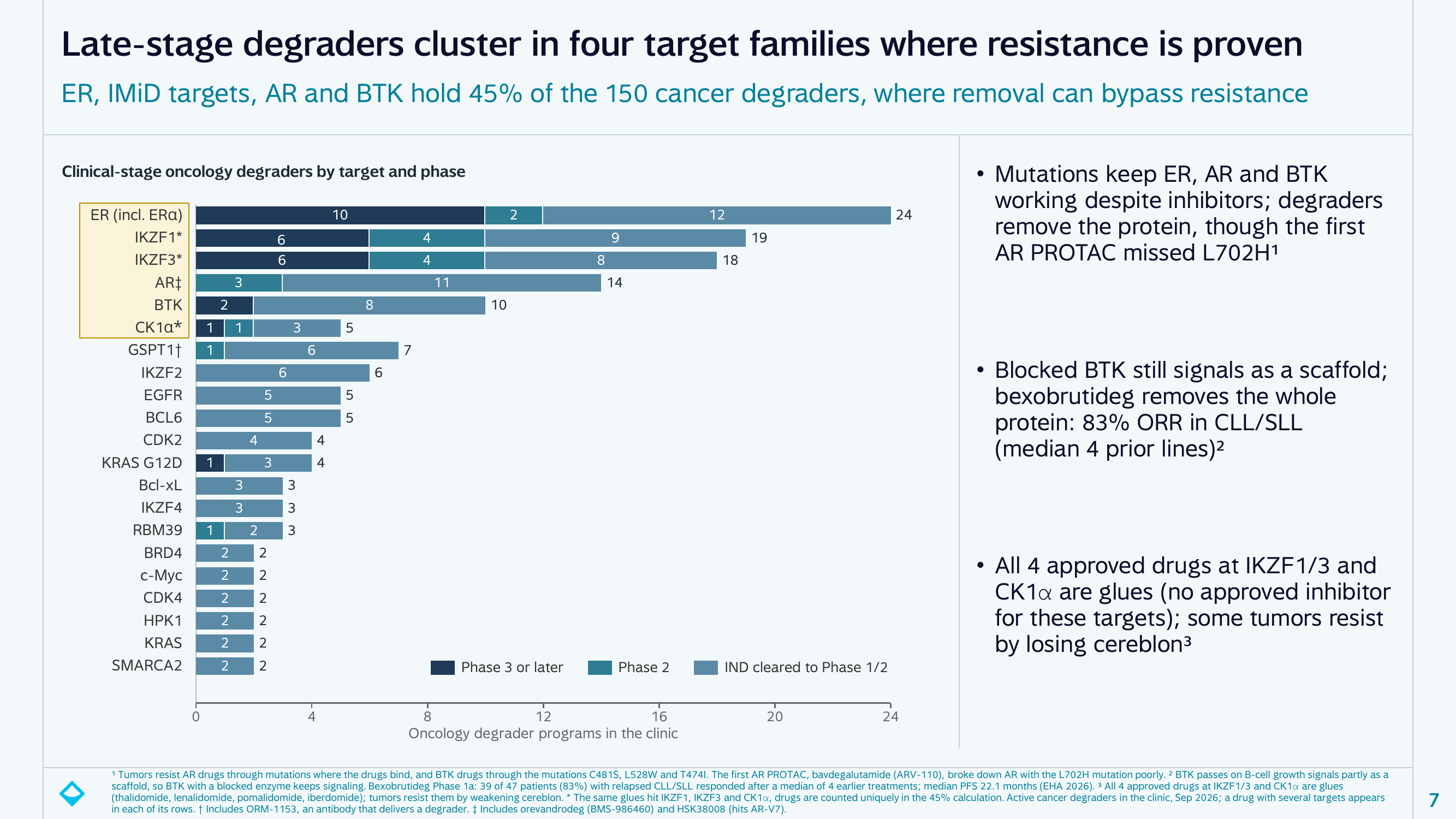
The pipeline is still narrow. ER, the IMiD targets, AR, and BTK hold 45% of the 150 clinical cancer degraders, all target families where resistance to existing drugs is well documented. Oncology PROTACs remain early, with 45 of 53 clinical assets in Phase 1 or 1/2 and only four at Phase 3 or market, all at ER, BTK, or KRAS G12D. A proven target is not enough on its own: three oral ER degraders missed first-line Phase 3 goals, and BMS stopped its AR Phase 3. For BD teams, the question is now less "can you degrade it?" and more "does the tumor still need this protein after the current drug fails?" Of 10 degraders stopped at targets with an approved drug, six had been tested in patients resistant to that drug. The space needs reasons to win, not just reasons to exist.
That makes BTK the clean next test. Mutant BTK can keep signaling as a scaffold even with its enzyme blocked, and a degrader removes the whole protein. Bexobrutideg and tacabrutideg posted 83–85% response rates in heavily pretreated CLL (single-arm, almost all after a BTK inhibitor), and both are now in Phase 3. In Sleuth's view, BTK is the only new target in reach of a first degrader approval through 2027; every FDA decision and Phase 3 readout on the calendar otherwise sits in ER or IKZF1/3. KRAS G12D is further behind (24% response in later-line pancreatic cancer) and faces daraxonrasib, already approved in that setting, while BCL6 is an open bet with no approved inhibitor and a 65% response for BMS-986458 in lymphoma.
Degrader deals have mostly bought platforms, while upfront cash has followed clinical proof: two platform buyouts and six deals for clinical or approved drugs took 77% of the $5.6B paid upfront, and glues won 22 of 45 deals in 2022–25 at a median upfront of just $49.5M. Degrader-antibody conjugates remain unproven: of ~50 DAC programs, only four have reached the clinic, and all three dosed programs stopped without disclosing efficacy, mostly on the same GSPT1 payload. In myeloma, stronger CRBN glues such as mezigdomide and iberdomide are the main answer to IMiD resistance so far, and no new-E3-ligase degrader has shown a response yet. We predict BTK extends PROTAC approvals beyond ER by the end of 2027, DACs stall without a new payload, and new E3 ligases find their fit in the myeloma patients whose CRBN has broken. The question for the field: can protein degradation do something a best-in-class inhibitor cannot?