RNA Intelligence Report, Q3 2026
~3.1K therapeutic oligonucleotide programs mapped across chemistry, target, delivery tissue, and development stage. Covers target crowding in the liver, the cardiometabolic map, RNA dealmaking since 2021, 2026–2027 catalysts, CNS and muscle delivery deep dives, and predictions.

Download the Report
This report maps the global therapeutic oligonucleotide landscape across ~3.1K programs as of Q3 2026, ~684 of them in the clinic. Oligonucleotides remain the only approved RNA therapeutic class outside of vaccines: ASO holds 11 of 26 approvals and siRNA the next eight, while siRNA still leads the pipeline by volume. China has become a core contributor to the pipeline, but every approval so far originated in the West, 21 of them in the US. The headline: within the liver, RNA is moving toward a product execution story, but beyond it, it is still a delivery one.
Industry pioneers like Alnylam and Ionis first had to prove synthetic oligos could reliably silence a target. Alnylam's first approved RNAi drug, Onpattro, used lipid nanoparticles to deliver siRNA. GalNAc then made liver delivery repeatable, turning RNA into a legitimate platform that could hit a range of liver-expressed targets, and Alnylam and Ionis took advantage with a combined eight approvals between 2019 and 2025. With liver delivery solved, plus standardized sequence design and chemical modification, many developers converged on the same targets: HBV (29 clinical programs), dystrophin (21), AGT (17), and PCSK9 (15). In cardiometabolic alone, 84 active programs from 48 companies target just nine pathways. With some programs already showing 90%+ knockdown and six-month durability, incremental knockdown is less interesting, pushing differentiation toward traditional clinical metrics. GalNAc conjugate patents begin expiring in 2028, so that competitive pressure will only accelerate.
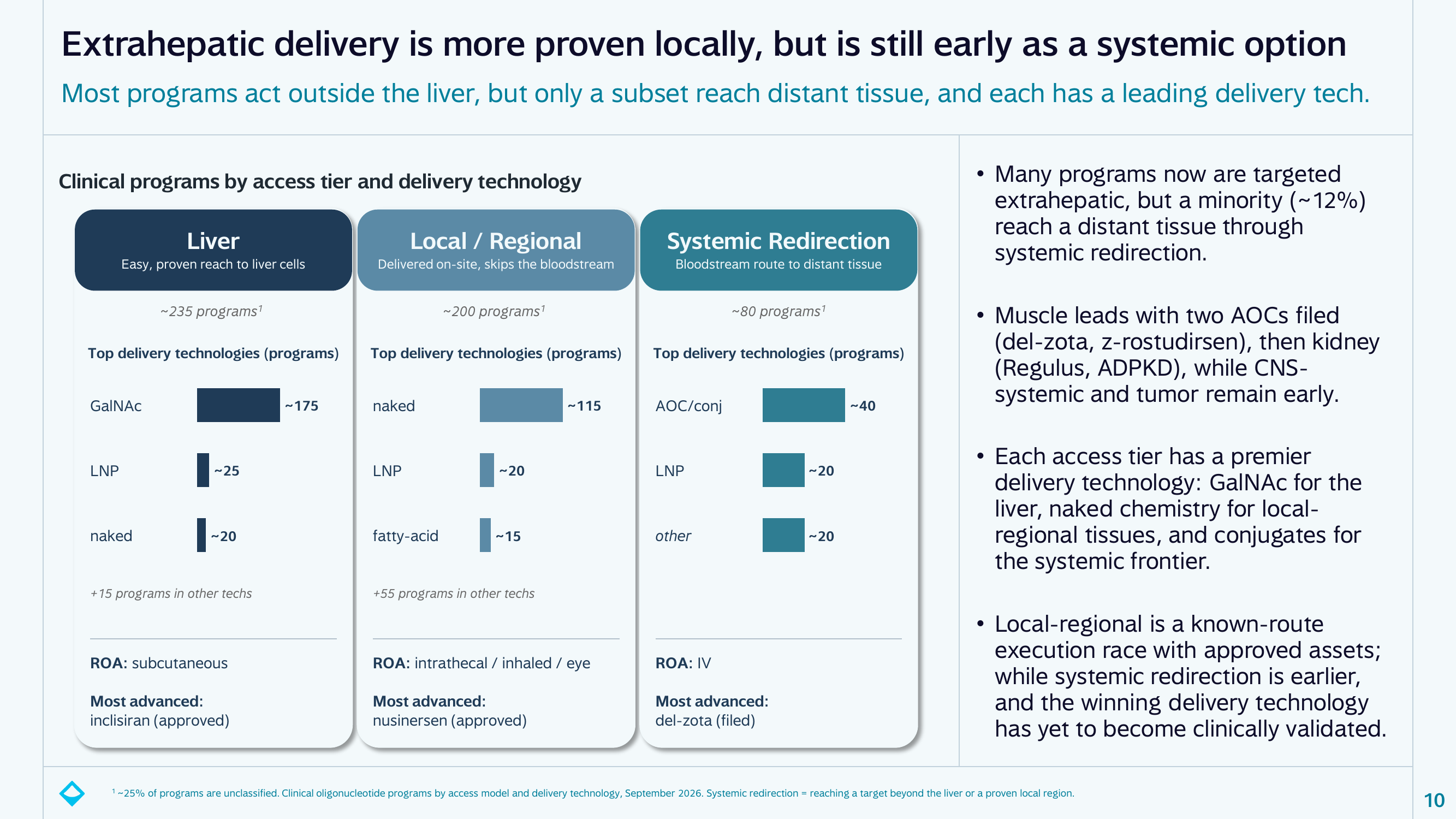
Developers have generally arrived at two paths. The first is indication-driven: use proven liver delivery to pursue larger chronic indications and compete with the established standard of care on clinical outcomes, safety, dosing, patient burden, cost, and overall value. Durability is siRNA's edge here, as twice-yearly Leqvio reached $1.2B in 2025 revenue, but 2026 showed the limits of knockdown alone: pelacarsen lowered Lp(a) sharply yet missed its cardiovascular endpoint. The second path is to unlock the next tissue, making systemic delivery into muscle, kidney, CNS, or other tissues as repeatable as GalNAc into the liver. The upside is large, but so is the list of challenges: cell-specific uptake, productive intracellular delivery, endosomal escape, adequate activity, durability and safety, and scalable manufacturing. Only ~12% of clinical programs are clearly attempting systemic redirection, although that share is much higher among early preclinical programs.
Pharma has shown it will pay platform prices when a capability works across assets. Novartis' $12B acquisition of Avidity is one example, alongside its Regulus and DTx deals, but the clinical outcome of a single asset (del-desiran's Phase 3 HARBOR study missed its primary functional endpoint) needs to be separated from whether muscle-directed AOCs work. A large part of the price buys a route into a new tissue. The key for the field is to reproduce what the last generation achieved: a genuine platform where the second and third drugs use the same route into a tissue and deliver clinical benefit. The full report also includes deep dives into CNS and muscle delivery, a 2026–2027 catalyst calendar, RNA dealmaking since 2021, and Sleuth's predictions.