
Download the Visual
Synthetic lethality is being licensed, not bought
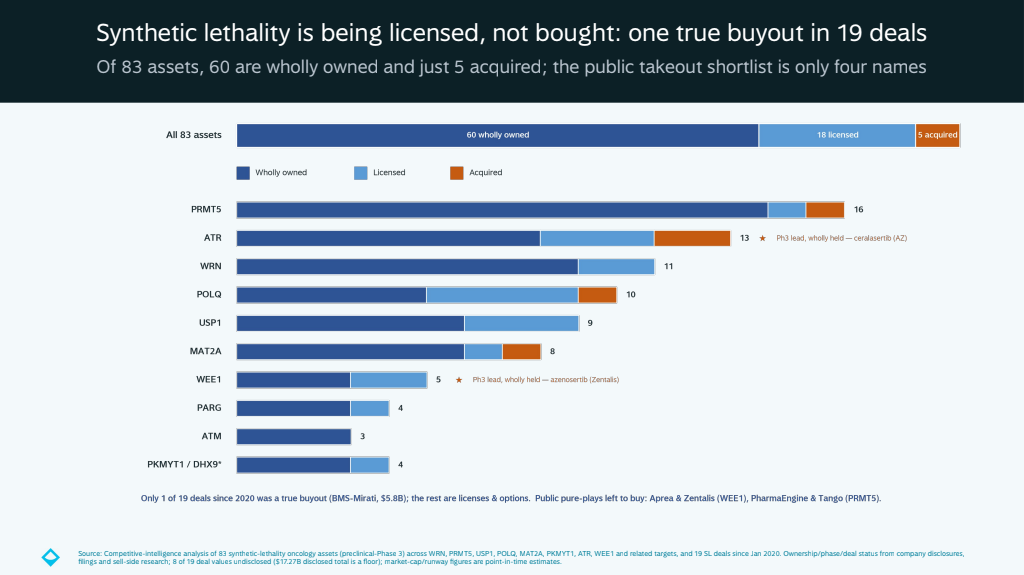
Synthetic lethality is being talked about as the next ADC-style M&A wave, but the field is still early, mostly held by the companies that built it, and few of its leading assets are actually for sale. Sleuth’s June 2026 map of 83 synthetic-lethality oncology assets finds 60 wholly owned by their developers, 18 licensed and just 5 acquired, with one true company buyout among 19 deals since January 2020.
The interest is real, and sell-side research has begun covering synthetic lethality as a category rather than company by company. But the deal record so far is licensing on an early field, not a bidding war.
Most assets are still wholly owned at every major target
PRMT5 is the most crowded target, with 16 assets: 14 wholly owned, 1 licensed and 1 acquired. ATR follows with 13 (8 wholly owned, 3 licensed, 2 acquired), then WRN with 11 (9 and 2, none acquired), POLQ with 10 (5, 4 and 1), USP1 with 9 (6 and 3) and MAT2A with 8 (6, 1 and 1). The smaller groups are WEE1 (5), PARG (4), PKMYT1 and DHX9 (4) and ATM (3), and none of their assets has been acquired.
POLQ is the most partnered target by share, with half its assets licensed or acquired.
Across the field, roughly seven in ten assets have never been licensed or sold, so most of the supply has not yet been priced by a partner.
Deal value rests on one buyout
Of the 19 synthetic-lethality deals since January 2020, only one was a true company buyout: Bristol Myers Squibb’s acquisition of Mirati Therapeutics, valued at up to $5.8 billion. That deal was driven largely by Mirati’s KRAS G12C drug Krazati, with its PRMT5 inhibitor attached through a contingent value right. Sleuth’s RAS landscape after daraxonrasib maps Krazati’s KRAS G12C class. The other 18 are licenses and options.
Disclosed value totals $17.27 billion, a floor since 8 of the 19 deals have undisclosed terms. Mirati alone is about a third of the disclosed total, and the largest deals account for about 85% of it.
Take out Mirati and the record is a string of licensing deals, which is how pharma has chosen to buy exposure to this mechanism so far.
The most advanced assets are not for sale
The two Phase 3 leads on the map are wholly held: ceralasertib (ATR) by AstraZeneca and azenosertib (WEE1) by Zentalis. Neither is available to license. AstraZeneca reported in December 2025 that the Phase 3 LATIFY trial of ceralasertib plus durvalumab in previously treated non-small cell lung cancer missed its overall survival endpoint. Zentalis started its Phase 3 ASPENOVA trial of azenosertib in Cyclin E1-positive platinum-resistant ovarian cancer in May 2026.
The public pure-plays a buyer could acquire number four: Aprea and Zentalis on WEE1, and PharmaEngine and Tango on PRMT5. Zentalis is the only one with a Phase 3 asset, which a buyer could get only by acquiring the company.
A buyer waiting for a clean, late-stage synthetic-lethality takeout has very few to choose from.
Optioning the mid-pipeline is the practical move
In Sleuth’s view, the better strategy for scouts is not to wait for a bidding war but to option the mid-pipeline now, both in crowded leading targets such as PRMT5, ATR and WRN and in the emerging tail before it is priced in. Teams that treat synthetic lethality as a watchlist of options are more likely to hold the winners than teams that wait and pay up for what is left.
Sleuth’s map of where pharma is placing early oncology bets shows which early oncology programs large pharma is already backing in its preclinical pipelines.
How Sleuth built this analysis
Assets and targets
The 83 assets run from preclinical through Phase 3 across the core targets above. Ownership, phase and deal status come from company disclosures, filings and sell-side research.
Deals and values
The 19 deals date from January 2020. Market capitalization and cash runway figures behind the public shortlist are point-in-time estimates.
Asset, ownership and deal counts are as of June 2026. The LATIFY result (December 2025) and the azenosertib trial status (May 2026) are as the companies reported them. This page is a dated snapshot.
Frequently asked questions about synthetic lethality M&A
How many synthetic-lethality oncology assets are there?
Sleuth counted 83 synthetic-lethality oncology assets, preclinical through Phase 3, in June 2026: 60 wholly owned, 18 licensed and 5 acquired. PRMT5 has the most, with 16.
How many synthetic-lethality companies have been acquired?
Of 19 synthetic-lethality deals from January 2020 to June 2026, only one was a true company buyout: Bristol Myers Squibb’s acquisition of Mirati, valued at up to $5.8 billion. The rest are licenses and options.
Which public synthetic-lethality companies could be acquired?
As of June 2026, Sleuth’s public takeout shortlist has four names: Aprea and Zentalis (WEE1), and PharmaEngine and Tango (PRMT5). Zentalis holds a Phase 3 asset, azenosertib.
Which synthetic-lethality drugs have reached Phase 3?
On Sleuth’s June 2026 map, the two Phase 3 leads are both wholly owned: AstraZeneca’s ATR inhibitor ceralasertib, whose LATIFY lung cancer trial missed its survival endpoint in December 2025, and Zentalis’s WEE1 inhibitor azenosertib.
