T-cell Engagers Intelligence Report, Q3 2026
~770 T-cell engager programs mapped across targets, formats, and development stage. Covers the heme-to-solid gap, dealmaking shift to B-cell autoimmunity, target crowding, next-gen engineering levers, trispecific advances, autoimmune frontier, and predictions.

Download the Report
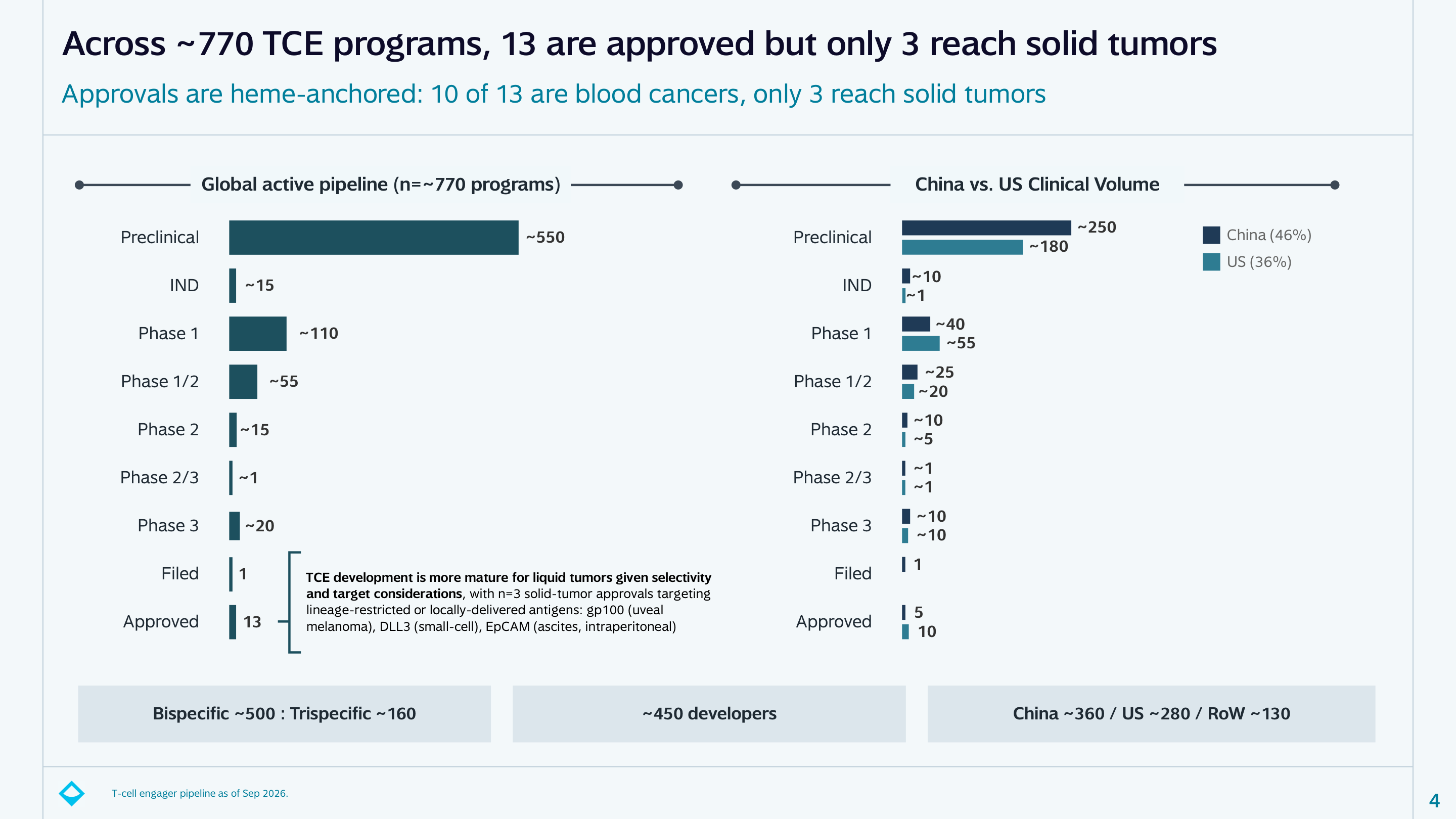
This report maps the global T-cell engager competitive landscape across ~770 active programs as of Q3 2026. Thirteen are approved but only three reach solid tumors — approvals remain heme-anchored, with multiple myeloma as the most validated lane (five global approvals). China accounts for 46% of clinical volume versus 36% for the US. The vast majority of the pipeline sits in preclinical (~550 programs), with ~110 in Phase 1 and a thin late-stage funnel.
CD3 remains the effector arm in 79% of programs, but roughly half now add engineering beyond the plain CD3×TAA bispecific format — masking, attenuation, costimulation, or extra targets. No next-generation format exceeds ~8% of the active base, so novel approaches are spread thin with no consolidating winner. Target crowding concentrates on B-cell lineage markers (CD19, BCMA) for blood cancers, then solid-tumor targets (PSMA, HER2). Proven window-widening levers are incremental: attenuated CD3 decoupled tumor depletion from CRS (AZD0486 reached 96% response with no serious CRS), and masking confines engager activity to the tumor (Vir's masked PSMA showed 82% vs. 30% response in cross-trial comparison).
Dealmaking peaked in 2024 as capital shifted to B-cell autoimmunity. Autoimmune went from zero deals before 2024 to the field's busiest new lane, with 16 deals more than doubling heme's seven. China-origin sellers account for 40% of deal activity, and 13 of 16 autoimmune deals are China-sourced. Capital concentrated on B-lineage depletion targets: BCMA (11 deals), CD19 (8), CD20 (5), well ahead of solid-tumor targets. Trispecific programs sort into four distinct bets — second antigen, costimulation, longer half-life, or a second B-cell target — but only the dual-target myeloma bet shows early efficacy, closing the escape route single-target bispecifics leave open.
The autoimmune frontier is the report's defining theme. TCEs can deplete the compartment rituximab misses: CD19 engagers reach tissue B-cells while BCMA engagers reach marrow plasma cells that sustain autoantibody. Early human data back the bet — CLN-978 cleared B-cells in lymph node and synovial tissue, and blinatumomab improved refractory RA. We predict no shared-antigen engager clears the efficacy bar before 2027, the trispecific premium is priced ahead of clinical payoff, and the autoimmune read from plamotamab and cizutamig will set whether TCEs become a durable platform beyond oncology.