
Download the Visual
Pharma I&I has moved from single-pathway biologics to mechanism stacks
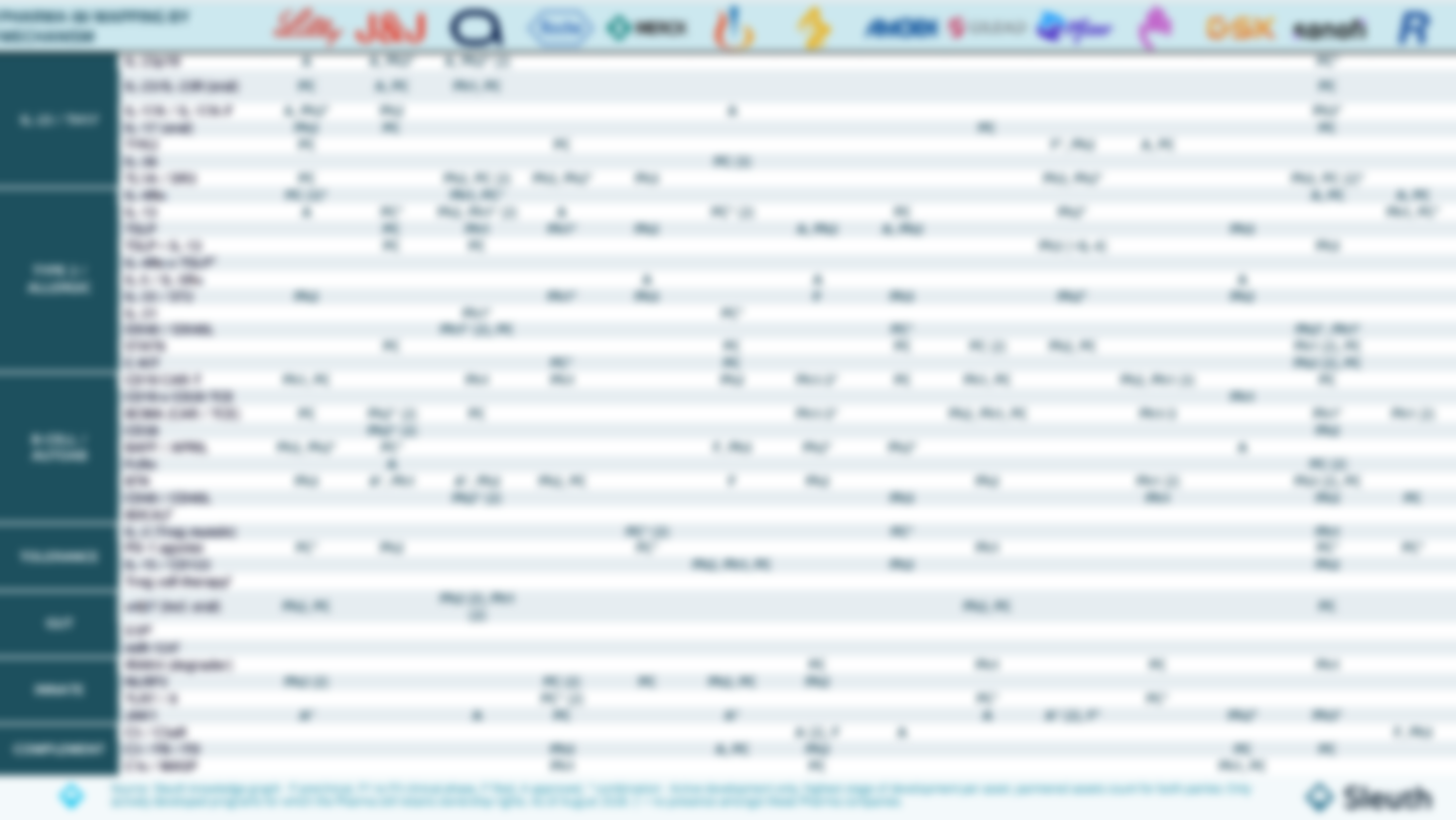
Top pharma companies no longer build immunology pipelines around single-pathway biologics; they are assembling mechanism stacks designed to work across diseases, hedge biological risk and replace at-risk franchises elsewhere in their portfolios. Sleuth’s August 2026 map counts 41 distinct immunology and inflammation (I&I) mechanisms across 14 top pharma companies, with active programs in 36 of them. The market has evolved in three stages to get here.
The I&I market has evolved in three stages
Stage 1, the blockbuster biologic. TNF, IL-12/23, IL-17 and IL-4/13 established the model: validate a single pathway, then expand it across multiple diseases.
Stage 2, the rise of orals. JAK and S1P modulators showed demand for systemic oral therapy, but also that convenience is commercially viable only with an acceptable chronic-use safety profile. Newer attempts include selective TYK2 inhibitors and oral IL-23, where Johnson & Johnson’s icotrokinra became the first approved oral IL-23 drug in March 2026.
Stage 3, the mechanism stack. The map now spans degraders, bispecifics, T-cell engagers, CAR-T and more.
The question is no longer which cytokine wins, but how to cover the most strategically useful parts of the treatment landscape: convenient chronic control, precision biologics and immune reset in one portfolio.
I&I is fracturing the way oncology did
Once a target is validated in oncology, value shifts toward patient selection, combination architecture and asset-level differentiation. I&I is following the same path. One mechanism can create several commercial shots on goal, but the biological heterogeneity of immune disease makes a single winner unlikely, leaving room for segmentation, sequencing and multiple standards of care.
For BD teams, a portfolio’s strength depends less on owning the best drug on one target and more on covering the right patients at each stage of disease.
Top pharma is running a barbell strategy
One end of the barbell is chronic substitution: making advanced treatment easier and moving it earlier, initially for larger, less refractory populations. Examples include oral IL-23, TYK2 inhibitors and STAT6 or IRAK4 degraders. The other end is immune reset: deep, potentially drug-free remission, initially for severe, treatment-refractory disease. Examples include CD19 CAR-T and T-cell engagers, BCMA and CD19 approaches, and CD38.
Most companies are betting on both ends. Owning a ladder of interventions and matching patients to each rung will be key as I&I fractures, a shift Sleuth quantifies in its I&I Intelligence Report.
Mechanisms mapped across 14 top pharma companies as of August 2026. Approval status is current as of September 2026.
Frequently asked questions about pharma I&I strategy
What is a mechanism stack in immunology?
A mechanism stack is a portfolio of I&I drugs with different mechanisms and modalities, such as oral small molecules, biologics, degraders, bispecifics and cell therapies, assembled to cover several diseases and stages of treatment rather than relying on a single pathway.
How many I&I mechanisms are top pharma companies pursuing?
Sleuth mapped 41 distinct I&I mechanisms across 14 top pharma companies as of August 2026. The companies have active programs in 36 of them.
What is the barbell strategy in I&I?
It pairs chronic substitution, such as oral IL-23, TYK2 inhibitors and STAT6 or IRAK4 degraders for larger, less refractory populations, with immune reset, such as CD19 CAR-T and T-cell engagers for severe, refractory disease.
Why are oral I&I drugs hard to commercialize?
JAK and S1P modulators showed that patients want oral therapy, but convenience only wins when paired with an acceptable safety profile for chronic use.