ADC Intel Report, Q3 2026: The Next-Generation Engineering Race
Sleuth mapped 2,045 antibody-drug conjugate programs, 313 active targets and 393 deals to examine where the ADC market is crowded, where differentiation remains possible and what buyers are funding before clinical proof.

Download the Report
ADC development has entered its next-generation engineering era
A mature modality still has a large preclinical tail
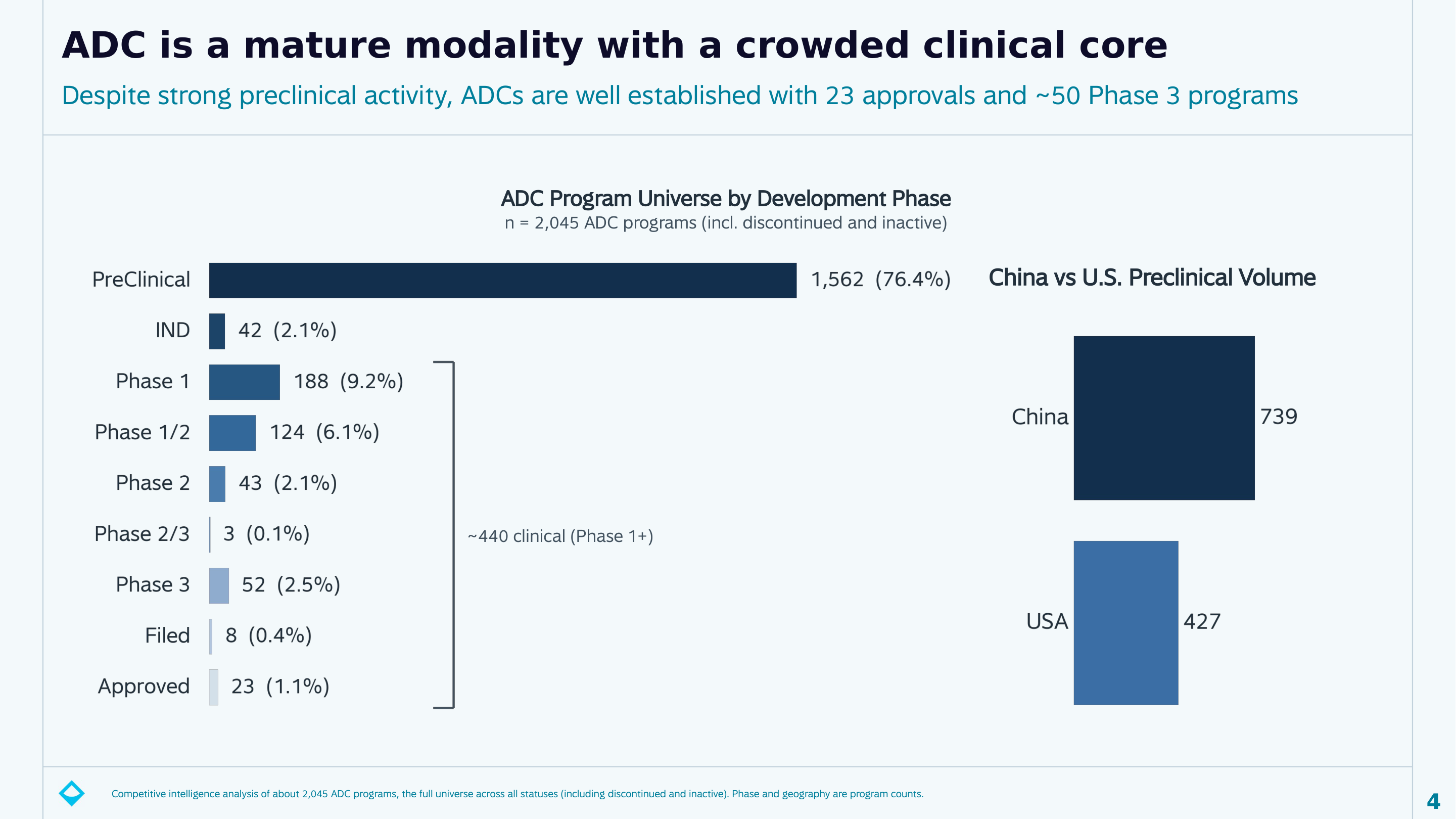
Antibody-drug conjugates have become an established drug class, with 23 approved products, roughly 440 clinical-stage programs and about 50 programs in Phase 3. At the same time, the first generation of ADC development exposed persistent constraints: narrow therapeutic windows, dose reductions in combination regimens and resistance to widely used payload classes.
The next competitive cycle is increasingly an engineering race. Sponsors are using new payload mechanisms, linker and conjugation chemistry, bispecific formats and dual-payload designs to improve how much active drug reaches a tumor and how much exposure a patient can tolerate. A wider therapeutic window gives an ADC more room to dose at effective levels, combine with standard of care and move into earlier treatment settings.
The full ADC universe contains about 2,045 programs, including discontinued and inactive assets. Of these, 1,838 active programs span 313 targets. Yet only about 440 programs have entered Phase 1 or later, showing how much of the apparent breadth remains preclinical.
Developer depth is similarly concentrated. Sleuth identified about 640 active ADC developers, but only 59 met at least one multi-program test: multiple clinical programs across payload classes, a multi-target clinical portfolio or repeated ADC out-licensing. The market is large by asset count and much smaller by demonstrated platform depth.
Target crowding moves differentiation into payload and linker design
HER2, EGFR, TROP2, B7-H3, c-Met and HER3 each have more than 20 clinical-stage programs. HER2 alone has about 160 active programs, but 35 have reached the clinic. Its clinical count sits closer to targets with far fewer total programs, suggesting that adding another preclinical asset against validated biology does not create much separation on its own.
Construct design offers more variables than target selection. The choice of antibody, payload, linker, conjugation method and drug-to-antibody ratio can change efficacy, stability, safety and resistance behavior even when two programs address the same antigen. That is why crowded targets can still support differentiated assets, but a target name alone is no longer a sufficient position.
The therapeutic window determines combination and first-line potential
Wide-window ADCs can combine at full dose
An ADC's therapeutic window affects more than tolerability. It sets the dose available for combination therapy and can determine whether a drug has a credible path from later-line use into first-line treatment.
Sleuth mapped 166 ADC combination pairings. Checkpoint inhibitors and other immuno-oncology agents accounted for 73, or 44%, making them the default combination strategy. The presence of a checkpoint partner therefore offers little differentiation by itself.
Dose intensity matters more. Trastuzumab deruxtecan, sacituzumab govitecan and datopotamab deruxtecan all carry explicit dose constraints in combination settings. When an ADC and its partner each require dose reductions, the regimen may give up part of the efficacy it was intended to add. Wider-window constructs have more room to stack with standard therapies at clinically useful doses.
First-line use is the commercial value trigger
First-line entry remains rare. Most ADCs that reached the front line first established themselves in later treatment settings, so the migration path matters as much as the initial indication. Enfortumab vedotin plus pembrolizumab provides one benchmark: in EV-302, the combination produced median progression-free survival of 12.5 months versus 6.3 months with chemotherapy in advanced urothelial cancer.
Within Sleuth's curated set of first-line ADC milestones, every successful move into first-line treatment involved a combination with standard of care. This links construct design to commercial potential. An ADC that cannot preserve adequate exposure in combination will have a harder time competing for the treatment settings with the broadest use.
Payload and construct design define the next value wave
Two payload families carry 44% of the disclosed clinical field
Sleuth identified at least 110 clinical-stage programs with a disclosed payload across 22 payload classes. Auristatins and topoisomerase-1 or DXd payloads together account for about 44% of this disclosed group, and topoisomerase-1 has overtaken MMAE as the most contested warhead class. A companion analysis of the broader ADC payload landscape tracks disclosed payloads across active programs at every development stage.
That percentage does not describe the entire clinical pipeline. Roughly three-quarters of the approximately 440 clinical ADC programs do not publicly disclose their payload. The visible field still shows substantial concentration, while the undisclosed majority limits how confidently any public analysis can characterize the full payload market.
Dual-payload ADCs move the combination inside the molecule
Dual-payload constructs are designed to deliver two mechanisms through one targeting vehicle and one therapeutic window. Leading designs pair a topoisomerase-1 warhead with a second payload that interferes with the damage response, such as an ATR inhibitor or an RNA polymerase II mechanism. The aim is to retain activity where either payload alone encounters resistance.
The broader dual and next-generation landscape contains 106 programs: 42 dual-target or bispecific ADCs, 13 ADC-plus-inhibitor combinations and 11 dual-payload ADCs. Eighty-six percent remain preclinical. Early platform transactions show that buyers are willing to fund the concept, but Phase 1 safety data will determine whether these designs widen the usable window or simply add another source of toxicity.
ADC dealmaking rewards platforms before clinical proof
Sleuth mapped 393 ADC deals announced from 2021 through August 2026. Annual deal count rose from 49 in 2021 to 93 in 2025, while 2026 was running near 70 deals on an annualized basis through the report cutoff. Deal count is more useful than disclosed headline value for tracking momentum because financial disclosure varies and a few large transactions can distort annual totals.
Among the 303 deals with a mapped development stage, 219, or about 72%, were signed preclinically. Buyers are often underwriting a repeatable platform rather than waiting for one asset to produce clinical proof. Novartis's acquisition of Myricx Bio shows how that thesis can play out: the buyer secured a novel payload platform years before it could produce a marketed drug. For developers, that raises the bar for the package behind an early program: payload rationale, linker behavior, conjugation control, translational evidence and applicability across additional targets all contribute to platform value.
China now originates half of the global ADC pipeline
China leads Phase 3 while ex-China markets retain the approval lead
China accounts for roughly 1,045 of the 2,045 programs in the full, all-status ADC universe. It also leads the combined rest of the world in Phase 3 programs, 32 to 20. Ex-China markets still lead in approvals, 13 to 10, leaving China with both a large late-stage cohort and a remaining commercialization gap. The broader China biopharma landscape shows the same concentration in bispecific antibodies, CAR-T and PROTACs.
This concentration reflects strengths in medicinal chemistry and development execution. It also creates two possible paths for the Phase 3 pipeline: a larger wave of cross-border partnering or more China-origin products pursuing global launches.
China has become a standing ADC sourcing channel
Within 150 mapped China-origin ADC deals, 59 were domestic and about 87 involved out-licensing. Roughly 60% of the China-to-global transactions were enabled by WuXi, creating a notable concentration in the supply chain supporting cross-border programs. Broader China-to-US and Europe licensing data show that asset deal flow continued to accelerate through the BIOSECURE debate and enactment.
Developer quality cannot be read from program count alone. Biocytogen and Synaffix show platform scale with limited proprietary clinical depth, while MediLink, CSPC, Biokin, Kelun and DualityBio combine clinical-stage assets with repeat partnering or late-stage validation. Search and evaluation teams should treat China as a market to monitor continuously rather than a source to revisit only after a prominent deal.
The remaining openings are narrow and specific
TROP2 has the nearer-term approval opportunity
Sleuth identified 51 active pivotal or Phase 3 ADC programs. HER2 dominates the near-term catalyst calendar, but many of its events are label expansions for established products such as trastuzumab deruxtecan. TROP2 has more potential to change the competitive order because its calendar includes both label expansions and first approvals, including programs in triple-negative breast cancer.
B7-H3 requires a differentiated construct
The B7-H3 field contains at least 80 active programs. Among 26 named clinical competitors, 15 are based in China. Ifinatamab deruxtecan leads on regulatory timing in previously treated extensive-stage small-cell lung cancer, where it has reported a 48.2% objective response rate and received FDA Breakthrough Therapy designation and Priority Review. Those statuses reflect a filed application, not an approval.
A new B7-H3 program must contend with that timing advantage and a deep competitive set. A bispecific construct or a payload outside the DXd class offers a clearer basis for differentiation than another conventional B7-H3/DXd design.
Beyond oncology, payload innovation becomes the central question
Sleuth counted 39 non-oncology antibody-conjugate programs with enough evidence to classify. Autoimmune and immunology is the largest group, followed by infectious disease with 10 programs. Payloads in these settings extend beyond cytotoxics to glucocorticoids and oligonucleotides, shifting the design problem toward cell-specific delivery of mechanisms that would be difficult to use systemically.
The category remains early. Del-desiran, the only Phase 3 program in the review, is an antibody-oligonucleotide conjugate included for context rather than counted as an oncology ADC. The opportunity is meaningful, but the field still needs clinical proof that conjugate platforms can deliver non-cytotoxic payloads with a useful efficacy and safety profile.
All pipeline, target, payload, deal and clinical-stage figures are current through August 2026 unless otherwise noted. Counts use the scope and definitions described in the Q3 2026 Sleuth ADC Intelligence Report.
Frequently asked questions about the ADC landscape
How large is the global ADC pipeline?
Sleuth mapped about 2,045 antibody-drug conjugate programs across all statuses, including discontinued and inactive assets. The active subset contains 1,838 programs across 313 targets, and roughly 440 programs have reached Phase 1 or later as of August 2026.
Which ADC targets are the most crowded?
HER2, EGFR, TROP2, B7-H3, c-Met and HER3 each have more than 20 clinical-stage ADC programs. HER2 has the largest total active pipeline, while the clinical-stage leaders sit within a narrower range than their preclinical program counts suggest.
Which payload classes dominate clinical ADC development?
Auristatin and topoisomerase-1 or DXd payloads account for about 44% of the 110 clinical-stage ADC programs with a publicly disclosed payload. About 75% of the roughly 440 clinical programs do not disclose their payload, so this share applies only to the disclosed subset.
Why does the therapeutic window matter for an ADC?
The therapeutic window determines how much drug can be given before toxicity limits dosing. A wider window can preserve dose intensity, support combinations with standard therapies and improve the chance that an ADC can move into first-line treatment.
What is a dual-payload ADC?
A dual-payload ADC carries two payload mechanisms on one antibody-based construct. Many current designs pair a topoisomerase-1 warhead with a second mechanism, such as ATR inhibition or RNA polymerase II inhibition, to address resistance and deliver a combination through one targeting vehicle.
How much of the ADC pipeline originates in China?
China originates roughly 1,045 of the 2,045 programs in Sleuth's all-status ADC universe. China also had 32 Phase 3 programs versus 20 across the combined rest of the world, although ex-China markets retained the approval lead, 13 to 10, at the August 2026 cutoff.
How often are ADC deals signed before clinical testing?
Of 303 ADC deals with a mapped development stage, 219, or about 72%, were signed preclinically. This subset sits within the 393 total ADC deals Sleuth mapped from 2021 through August 2026.