
Download the Report
GLP-1 competition is moving from peak weight loss to the whole product
With leading GLP-1 injectables at 20% to 28% mean weight loss, a few more points of weight loss matter less, and matching the leaders on efficacy alone does not open a market against their payer access and brand strength. Sleuth’s August 2026 data counts 628 active GLP-1 and metabolic programs, yet the branded US market remains a Novo Nordisk and Eli Lilly duopoly. The next phase of the class will be decided by the most useful product profile for a given patient: oral convenience, tolerability, staying on therapy, preserving lean mass and winning comorbidity labels.
GLP-1 is becoming a validated backbone that other mechanisms are layered onto. Lilly and Novo are using business development to cover each part of that profile, so the market may stay concentrated at the company level even as it fragments at the product level.
628 programs crowd a market two companies still control
The late-stage wave is dominated by incumbents, biosimilars and China
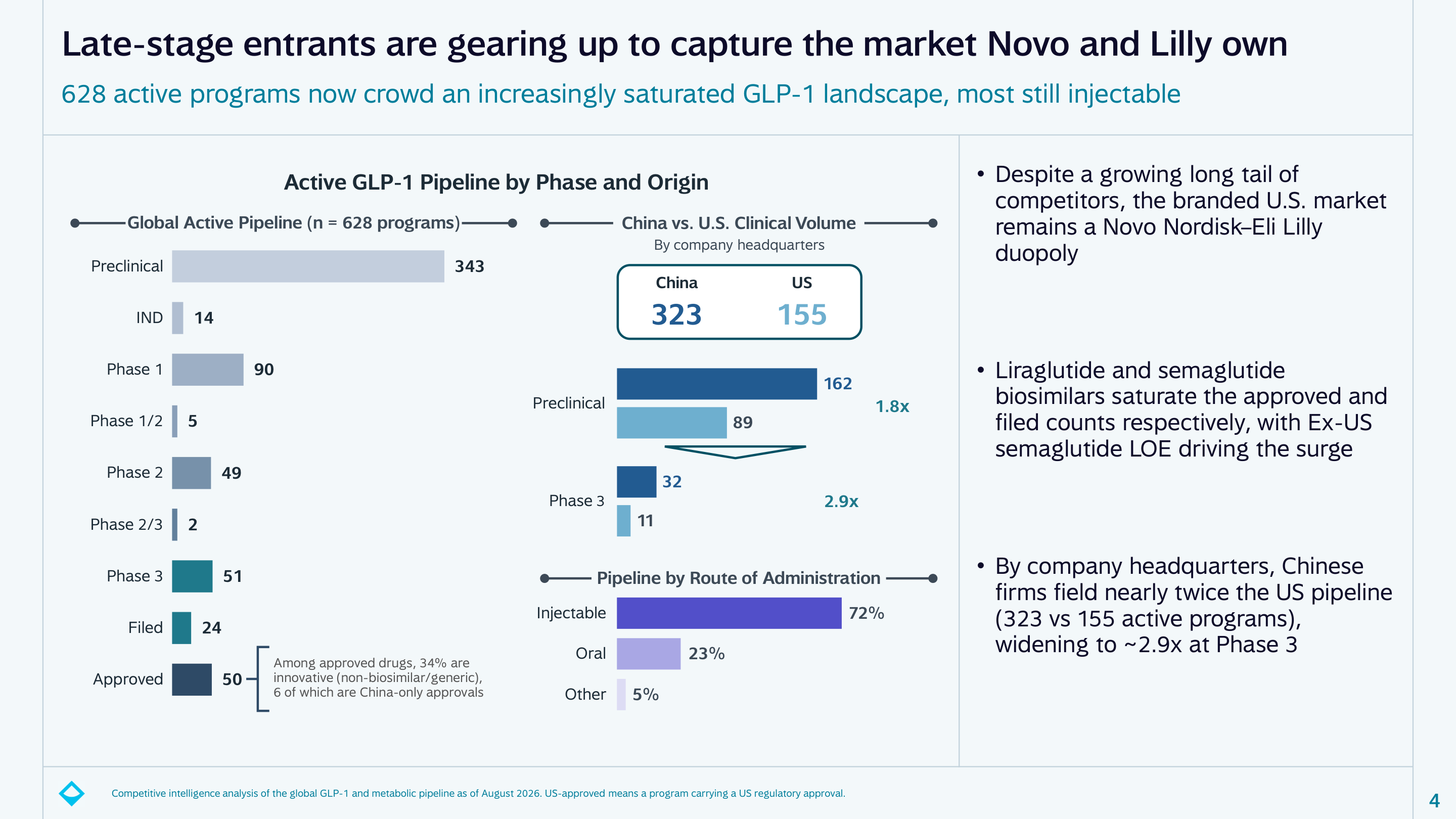
Of the 628 active programs, 343 are preclinical, 14 at IND, 95 in Phase 1 or Phase 1/2, 51 in Phase 2 or 2/3, 51 in Phase 3, 24 filed and 50 approved. Liraglutide and semaglutide biosimilars fill much of the approved and filed counts, driven by semaglutide’s loss of exclusivity outside the US, and only 34% of approved drugs are innovative products. By company headquarters, Chinese developers run 323 programs against 155 in the US, a gap that widens from 1.8x in preclinical development to 2.9x in Phase 3 (32 programs to 11).
The pipeline count overstates how open the market is. Much of the late-stage volume is either a biosimilar, an incumbent’s own next asset or a China-originated fast follower, which is why entrants need a reason to exist beyond joining the queue.
Tirzepatide now carries most of the category’s branded sales
Lilly’s tirzepatide franchise reached 58% of disclosed GLP-1 brand sales in the first half of 2026, up from 48% in 2025. Mounjaro sales rose 106% to $18.6 billion in the first half, while Ozempic slipped 6% to $9.3 billion; Zepbound added $9.1 billion and Wegovy $5.9 billion. Injectables held 95% of disclosed first-half sales, and the US accounts for 59% to 70% of sales for Mounjaro, Ozempic and Wegovy.
The oral launches are still small, with $855 million for the Wegovy pill and $98 million for Lilly’s Foundayo (orforglipron) in the first half. They matter because they move the competitive battle from efficacy to format, a shift Sleuth has tracked since obesity value began moving from efficacy to access.
Indication breadth has become the incumbents’ race
Semaglutide and tirzepatide keep turning positive outcome readouts into new labels in cardiovascular disease, kidney disease, sleep apnea and MASH. Sleuth counted 181 GLP-1 and incretin programs in cardiovascular indications, 147 in liver disease and MASH, 53 in neurology and psychiatry and 33 in addiction. Of the 144 late-stage programs outside core obesity and type 2 diabetes, Novo and Lilly run about 74%, and Lilly leads the mental health and addiction frontier with brenipatide in late-stage development for alcohol use disorder and depression.
Comorbidity labels are where incumbents extend their lead, because outcome trials are large, slow and expensive. Smaller entrants chasing these adjacencies are competing against the companies that already own the data.
The weight-loss ceiling is high enough that differentiation has moved elsewhere
Five of six leading injectables clear 20% weight loss
In pivotal or late-stage readouts through August 2026, retatrutide reached 28.3% mean weight loss at 80 weeks (TRIUMPH-1), tirzepatide 25.5% at 84 weeks, amycretin 24.3% at 36 weeks in Phase 1b/2a, CagriSema 23.0% at 84 weeks and semaglutide 7.2 mg 20.7% at 72 weeks. Survodutide reached 16.6%. The approved orals trail: oral semaglutide 25 mg at 13.6% and orforglipron at 12.4%. Only the REDEFINE-4 comparison, in which CagriSema missed non-inferiority to tirzepatide, is head to head; the rest are cross-trial comparisons.
With the injectable ceiling this high, the open ground for new drugs is route, dosing and the quality of weight loss rather than another headline percentage.
Incumbents own the hard-outcome readouts on the 2027 calendar
Through December 2027, 19 of 23 late-stage assets are still chasing obesity or type 2 diabetes, while a few test beyond them, such as KBP-336 in obesity with osteoarthritis and HRS-7535 in heart failure. In Sleuth’s catalyst calendar, the hard-outcome studies due in 2027 are all incumbent-run: tirzepatide’s SURMOUNT-MMO mortality trial, CagriSema’s REDEFINE-3 cardiovascular trial and semaglutide’s FOCUS retinopathy trial. Other near-term catalysts include an FDA decision on CagriSema, expected in the fourth quarter of 2026, a retatrutide filing planned for early 2027 and Amgen’s MariTide Phase 3 readouts in early 2027.
Challengers are left to compete on converging weight-loss numbers while Novo and Lilly add outcome data that payers and physicians reward.
Combinations and muscle preservation define the next product profile
Only incretin co-agonists have matured among 124 combinations
The pipeline contains 124 unique target combinations. Incretin co-agonists that pair GLP-1 with GIP or glucagon are the only mature family, with 168 programs, 16 of them in Phase 3 or later. The novel-partner frontier is early: amylin and calcitonin combinations have 28 programs, FGF21 22, PYY and NPY 10, and muscle or myostatin partners 10, mostly preclinical to Phase 1. Among 20 key combination approaches, muscle preservation (6 regimens), satiety (5) and MASH (5) are in Phase 2, and only SGLT2 pairings in diabetes have reached Phase 3.
Beyond the incretins, sponsors are pairing GLP-1 with partners chosen for a specific indication or patient problem, such as FGF21 for MASH, rather than for more weight loss.
Muscle sparing is becoming a combination race incumbents lead
At least 70 programs mention muscle preservation, and 19 make it a core part of their positioning. Phase 2 combinations have cut lean-mass loss by half or more. Scholar Rock’s apitegromab cut lean-mass loss by 54.9% versus tirzepatide alone in EMBRAZE. Regeneron’s trevogrumab and garetosmab with semaglutide cut the lean share of weight loss from 33% to 7.4% in COURAGE. Lilly’s bimagrumab with semaglutide produced weight loss that was 92.2% fat in BELIEVE, and Veru’s enobosarm reduced lean loss by 71% versus semaglutide alone in QUALITY.
The incumbents are winning this race by adding anti-catabolic agents to their own GLP-1s, as Lilly did when it acquired Versanis and bimagrumab for $1.9 billion in 2023. The question is shifting from how much weight comes off to how well it comes off.
Staying on therapy is the real unmet need
Small-molecule orals solve scale, not peak efficacy
Oral drugs make up 23% of active programs but only 9% of late-stage programs, and 68% of the orals are small molecules. Orforglipron reaches about 79% bioavailability with no food restrictions, against roughly 1% for oral peptides, which makes small molecules easier to manufacture and supply at scale. Needle aversion affects an estimated 14% to 38% of adults, so a convenient oral could win a growing segment, with injectables as the higher-efficacy step up. GI tolerability remains the open question, and so does whether route alone can break Novo and Lilly’s entrenched payer contracts.
About half of obesity patients stop within six months
Across a consolidated set of 43 real-world studies, about half of obesity patients discontinue GLP-1 therapy within six months, and only 8% to 14% are still on therapy at three years. Cost is the leading reason, cited by 43% to 68% of patients who stop, followed by reaching their goal (18% to 28%) and side effects (15% to 24%). Insufficient efficacy accounts for under 2%.
Efficacy is proven; durability is not. A regimen the broad obesity population can stay on, combining route, tolerability and cost, is the unmet need, and cheaper prices alone may not solve it because side effects also drive patients away.
Failed programs show how high the bar is for entrants
Sleuth reviewed 37 discontinued or deprioritized programs: 9 from Novo and Lilly and 28 from other companies. The incumbents mostly pruned assets that were not differentiated enough on efficacy. Entrants also ran into safety and tolerability problems, including liver signals that ended Pfizer’s oral small molecules lotiglipron in 2023 and danuglipron in 2025. Even a clean profile then faces a commercial bar of entrenched formulary positions, portfolio contracts and brand recognition.
China is the fast-follower engine behind the next GLP-1 deals
Disclosed GLP-1 deal value hit $34 billion in 2025
GLP-1 and key-mechanism deals rose from 7 in 2021 to 19 in 2025, when disclosed value reached $34.2 billion, including $8.2 billion in upfronts. Through August 2026, 9 deals carried $20.1 billion in disclosed value, led by AstraZeneca’s $18.5 billion headline pact with CSPC. China-linked assets have made up most deals since 2024, and buyers pay a median $70 million upfront for them against $500 million for non-China assets, even though median total deal values are near $2 billion for both.
Novo and Lilly buy capabilities, such as muscle preservation, oral formats and long-acting delivery, to build on portfolios that already lead. Other entrants pay to buy in early, as Pfizer did when it won Phase 2 Metsera for up to about $10 billion, including contingent payments, after a bidding war with Novo in November 2025.
Western buyers are licensing China’s fast followers back
China’s GLP-1 fast-follower field has 69 programs from 44 developers, led by Hengrui, Hansoh and CSPC, and new entries rose from 2 a year to 13. Since 2021, Western companies have licensed 13 Chinese assets back across 15 deals at a median total value of about $2.0 billion and a median upfront of $106 million, with 8 of those deals signed in 2025. Assets also reach the West through venture-backed NewCos such as Kailera, Verdiva and Sidera, which raised about $920 million combined. Of 368 funding rounds for these developers, about 66% were Chinese-domestic and about 3% direct US equity.
For an entrant, the question is no longer whether to source from China but through which channel and how early. Sleuth’s comparison of how China and the West are building different obesity drugs shows where those pipelines diverge.
What the GLP-1 findings mean for developers and buyers
These implications are Sleuth’s interpretation of the data above.
For developers, parity is not a strategy. A new GLP-1 needs a product profile that serves a defined patient group better, whether through route, tolerability, lean-mass preservation, durability of use or a comorbidity label. The combination and muscle data suggest the most credible profiles pair GLP-1 with a partner chosen to solve one specific problem.
For buyers, the next assets are profile plays, and many will come from China. Diligence should weigh persistence, tolerability and lean-mass data alongside weight loss, and account for the payer contracts incumbents already hold. China-originated fast followers are available at low upfronts, but the value depends on whether an asset adds something the incumbents’ portfolios do not already cover.
What Sleuth expects in GLP-1 and metabolic disease
These predictions are Sleuth’s analytical interpretation, looking beyond what the data shows today.
- By 2027, quality of weight loss will displace raw weight loss as the benchmark, with muscle-sparing endpoints becoming an integral part of portfolio strategy.
- Orforglipron will take a double-digit share of new obesity starts, driven by incumbent contracts, oral demand and indication expansion into areas such as sleep apnea and hypertension.
- By 2028, maintenance will become its own race. With persistence collapsing inside six months and about two-thirds of lost weight returning off drug, the most important readouts will shift from peak weight loss to tolerability-first regimens patients can stay on, led by amylin agonists.
How Sleuth built this analysis
Pipeline scope
The pipeline covers 628 active GLP-1 and metabolic programs as of August 2026, including biosimilars. Origin is based on company headquarters, and US-approved means a program with a US regulatory approval.
Sales
Sales are approved-brand net sales from Novo Nordisk and Eli Lilly disclosures for full-year 2025 and the first half of 2026. Novo figures are converted from Danish kroner at period-average rates, and compounded semaglutide and tirzepatide sit outside these figures.
Weight-loss benchmarks and catalysts
Weight loss is the mean percent change in body weight at the highest studied dose under the efficacy or trial-product estimand, from pivotal readouts through August 2026. Timepoints range from 36 to 84 weeks, and comparisons are cross-trial except REDEFINE-4. Catalysts cover August 2026 through December 2027, with readouts dated by expected primary completion.
Deals and China
The deal set covers GLP-1 and key-mechanism licensing, collaboration and acquisition deals from 2021 through August 2026, using disclosed values only. The China fast-follower analysis covers 2018 to 2026, including 15 license-back deals and 368 funding rounds.
Persistence and failure modes
Persistence figures come from a consolidated set of 43 real-world and claims-based studies. The failure-mode review covers 37 discontinued or deprioritized programs, grouped into six categories and split between Novo and Lilly and other developers.
Interpretation
The implications and predictions are Sleuth’s analytical interpretation rather than direct findings from the data.
Pipeline, sales, deal and clinical figures are as of August 2026 unless otherwise noted. Regulatory timing is current as of September 2026.
Frequently asked questions about the GLP-1 landscape
How many GLP-1 and metabolic drugs are in development?
Sleuth tracked 628 active GLP-1 and metabolic programs as of August 2026, including 343 preclinical programs, 51 in Phase 3, 24 filed and 50 approved. Chinese developers run 323 of them and US developers 155.
Which GLP-1 drug produces the most weight loss?
Among pivotal readouts through August 2026, Lilly’s retatrutide reached the highest mean weight loss, 28.3% at 80 weeks in TRIUMPH-1, followed by tirzepatide at 25.5% at 84 weeks. These are cross-trial comparisons except CagriSema versus tirzepatide in REDEFINE-4.
Which oral GLP-1 drugs are approved?
Novo Nordisk’s oral semaglutide 25 mg (the Wegovy pill) and Lilly’s orforglipron (Foundayo) are approved oral GLP-1 drugs for obesity, reaching 13.6% and 12.4% mean weight loss in their pivotal trials. Orforglipron is a small molecule with no food or water restrictions.
Why do patients stop taking GLP-1 drugs?
About half of obesity patients stop within six months. Cost is the leading reason (43% to 68% of discontinuations), followed by reaching their goal (18% to 28%) and side effects (15% to 24%). Only 8% to 14% of patients are still on therapy at three years.
What are muscle-sparing obesity drugs?
Muscle-sparing approaches add an agent such as a myostatin or activin blocker to a GLP-1 to preserve lean mass during weight loss. In Phase 2, combinations from Scholar Rock, Regeneron, Lilly and Veru cut lean-mass loss by half or more. At least 70 programs mention muscle preservation.
How much of the GLP-1 pipeline comes from China?
Chinese developers run 323 of 628 active programs, nearly twice the US count, and lead Phase 3 by 32 programs to 11. Western companies have licensed 13 Chinese GLP-1 assets back across 15 deals since 2021, at a median total value of about $2.0 billion.
How large are GLP-1 sales?
Mounjaro led first-half 2026 brand sales at $18.6 billion, followed by Ozempic at $9.3 billion, Zepbound at $9.1 billion and Wegovy at $5.9 billion. Lilly’s tirzepatide franchise accounted for 58% of disclosed GLP-1 brand sales.
What are the key GLP-1 catalysts through 2027?
Key events include an FDA decision on CagriSema expected in the fourth quarter of 2026, a retatrutide filing planned for early 2027, Amgen’s MariTide Phase 3 readouts in early 2027 and three incumbent outcome studies in 2027: SURMOUNT-MMO, REDEFINE-3 and FOCUS.