
Download the Visual
Two chemistries dominate ADC payloads, which is why Novartis bet on a third
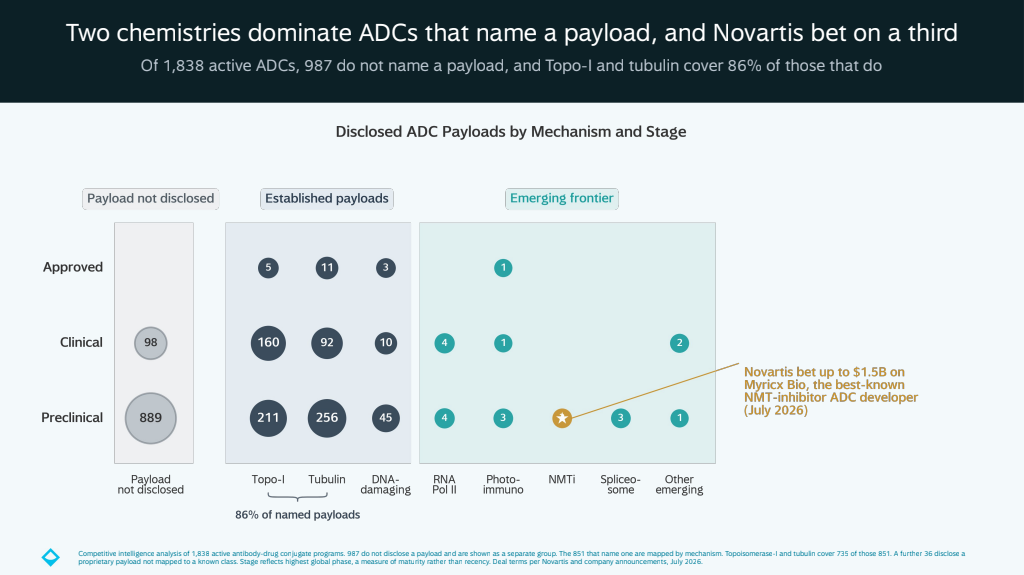
Novartis’s agreement to buy Myricx Bio for its N-myristoyltransferase inhibitor (NMTi) payload is a bet against a crowded field: among antibody-drug conjugates (ADCs) that name a payload, two chemistries dominate, and genuinely new mechanisms are rare and early. Sleuth’s July 2026 map of 1,838 active ADC programs finds that 987 do not name a payload, and topoisomerase-I (Topo-I) and tubulin inhibitors cover 735 of the 851 that do, about 86%.
The payload is becoming the next battleground in ADC innovation.
Topo-I and tubulin account for most named payloads at every stage
Topo-I payloads account for 376 programs: 5 approved, 160 clinical and 211 preclinical. Tubulin payloads account for 359: 11 approved, 92 clinical and 256 preclinical. DNA-damaging payloads are a distant third with 58 programs, 3 of them approved. A further 36 programs disclose a proprietary payload that is not mapped to a known class.
The clustering has a logic. ADCs were meant to widen the therapeutic index, delivering a tumor-killing dose of payload while sparing healthy tissue, but in practice they leak through off-target binding and imperfect linkers, and safety failures are common. Payload class became a good predictor of an ADC’s toxicity, so the field gathered around the classes with a proven balance of potency and tolerability.
The concentration is a rational response to toxicity risk, and it makes differentiation inside the two dominant classes hard.
More than half of active ADCs do not name a payload
The 987 programs without a disclosed payload are 54% of the 1,838, and 889 of them are preclinical. Only 98 are in the clinic.
That makes the current split provisional. In Sleuth’s view, as these programs advance and disclose their payloads over the next year, the share held by Topo-I and tubulin could look very different.
The emerging frontier is small and mostly preclinical
The emerging payload classes on Sleuth’s map, RNA polymerase II inhibitors (8 programs), photoimmunotherapy (5), spliceosome modulators (3), other emerging mechanisms (3) and NMTi, hold only about 20 programs. One, a photoimmunotherapy conjugate, is approved, and most of the rest are preclinical.
Novartis announced on July 6, 2026 that it would acquire Myricx, the best-known NMTi ADC developer, for up to $1.5 billion, including $1.1 billion upfront. Myricx’s lead ADCs, against B7-H3 and HER2, are preclinical, and the deal was expected to close in the second half of 2026. Sleuth’s map of the 23 independent novel-payload ADC developers shows who else holds this kind of chemistry.
Novel payloads are scarce enough that a large pharma agreed to pay more than $1 billion upfront for a preclinical one. In Sleuth’s view, Novartis will not be the last.
The limits of established payloads are pushing sponsors to other levers
Resistance, non-responders and a tolerability ceiling, notably interstitial lung disease (ILD), now cap how potent established ADCs can be and how freely they can be combined. Sponsors are responding along five lines:
- Payload: a differentiated warhead is the moat.
- Chassis: linker, conjugation and drug-to-antibody ratio (DAR) engineering for stable, precise delivery.
- Format: bispecific and biparatopic ADCs for smarter targeting.
- Combination: dual payloads or combined mechanisms.
- Target: reaching new tumor biology.
Most sponsors are working several levers at once. Because ADCs are modular, Sleuth sees an advantage for incumbents such as Daiichi Sankyo, which have spent years optimizing payload, linker and antibody together. Sleuth’s ADC Intelligence Report, Q3 2026 covers the wider race for the therapeutic window.
For BD and licensing teams, where novel payloads emerge over the next 6 to 18 months is the signal to track.
Program counts are as of July 2026; stage is each program’s highest global phase, and the 86% share is of the 851 programs that name a payload. The Myricx terms are as Novartis and Myricx announced them on July 6, 2026. This page is a dated snapshot.
Frequently asked questions about the ADC payload landscape
How many ADCs are in active development?
Sleuth counted 1,838 active antibody-drug conjugate programs in July 2026. Of these, 987 do not name a payload and 851 do.
What are the most common ADC payloads?
Topoisomerase-I and tubulin inhibitors, with 376 and 359 programs. In Sleuth’s July 2026 map they cover 735 of the 851 ADCs that name a payload, about 86%.
How many ADCs use novel payloads?
Few. As of July 2026, the emerging classes on Sleuth’s map (RNA polymerase II, photoimmunotherapy, spliceosome, NMTi and other emerging mechanisms) hold about 20 programs, one of them approved and most preclinical.
What did Novartis buy with Myricx Bio?
Novartis agreed on July 6, 2026 to acquire Myricx Bio for up to $1.5 billion, including $1.1 billion upfront, for its NMT-inhibitor ADC payload platform. Myricx’s lead ADCs, against B7-H3 and HER2, are preclinical.