T15 Pharma Buyout Map: 29 Buyouts, ~$98B, and Who Has Room for More
The top 15 pharma companies still have plentiful acquisition capacity, unevenly matched to need. Sleuth’s map counts 29 buyouts worth about $98B in disclosed value in 2026 through early September, 13 of them by Lilly.

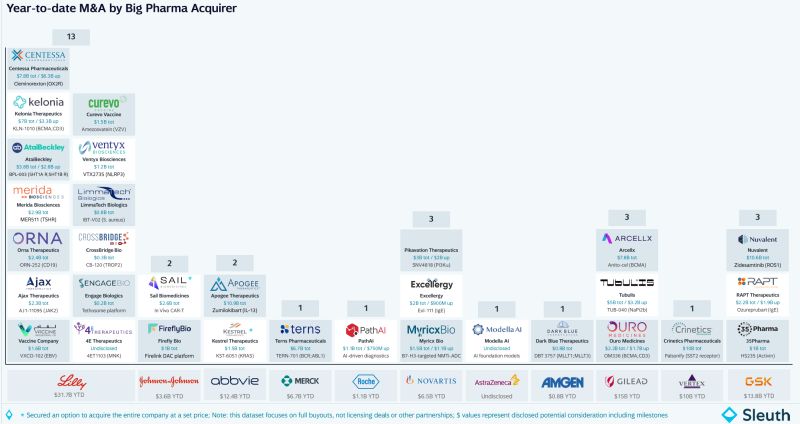
Download the Visual
Top pharma made 29 buyouts worth about $98 billion in 2026, with room for more
The top 15 (T15) pharma companies still have plentiful acquisition capacity, but it is unevenly matched to their need for new revenue. Sleuth’s map counts 29 buyouts by these companies in 2026 through early September, worth about $98 billion in disclosed potential deal value, and Lilly leads with 13, or 45% of them. Based on second-quarter earnings, the median T15 company has about $24 billion of acquisition capacity.
Buyers are concentrating on oncology, I&I and early-stage assets
Oncology and I&I account for about two-thirds of transactions and 72% of deal value. Modality is more distributed: small molecules and antibody-based therapies account for about 34% each, followed by vaccines and cell therapy at 10% each and target-enabling technology at 10%. Only three targets, Arcellx, Nuvalent and Crinetics, had a lead asset under regulatory review or already marketed at announcement, and Phase 1 was the most common stage at the time of the deal (about 28%). Novo Nordisk, Pfizer, BMS and Sanofi had announced no buyouts this year, though all have done major recent deals or been active through licensing.
Most of this year’s acquisitions are early bets, not bought revenue.
Acquisition capacity is plentiful but unevenly matched to need
High-capacity companies, above $50 billion, are Lilly, Johnson & Johnson, Roche and Novo Nordisk. Novartis, AstraZeneca, Sanofi, BMS, Gilead, AbbVie and Vertex sit in the medium tier at $15 billion to $50 billion, and GSK, Pfizer, Amgen and Merck in the lower tier below $15 billion. Johnson & Johnson has the clearest combination of need and capacity, with about $40 billion of revenue exposed to loss of exclusivity over the next five years, about 20% of it covered by acquired peak sales and about $80 billion of capacity. Merck has about $47 billion exposed, mostly Keytruda, about 25% covered and only about $12 billion of capacity.
Companies with similar replacement needs can run very different BD strategies once internal growth and licensing are factored in, so capacity alone does not predict who buys next.
Lilly is operating like a venture investor
Lilly gained early visibility into how large GLP-1 sales would become, creating a free-cash-flow engine into the 2030s. That gives it room to place many more bets across early-stage programs, technologies and modalities. Pharma has always been structured like a venture portfolio, but Lilly is operating like one.
Its eventual loss-of-exclusivity cliff will be unprecedented, and the bet is that investing aggressively now builds a revenue base broad enough to grow beyond it, a strategy Sleuth traces in Eli Lilly’s 26 deals in 2026.
How Sleuth built this analysis
Deal scope
The map counts buyouts announced by the T15 pharma companies in 2026 through September 4, using disclosed potential deal value. Licensing and collaboration deals are not counted. The map also shows two options to acquire a whole company at a set price, Johnson & Johnson’s on Sail Biomedicines and AbbVie’s on Kestrel Therapeutics, which are not among the 29 buyouts.
Acquisition capacity
Capacity is estimated from second-quarter 2026 earnings and a leverage ceiling of about three times gross debt to EBITDA. It is a directional estimate of balance-sheet room, not a forecast of spending.
Deals announced through September 4, 2026. Capacity based on second-quarter 2026 financials.
Frequently asked questions about pharma M&A in 2026
How many acquisitions have top pharma companies announced in 2026?
The top 15 pharma companies announced 29 buyouts in 2026 through September 4, worth about $98 billion in disclosed potential value, plus two options to acquire a whole company at a set price. Lilly accounted for 13.
Which pharma companies have the most room for acquisitions?
Lilly, Johnson & Johnson, Roche and Novo Nordisk each have more than $50 billion of estimated capacity. The T15 median is about $24 billion.
Which pharma companies need acquisitions most?
Johnson & Johnson combines about $40 billion of revenue exposed to loss of exclusivity with about $80 billion of capacity. Merck has about $47 billion exposed, mostly Keytruda, but only about $12 billion of capacity.
What stage are pharma acquisition targets at?
Phase 1 was the most common stage at announcement, at about 28% of deals, and only three targets had a lead asset under regulatory review or on the market.