Cardiometabolic RNA Competitive Map: 84 Programs Across 9 Targets
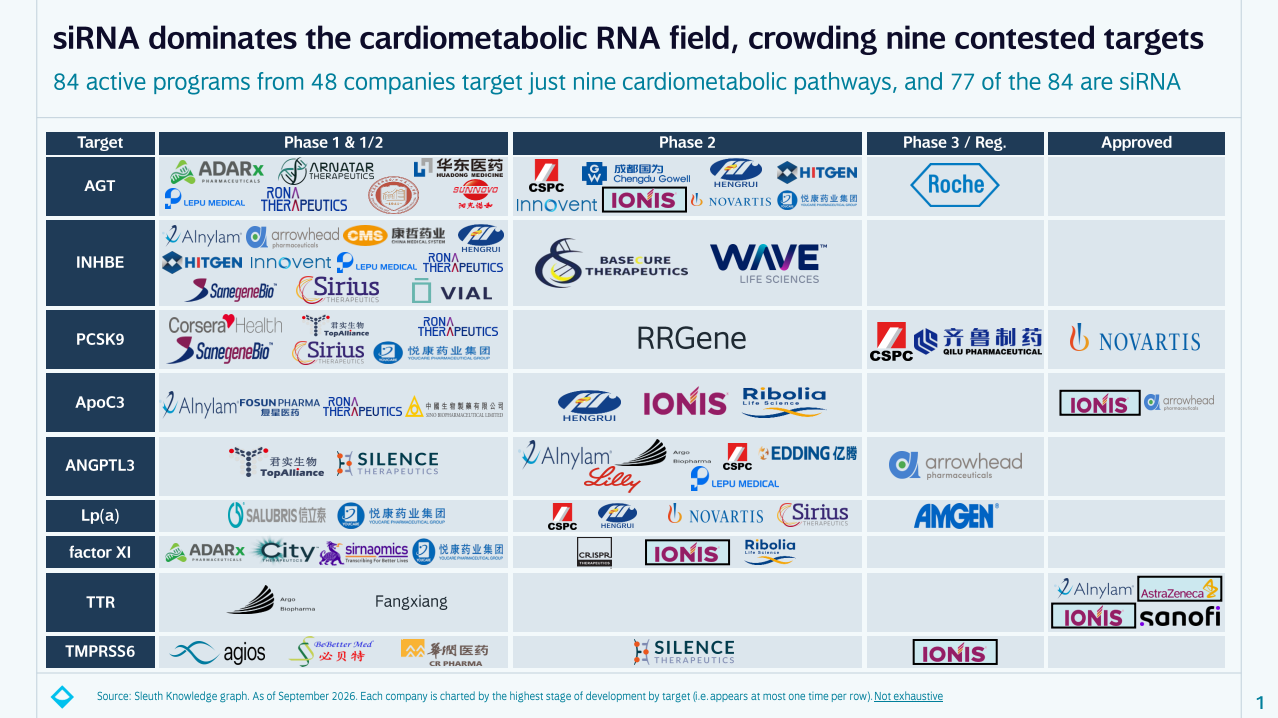
84 active cardiometabolic RNA programs from 48 companies mapped across 9 contested targets and development stage. ~92% are siRNA, driven by GalNAc liver delivery. 7 of 9 pathways already have Phase 3+ programs, making durability and outcomes data the differentiators.

Download the Visual
We mapped 84 active programs from 48 companies targeting 9 popular cardiometabolic pathways — about 40% of the total active RNA pipeline. The concentration is stark: ~92% of programs are siRNA versus just 8% ASO. That split is mostly delivery-driven. GalNAc has made liver delivery efficient and repeatable, and every target on this map is largely produced there. Once this core delivery platform is in place, a company can swap the RNA sequence fairly easily, so clinical validation leads to fast followers.
For 7 of 9 pathways, programs have already reached Phase 3 or beyond. That crowding is making durability, convenience (twice-yearly dosing is increasingly the entry ticket), and outcomes data much more important to differentiate. AGT leads in breadth with programs from Roche (approved) through a dense Phase 1–2 field. PCSK9, ApoC3, ANGPTL3, and Lp(a) each have multiple Phase 2–3 competitors. TTR is the most mature, with four approved products across Alnylam, AstraZeneca, Ionis, and Sanofi.
But showing target activity does not guarantee a meaningful clinical benefit on the other side. Novartis’ Pelacarsen lowered Lp(a) but did not reduce CV events in an 8,000+ patient Phase 3. AstraZeneca/Ionis’ Eplontersen reduced TTR but missed the overall Phase 3 primary endpoint in ATTR-CM. Ionis’ Olezarsen reduced triglycerides by 64% and remnant cholesterol by 72% but did not change non-calcified coronary plaque at 12 months. These are all ASO readouts, which mostly highlights that it is a more mature modality that reached outcomes-stage testing earlier. siRNA programs will face the same question: does deep, durable knockdown actually produce a benefit on top of modern standard of care?
Looking ahead, the next battleground is extrahepatic delivery — reaching the heart, muscle, CNS, and other tissues beyond the liver. The cardiometabolic RNA field is liver-locked by design, and breaking out of that constraint will define the next generation of programs.