
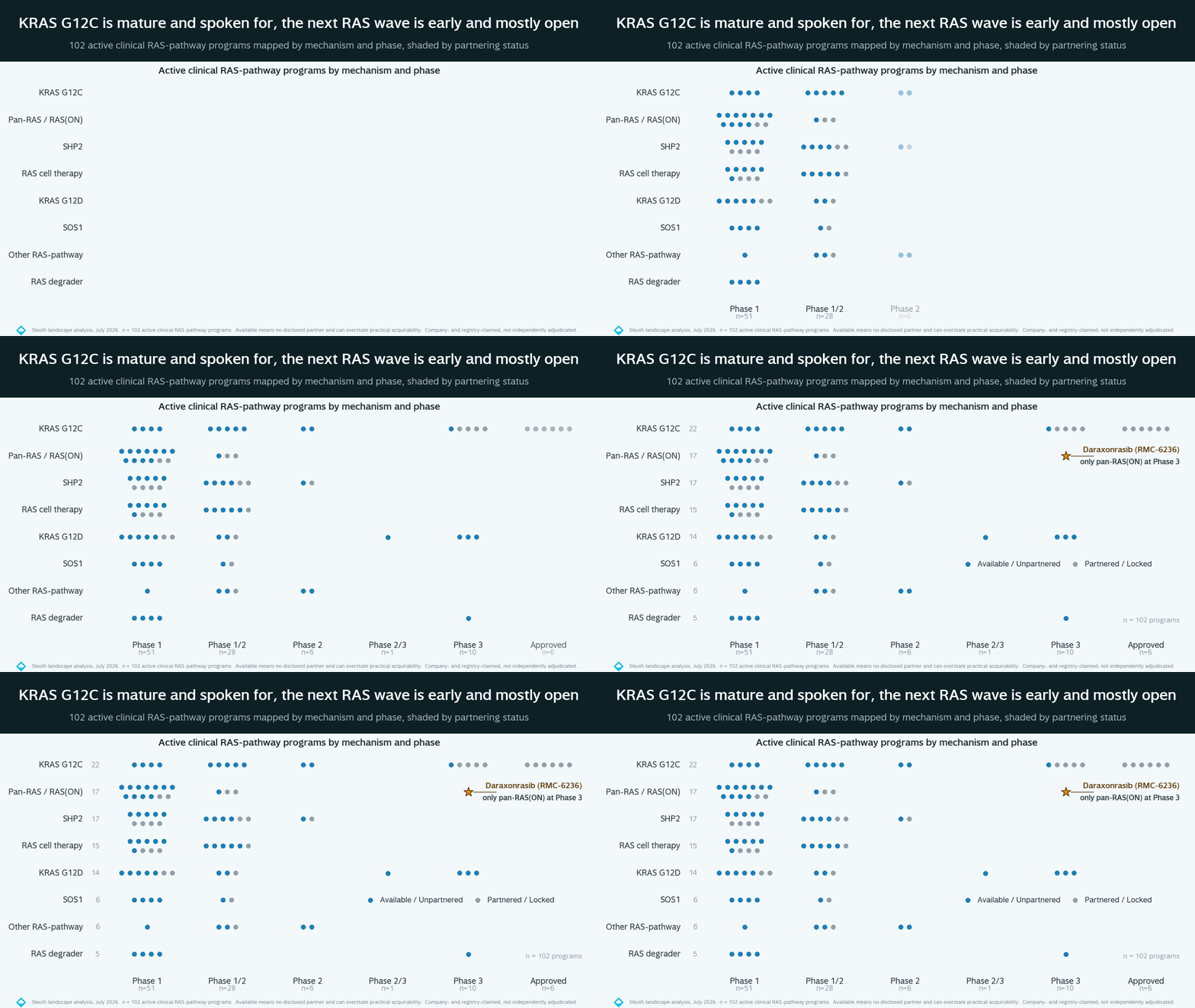
Download the Visual
Daraxonrasib proved pan-RAS can work, and few late-stage RAS assets are left to buy
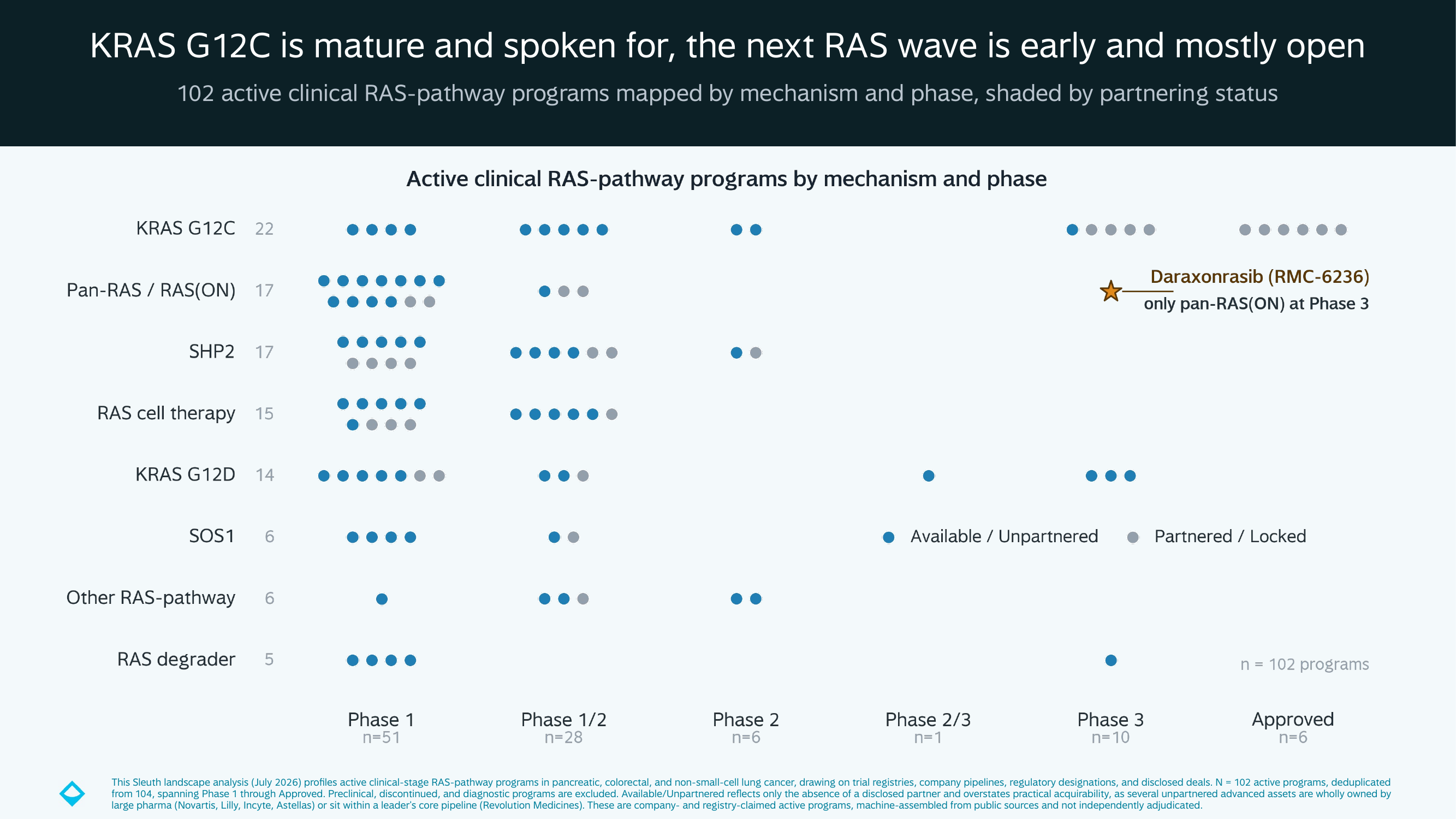
Daraxonrasib’s survival win in pancreatic cancer reset the bar for RAS drugs well beyond KRAS G12C, and the late-stage RAS assets a buyer can still get are few. Sleuth’s July 2026 map counts 102 active clinical RAS-pathway programs in pancreatic, colorectal and non-small cell lung cancer: 23 are at Phase 2 or beyond, and 11 of those have no disclosed partner.
In the Phase 3 RASolute 302 trial, presented at the ASCO 2026 plenary and covered in Sleuth’s ASCO 2026 abstract analysis, Revolution Medicines’ pan-RAS(ON) inhibitor daraxonrasib (RMC-6236) nearly doubled median overall survival in previously treated metastatic pancreatic cancer, from 6.7 months with chemotherapy to 13.2 months.
KRAS G12C is the mature class, and it is mostly spoken for
KRAS G12C has 22 clinical programs on the map, including six approved drugs and five more in Phase 3. All six approved drugs and four of the five Phase 3 programs are partnered or otherwise locked. Of the 12 G12C programs without a disclosed partner, 11 are in Phase 1 to Phase 2.
A buyer entering G12C now gets a follower into a class with six approved drugs, not a first-in-class position.
The next RAS wave is larger, and almost all of it is early
Four newer classes hold 63 programs, nearly three times the G12C count: pan-RAS/RAS(ON) and SHP2 with 17 each, RAS cell therapy with 15 and KRAS G12D with 14. Of those 63, 56 are in Phase 1 or Phase 1/2, and 44 have no disclosed partner. Daraxonrasib is the only pan-RAS(ON) program at Phase 3. KRAS G12D has the most late-stage programs of the newer classes, with three Phase 3 programs and one at Phase 2/3, none with a disclosed partner. The map also counts six SOS1 programs, six other RAS-pathway programs and five RAS degraders, one of them at Phase 3.
After this analysis, on August 26, 2026, the FDA approved daraxonrasib as Rasonque for adults with metastatic pancreatic adenocarcinoma who have had at least one prior systemic therapy or cannot receive multiagent therapy. On September 28, 2026, Merck licensed SPR2015, a preclinical oral KRAS G12D (ON) inhibitor from Shanghai-based SciBrunch Therapeutics, for $400 million upfront and up to $2.13 billion in total.
Daraxonrasib did not only validate pan-RAS. It started a clock on everything behind it, and Merck’s deal shows buyers already reaching into preclinical G12D for a position.
“Unpartnered” overstates what is actually available
Of the 23 programs at Phase 2 or beyond, 11 have no disclosed partner, not counting daraxonrasib: five at Phase 2, one at Phase 2/3 and five at Phase 3. Several of those are wholly owned by Novartis, Lilly, Incyte or Astellas, or sit in Revolution Medicines’ core pipeline, so no partner is needed or likely. Strip them out, and the partnerable late-stage set shrinks to a short list, mostly China-origin assets and small biotechs.
For BD teams, the real RAS shortlist is set by ownership, not by partner flags, and it is shorter than the count of 11 suggests. How China-origin assets reach Western buyers is covered in Sleuth’s China biopharma landscape.
How Sleuth built this analysis
Which programs are counted
Active clinical-stage RAS-pathway programs in pancreatic, colorectal and non-small cell lung cancer, from Phase 1 through approval, drawn from trial registries, company pipelines, regulatory designations and disclosed deals and deduplicated from 104 entries to 102. Preclinical, discontinued and diagnostic programs are excluded. Programs are company- and registry-claimed, not independently adjudicated.
What “unpartnered” means
Unpartnered means only that no partner has been disclosed. It overstates practical acquirability, because several unpartnered advanced assets are wholly owned by large pharma or sit in a leader’s core pipeline.
Program counts, phases and partnering status are as of July 2026. The daraxonrasib approval and the Merck and SciBrunch deal are current as of September 2026. This page is a dated snapshot.
Frequently asked questions about the RAS inhibitor landscape
How many KRAS and RAS drugs are in clinical development?
Sleuth’s July 2026 map counts 102 active clinical RAS-pathway programs in pancreatic, colorectal and non-small cell lung cancer, led by KRAS G12C (22), pan-RAS/RAS(ON) (17), SHP2 (17), RAS cell therapy (15) and KRAS G12D (14).
Is daraxonrasib approved?
Yes. On August 26, 2026, the FDA approved daraxonrasib (Rasonque) for metastatic pancreatic adenocarcinoma after prior systemic therapy, or when multiagent therapy is not an option, after it raised median overall survival to 13.2 months from 6.7 months with chemotherapy in the Phase 3 RASolute 302 trial.
How many KRAS G12C drugs are approved?
Six, in Sleuth’s July 2026 map of pancreatic, colorectal and lung cancer, with five more G12C programs in Phase 3. All six approved drugs and four of the five Phase 3 programs are partnered or otherwise locked.
Which late-stage RAS assets are still available to partner?
As of July 2026, 11 of the 23 RAS-pathway programs at Phase 2 or beyond had no disclosed partner, not counting daraxonrasib, but several are wholly owned by large pharma or by Revolution Medicines. The partnerable set is a short list, mostly China-origin assets and small biotechs.