

Download the Visual
Big pharma’s early oncology bets are spread wide but concentrated by modality
About half of the preclinical oncology programs at 12 large pharma companies pursue a target or target combination that none of the other 11 is working on. Sleuth’s September 2025 analysis of more than 500 of their programs also finds emerging modalities clustered in a few companies, even though most of the 12 keep at least a foothold in cell therapy, radiopharma and ADCs.
The 12 are AbbVie, Amgen, Astellas, AstraZeneca, Bristol Myers Squibb (BMS), Daiichi Sankyo, Eli Lilly, Johnson & Johnson, Merck, Novartis, Pfizer and Roche. Preclinical pipelines give an early read on emerging targets, modality shifts and where competitors concentrate resources.
Half of the programs chase targets no peer is pursuing
Roughly 25% of the programs pursue a single target that no other company in the group is working on, and another 25% a target combination no peer shares. Biotechs originate most new drugs, yet big pharma still runs a long tail of independent early exploration.
Where programs do cluster, with four or more in the peer set, most of those targets have limited late-stage development anywhere in the industry. Examples include MCL-1, SMARCA2, TEAD, mesothelin (MSLN) and GPC3.
Crowding inside big pharma’s early pipelines is not clinical validation: many shared bets are on targets the industry has yet to prove out.
Small molecules dominate, and emerging modalities cluster in a few companies
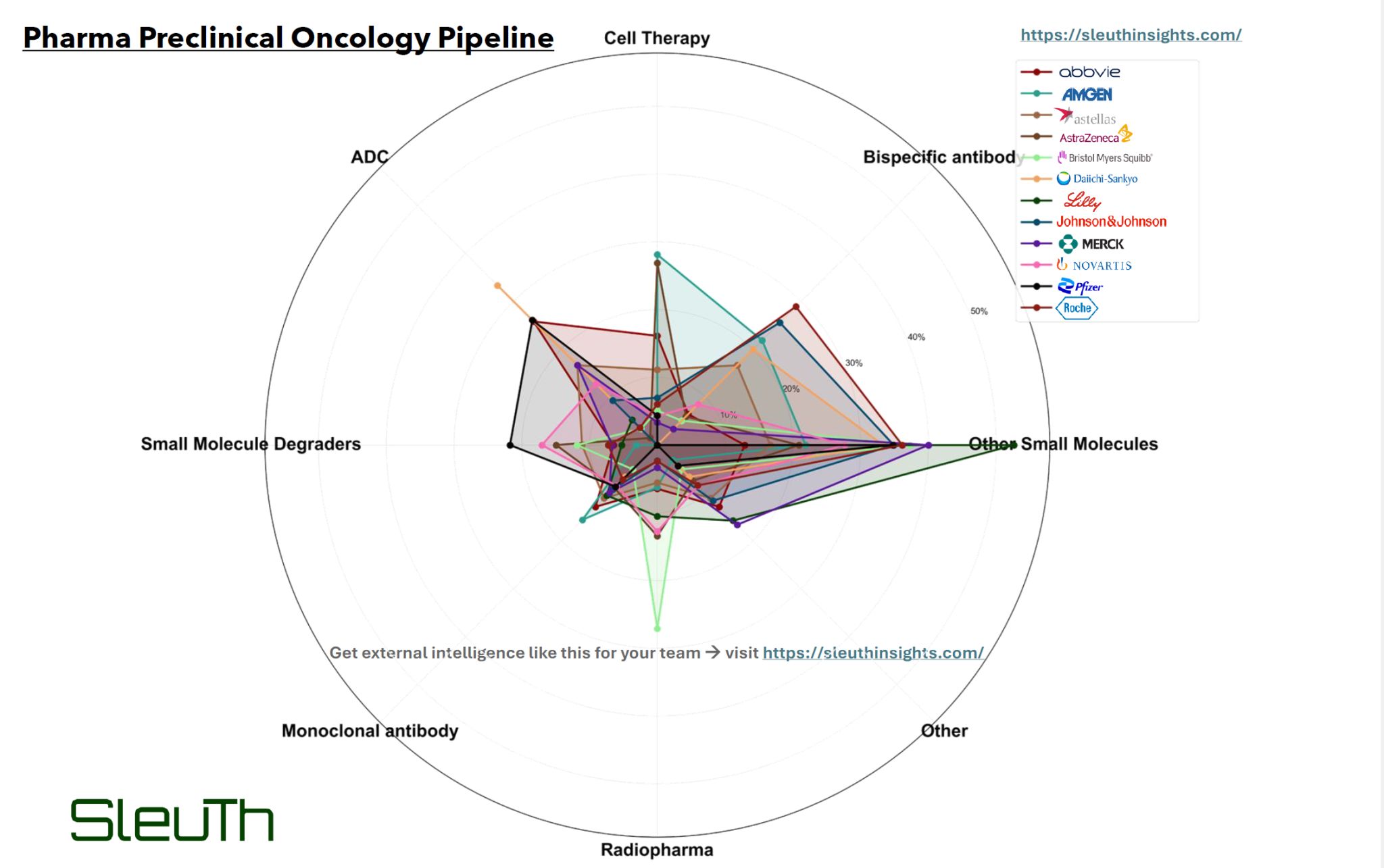
Across all 500+ programs, conventional small molecules make up the largest share, with bispecific antibodies, cell therapy, ADCs, radiopharmaceuticals and degraders each holding a smaller slice. Small molecules other than degraders are the largest part of most of the 12 pipelines, and about half of Lilly’s.
Concentration by company is sharper than the overall split suggests:
- About 75% of the group’s preclinical radiopharma programs sit at three companies: AstraZeneca, BMS and Novartis. Radiopharma makes up roughly a quarter of BMS’s own preclinical oncology pipeline, the highest share of any of the 12.
- About 75% of the group’s preclinical cell therapy programs sit at four companies: AstraZeneca, Amgen, Roche and AbbVie. Cell therapy makes up roughly a quarter of both Amgen’s and AstraZeneca’s pipelines.
- Merck alone holds about 40% of the group’s preclinical trispecific oncology programs, while Roche, including Genentech, leads in bispecific antibodies.
- ADCs make up about a third of Daiichi Sankyo’s preclinical oncology pipeline, and degraders about a fifth of Pfizer’s, the highest shares for those modalities in the group.
Most companies still hedge: only two of the 12 lack any cell therapy or radiopharma programs, and only one lacks ADCs.
Big pharma keeps broad modality coverage for optionality while concentrating resources where it sees an advantage. The same 12 companies’ revenue outlook and modality shifts are covered in Sleuth’s look at pharma oncology backbones and modality-agnostic combinations.
Program counts and shares come from Sleuth’s September 2025 analysis of the 12 companies’ preclinical oncology pipelines; company modality shares are approximate readings of its chart. This page is a dated snapshot.
Frequently asked questions about pharma preclinical oncology pipelines
Which pharma companies are in Sleuth’s preclinical oncology analysis?
Twelve large oncology players: AbbVie, Amgen, Astellas, AstraZeneca, BMS, Daiichi Sankyo, Eli Lilly, Johnson & Johnson, Merck, Novartis, Pfizer and Roche. Sleuth’s September 2025 analysis covered more than 500 of their preclinical oncology programs.
How many of pharma’s preclinical oncology programs are unique?
About half, in Sleuth’s September 2025 analysis: roughly 25% pursue a single target and 25% a target combination that no other company in the 12-company group is pursuing.
Which pharma companies lead in preclinical radiopharma and cell therapy?
As of September 2025, about 75% of the 12-company group’s preclinical radiopharma programs sat at AstraZeneca, BMS and Novartis, and about 75% of its preclinical cell therapy programs at AstraZeneca, Amgen, Roche and AbbVie.
Which modality dominates pharma’s preclinical oncology pipelines?
Conventional small molecules, the largest share of the 500+ programs in Sleuth’s September 2025 analysis and about half of Lilly’s preclinical oncology pipeline.
