
Download the Visual
Wainua’s miss moved the ATTR-CM bar to benefit on top of a stabilizer
Wainua’s miss didn’t prove that silencing transthyretin (TTR) fails in the heart. It moved the bar: in transthyretin amyloid cardiomyopathy (ATTR-CM), a TTR-lowering drug now has to add benefit for patients already on a stabilizer. On July 9, 2026, AstraZeneca and Ionis reported that Wainua (eplontersen) missed the primary endpoint of CARDIO-TTRansform, the largest ATTR-CM trial yet, which tested exactly that question; in the full population, the answer was no.
The prize now goes to whichever therapy can beat a stabilizer-treated patient who already feels well.
CARDIO-TTRansform tested an add-on, not silencing itself
CARDIO-TTRansform was designed against a placebo arm that changed while it ran. Stabilizers, first tafamidis and then acoramidis, became standard of care, and 57% of patients were on one at baseline, with another 24% starting one during the study, according to Ionis. A prespecified subgroup of patients on eplontersen alone reached nominal significance (hazard ratio 0.71), while patients already on a stabilizer showed no treatment effect.
The result says less about whether TTR silencing works than about how much it adds for a patient who is already stabilized.
Only 2 of 18 TTR-directed assets test a pure add-on to a stabilizer
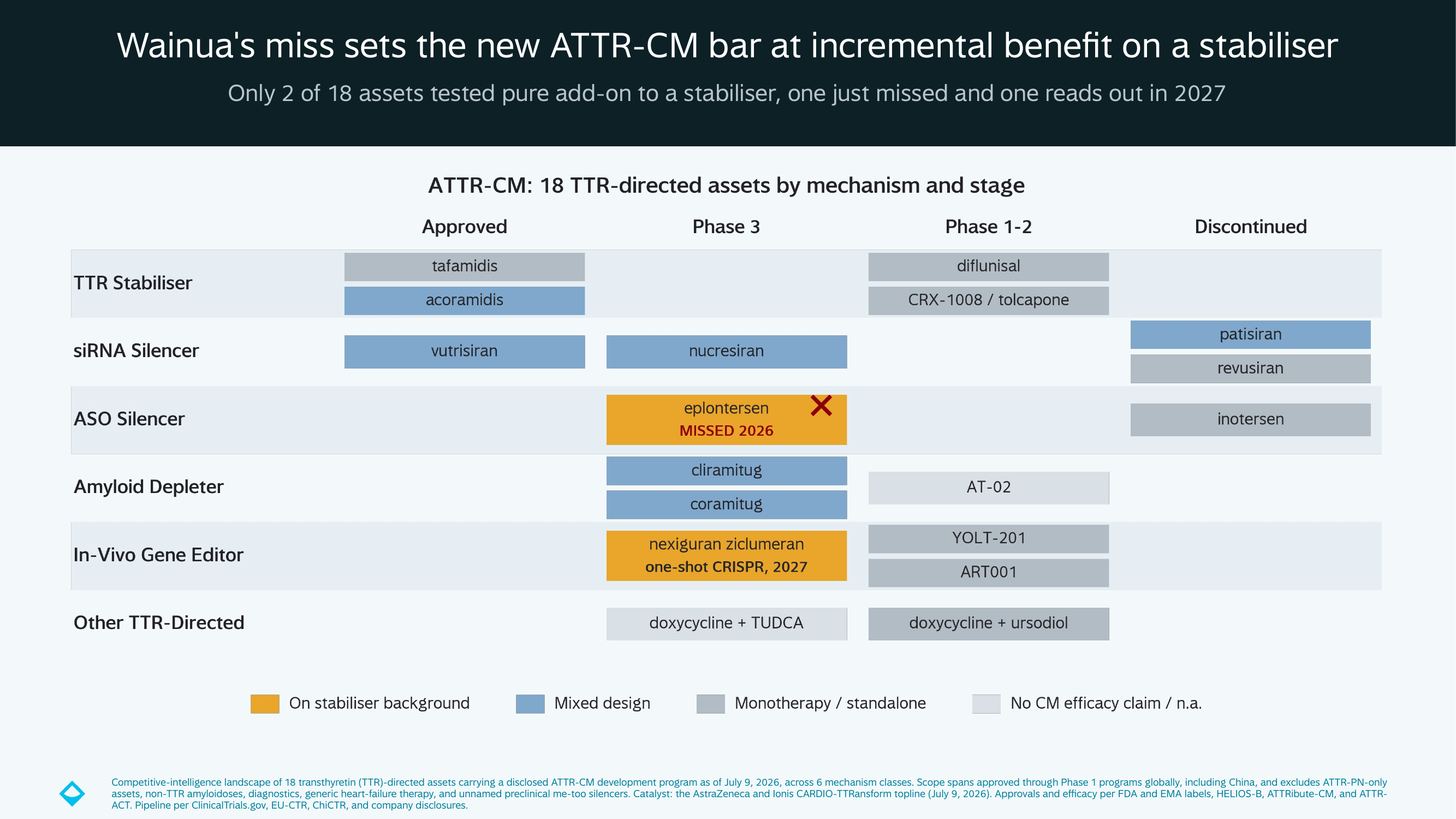
As of July 9, 2026, Sleuth mapped 18 TTR-directed assets with a disclosed ATTR-CM program, across six mechanism classes: stabilizers, siRNA silencers, ASO silencers, amyloid depleters, in-vivo gene editors and other TTR-directed approaches. Three are approved (tafamidis, acoramidis and vutrisiran), six are in Phase 3, six are in Phase 1 or 2, and three have been discontinued in ATTR-CM (patisiran, revusiran and inotersen).
Only two were designed on a stabilizer background. One is eplontersen, which has now answered the add-on question. The other is Intellia and Regeneron’s one-shot CRISPR edit, nexiguran ziclumeran (nex-z), which Sleuth’s map expected to read out in 2027. Six assets use a mixed design, with and without a stabilizer, including vutrisiran, Alnylam’s next-generation siRNA nucresiran and the Phase 3 amyloid depleters cliramitug and coramitug. Eight are tested as monotherapy or standalone, and two carry no cardiomyopathy efficacy claim.
Every drug approved in ATTR-CM so far won as the stabilizer itself or through a mixed design that held up with and without one. Vutrisiran did this in HELIOS-B, where its benefit on death and recurrent cardiovascular events held with and without tafamidis, and the FDA approved it for ATTR-CM in March 2025.
For the Phase 3 field, trial design now matters as much as mechanism: a TTR-directed drug has to show benefit in patients a stabilizer already treats. Sleuth’s RNA Intelligence Report, Q3 2026 places the eplontersen miss among five 2026 readouts that hit the molecular target but missed the clinical endpoint.
The asset map is as of July 9, 2026, the day of the CARDIO-TTRansform topline, and is a dated snapshot. It covers approved through Phase 1 programs globally, including China, and excludes ATTR polyneuropathy-only assets and unnamed preclinical silencers.
Frequently asked questions about ATTR-CM after Wainua
Why did Wainua (eplontersen) miss in CARDIO-TTRansform?
In July 2026, AstraZeneca and Ionis reported no significant benefit in the overall ATTR-CM population, where 57% of patients were on a stabilizer at baseline. Patients on eplontersen alone reached nominal significance, but those on a stabilizer showed no effect.
How many TTR-directed drugs are in development for ATTR-CM?
As of July 9, 2026, Sleuth mapped 18 TTR-directed assets with an ATTR-CM program across six mechanism classes: three approved, six in Phase 3, six in Phase 1 or 2 and three discontinued. Only eplontersen and nex-z were designed as pure add-ons to a stabilizer.
Which drugs are approved for ATTR-CM?
As of July 2026, three: tafamidis and acoramidis, both TTR stabilizers, and the siRNA silencer vutrisiran, which the FDA approved for ATTR-CM in March 2025 based on HELIOS-B. Eplontersen is approved in ATTR polyneuropathy but not in ATTR-CM.
What are the next major ATTR-CM readouts?
In Sleuth’s July 9, 2026 map, the next test of the stabilizer add-on question is Intellia and Regeneron’s one-shot CRISPR therapy nex-z, in the Phase 3 MAGNITUDE trial, which the map expected to read out in 2027. Alnylam’s nucresiran and the amyloid depleters cliramitug and coramitug are also in Phase 3.