China and the West Are Building Different Obesity Drugs
1,200+ obesity assets mapped from preclinical through approved. Chinese sponsors are building better incretins. Western sponsors are solving what incretins can’t.

Download the Report
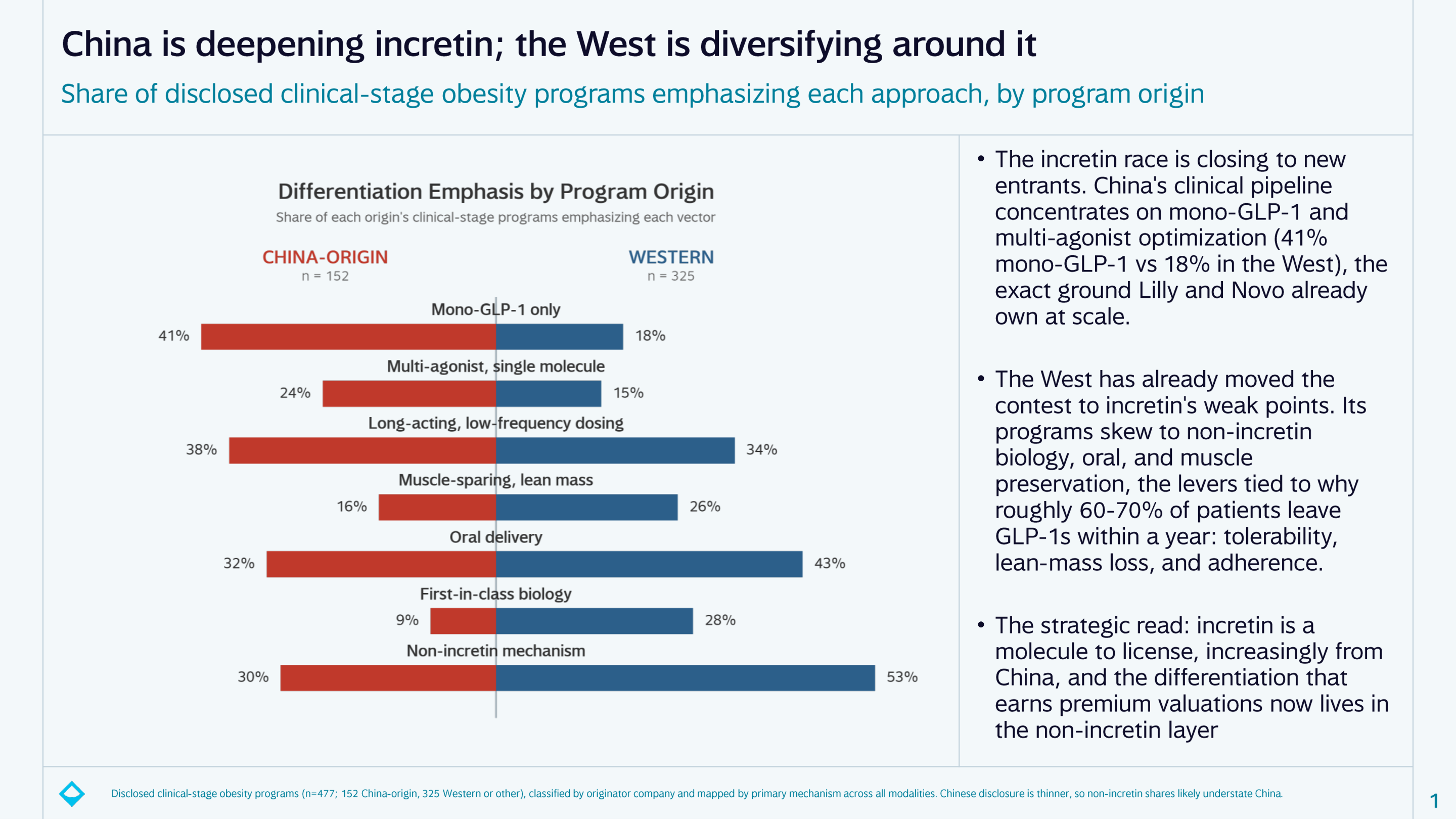
Obesity is amongst the most crowded pipelines in biotech, but sponsors in China and the West are building very different assets. I had Sleuth map 1,200+ active obesity assets from preclinical through approved and segment by primary development strategy and program origin. Two things stood out:
1. Chinese and Western drug development is indexing on different strategies
Amongst clinical stage assets (~470 programs), disclosed China-origin assets lean into “better incretins”, such as multi-agonist stacking or long-acting dosing. These stay within the traditional GLP-1 world.
Western programs tend to lean the other way, building toward what incretins don’t solve, to own the patients incretins struggle to keep (given ~60+% of patients discontinue GLP-1s within a year):
- Muscle-sparing weight loss (this is filling fast: Lilly / Versanis, Scholar Rock, Regeneron, GSK / Shian, China already in via RNAi, etc.)
- Oral delivery, for adherence and access
- Tolerability, the single biggest reason patients walk away
An important caveat: Sleuth does pull in proprietary or hard-to-source Chinese data, but overall program disclosure is a lot thinner – so the non-incretin gap is directional rather than exact.
2. The white space concentrates in the non-incretin world, but it’s uneven
If we zoom into the non-incretin programs and map them by (a) how clinically proven the science is and (b) how China-concentrated the activity is, we see:
- Muscle/activin and amylin are the crowded giants, with dozens of programs each
- The most clinically advanced pockets, FGF21, thyroid receptor beta, and bile-acid, sit high on Chinese origin, so the West would enter those as a fast-follower
- The genuinely open, China-light pockets are smaller and earlier: MC4R/melanocortin, NPY/PYY, PTP1B, NLRP3, mitochondrial uncouplers
That last point is important for positioning – because the pipeline activity is preclinical, it’s critical to map data points scattered across regional conferences, patents and company disclosures. If you’re a biotech CEO shaping a next-gen obesity asset, it’s useful to see the field in aggregate, but more important to personalize that analysis to your program. That’s the kind of positioning work we dig into.