
Download the Report
Depression R&D is a barbell: approvals locked on monoamines, a pipeline scattered across 130 mechanisms
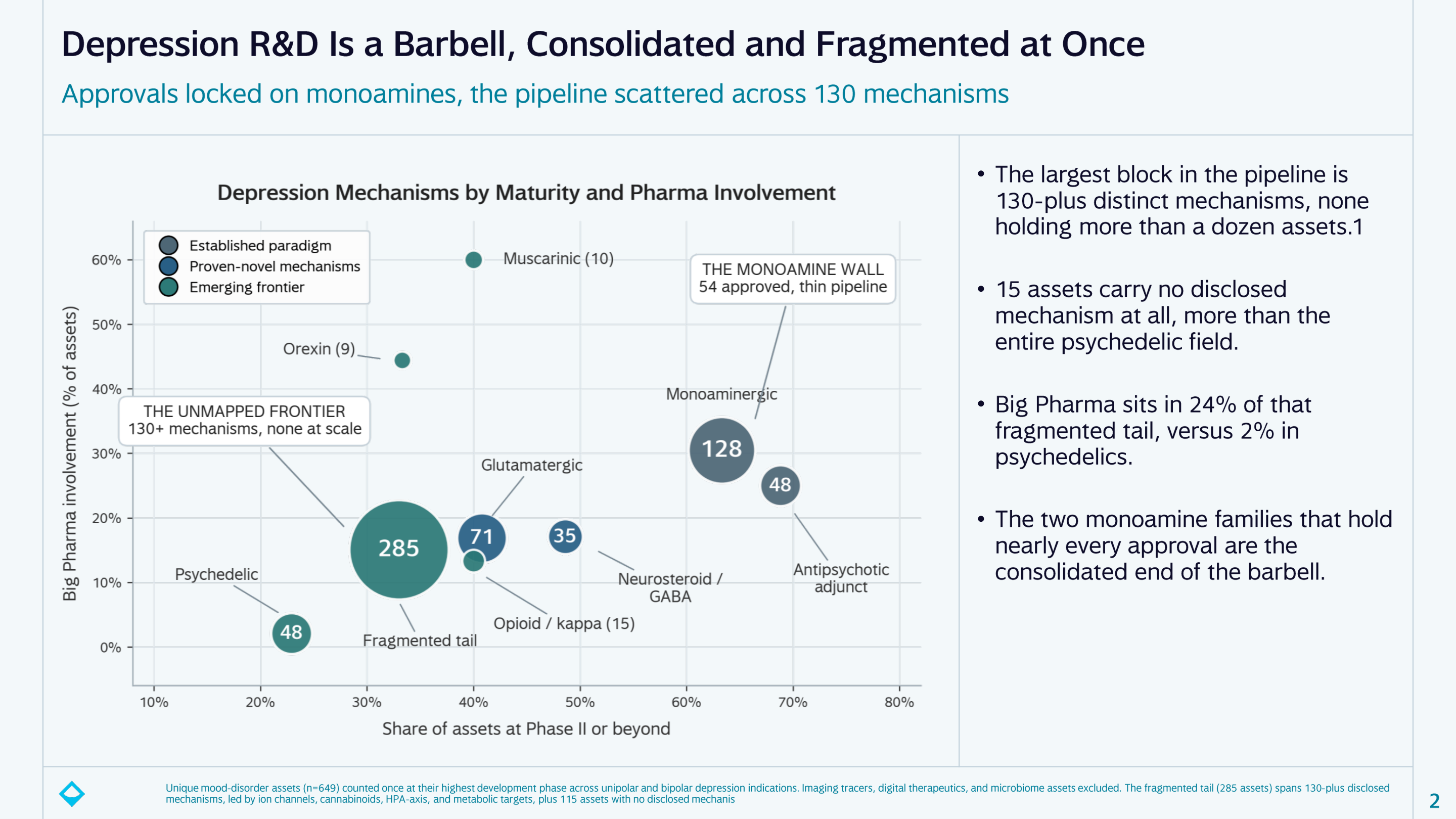
Depression looks crowded, but it is really two markets: approved drugs cluster on monoamine pharmacology, while the pipeline splinters across many mechanisms instead of converging on a new one. Sleuth’s June 2026 map of 649 depression assets across unipolar and bipolar indications finds monoamine drugs behind 80 of 108 approvals, while the pipeline’s largest block is a 285-asset tail spread over more than 130 mechanisms, none with more than a dozen assets.
For a sponsor, the strategic question is which end of the barbell its program sits on, and which indication gives it the cleanest wedge.
Monoamines hold three-quarters of approvals, and only four modern drugs broke the pattern
Of the 108 approved depression drugs in the June 2026 map, 54 are monoaminergic and 26 are antipsychotic adjuncts, so monoamine-based mechanisms carry 74% of approvals. The rest include 16 other drugs and 7 neurosteroid or GABA drugs, five of them legacy combinations and anticonvulsants. Psychedelics and orexin drugs have no approvals despite active clinical pipelines. No psychedelic had been approved by late September 2026: on September 24, 2026, Compass Pathways said it remained on track to complete its rolling FDA application for COMP360 psilocybin in the fourth quarter.
Four modern approvals broke the monoamine paradigm: esketamine and Auvelity (glutamate), and zuranolone and brexanolone (neurosteroid). All four share a rapid-relief claim, days to a week, against the four to eight weeks typical of SSRIs and SNRIs. Brexanolone’s FDA approval was withdrawn in April 2025: its 60-hour IV infusion and restricted REMS left it unworkable next to oral zuranolone.
Faster onset is a real differentiator in depression, but brexanolone shows it fails without a workable care model.
The rest of the pipeline is splintering, not converging
The 285-asset fragmented tail is led by ion channels, cannabinoids, HPA-axis and metabolic targets. It includes 115 assets with no disclosed mechanism at all, a group larger than the entire 48-asset psychedelic pipeline. About a third of the tail is at Phase 2 or beyond. Big pharma is involved in about 15% of the tail’s assets, against about 2% of psychedelic assets.
Between the two ends sit glutamatergic (71 assets), neurosteroid and GABA (35), kappa-opioid (15), muscarinic (10) and orexin (9) classes. Muscarinic drugs draw the most big pharma involvement, about 60% of assets. The monoamine end, 128 monoaminergic assets and 48 antipsychotic adjuncts, is the most mature, with roughly two-thirds at Phase 2 or beyond.
Many sponsors are willing to take on target-biology risk, which makes sense given the limits of the canonical approaches. Sleuth’s review of novel depression mechanisms in trials shows how often that risk shows up after a Phase 2 win.
Inside glutamate, the race is about delivery, not the target
Glutamate has 39 clinical-stage assets, and 24 of them are at Phase 2, the class’s bottleneck. Twelve are ketamine or esketamine in another form, such as racemic, R-enantiomer, oral or intranasal versions (four in Phase 1, six in Phase 2, one in Phase 3 and one approved), competing on how the drug is dosed rather than on biology. The differentiation bet sits with ten programs, six AMPA potentiators and four GluN2B negative allosteric modulators, that aim for ketamine’s speed without its dissociation.
In glutamate, tolerability and route of delivery now decide position more than the choice of target.
Postpartum and treatment-resistant depression are two different games
Postpartum depression (PPD) is close to a neurosteroid monoculture: 14 of its 25 programs share one mechanism, so price and convenience decide, and the win is a better oral neurosteroid in a commoditizing field. Treatment-resistant depression (TRD) has no settled mechanism. Its 58 programs scatter across other novel mechanisms (19), glutamate and NMDA (18), psychedelics (11), monoaminergic and anti-inflammatory drugs (4 each), and one neurosteroid and one antipsychotic.
TRD offers open biology and the deepest unmet need, against one of the toughest endpoints in the field. Across both, the positioning wins sit in the burden a program removes that incumbents cannot: route, tolerability, monitoring, or rapid relief without dissociation.
How Sleuth built this analysis
Which assets are counted
The 649 assets are unique mood-disorder assets across unipolar and bipolar depression indications, each counted once at its highest development phase. Imaging tracers, digital therapeutics and microbiome assets are excluded.
The approved set
The 108 approved drugs are unique assets approved in major depressive disorder and depressive disorder, excluding three approved digital therapeutics.
Glutamate and indication cuts
The glutamate view covers 39 clinical-stage assets, excluding 32 preclinical assets and four PET tracers. In the PPD and TRD comparison, 5-MeO-DMT agents count as psychedelics.
Asset counts, approvals and shares are as of June 2026; big pharma and Phase 2 shares are read from Sleuth’s chart and rounded. The COMP360 filing status is current as of September 2026. This page is a dated snapshot.
Frequently asked questions about the depression drug pipeline
How many depression drugs are in development?
Sleuth’s June 2026 map counts 649 unique depression assets across unipolar and bipolar indications. The largest block is a 285-asset tail spread over more than 130 mechanisms.
What share of approved depression drugs are monoamine-based?
About three-quarters. Of 108 approved depression drugs in the June 2026 map, 54 are monoaminergic and 26 are antipsychotic adjuncts, 80 in all.
Which depression drugs broke the monoamine paradigm?
Four modern approvals: esketamine, Auvelity, zuranolone and brexanolone, all with a rapid-relief claim. Brexanolone’s approval was withdrawn in April 2025, leaving oral zuranolone as the marketed neurosteroid as of June 2026.
