
Download the Visual
AML runs two pipelines, and the larger one is still unvalidated
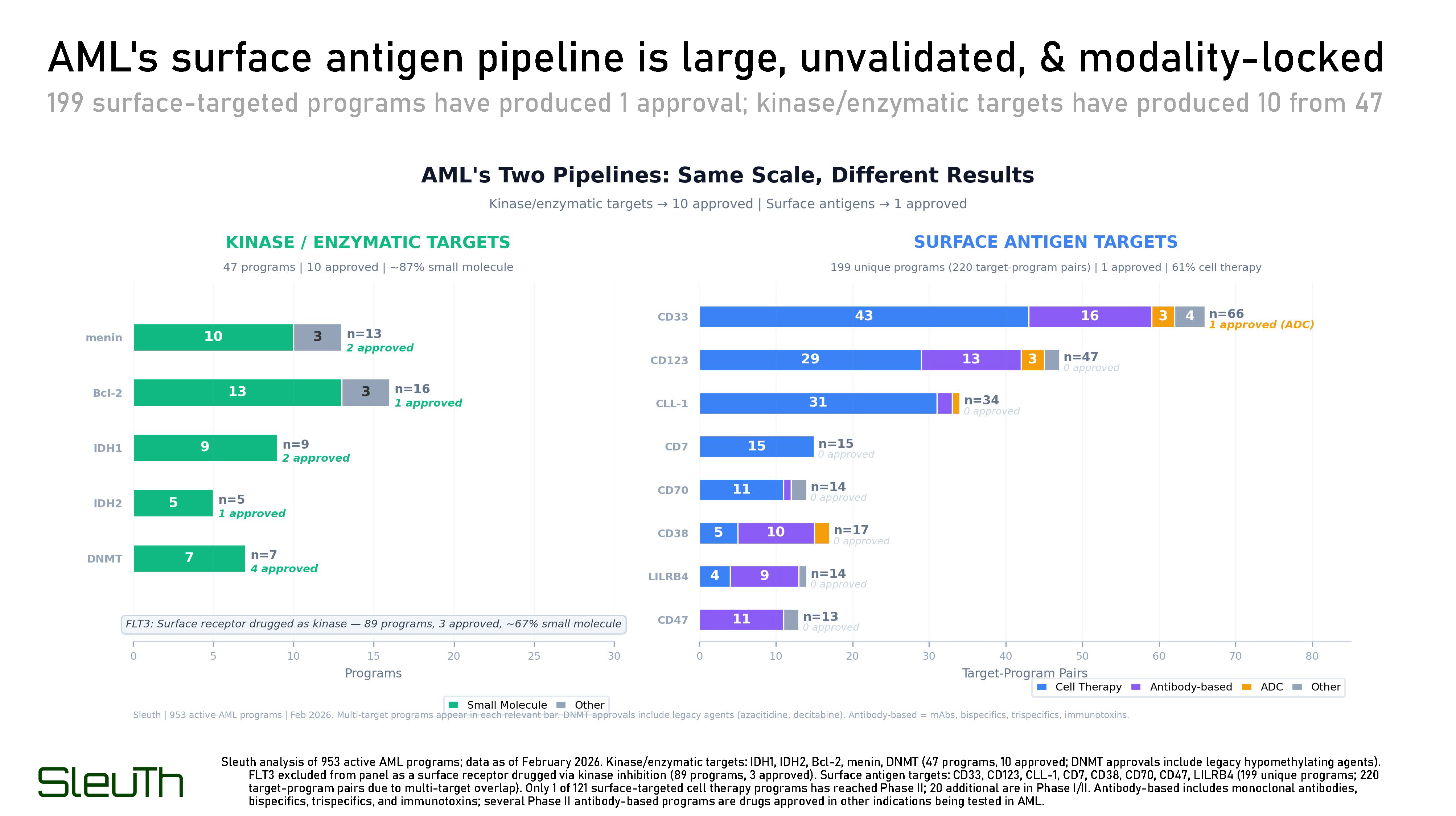
In acute myeloid leukemia (AML), 199 programs against eight surface antigen targets have produced one approval, while 47 programs against five kinase and enzymatic targets have produced 10. Sleuth’s February 2026 map of 953 active AML programs also finds that 61% of the surface antigen programs are cell therapies, a modality with no approved AML-targeted drug. The map splits the leading targets by how they are drugged: kinase and enzymatic (IDH1, IDH2, Bcl-2, menin and DNMT) and surface antigen (CD33, CD123, CLL-1, CD7, CD38, CD70, CD47 and LILRB4).
The surface antigen pipeline is large and early rather than failed, but overwhelmingly unvalidated.
Kinase and enzymatic targets produced most modern approvals
Kinase and enzymatic targets have produced most modern targeted AML approvals, from venetoclax (Bcl-2) to the menin inhibitors revumenib and ziftomenib. Counting multi-target programs under each target, menin has 13 programs and two approvals, Bcl-2 16 and one, IDH1 nine and two, IDH2 five and one, and DNMT seven and four, including legacy hypomethylating agents. About 87% of the 47 programs are small molecules.
FLT3 fits the same pattern: a surface receptor drugged as a kinase, with 89 programs, three approvals and about 67% small molecules, so Sleuth kept it out of the surface antigen panel.
In AML, intracellular kinase and enzyme targets have turned programs into approvals at a far higher rate than surface antigens: 10 from 47, against one from 199.
Most surface antigen programs are cell therapies, and just one of those has reached Phase 2
Of the 199 surface-targeted programs (220 target-program pairs, because some programs hit more than one target), 61% are cell therapies, most of them CAR-T. Across CD33, CD123, CLL-1 and CD7, 118 of 162 target-program pairs are cell therapies, including 31 of CLL-1’s 34 and all 15 of CD7’s. Antibody-based programs lead only at CD38 (10 of 17), LILRB4 (9 of 14) and CD47 (11 of 13).
This concentration is specific to surface antigens. Across the whole field, small molecules are the largest AML modality, with 347 of 957 programs in Sleuth’s January 2026 AML landscape, and cell therapy is second with 287.
Only one of the 121 surface-targeted cell therapy programs has reached Phase 2, and 20 more are in Phase 1/2, with none yet producing pivotal data. Some of this reflects timing: kinase targets have had decades of development, while surface antigen cell therapy is largely a post-2018 effort.
If the field treated these targets as early, it would be spreading its bets across modalities. Instead, risk is concentrated in a single unvalidated approach.
The modality behind the only surface-antigen approval gets a fraction of the investment
The only approved AML drug against these surface antigens is gemtuzumab ozogamicin (Mylotarg), an ADC against CD33. Yet the panel holds just nine surface-targeted ADC programs, three of them in Phase 2 or beyond, so cell therapies outnumber ADCs about 13 to 1. A handful of antibody-based programs have reached Phase 2, though several are drugs approved elsewhere being tested in AML.
As of September 2026, no cell therapy aimed at an AML target antigen has been approved. Orca Bio’s Tregzi, approved in June 2026, is a cell therapy used in stem cell transplants for blood cancers including AML, not an AML-targeted drug.
On AML surface antigens, investment has flowed to the least proven modality rather than to the one with an approval.
Program and approval counts are as of February 2026 and cover 953 active AML programs; multi-target programs appear under each relevant target. The 957-program landscape figures are from Sleuth’s January 2026 analysis. The Tregzi approval and the status of AML cell therapies are current as of September 2026.
Frequently asked questions about AML drug modalities
How many AML programs target surface antigens?
199 unique programs across CD33, CD123, CLL-1, CD7, CD38, CD70, CD47 and LILRB4, in Sleuth’s February 2026 analysis of 953 active AML programs. They have produced one approval, the CD33 ADC gemtuzumab ozogamicin, and 61% of them are cell therapies.
Is there an approved CAR-T or cell therapy for AML?
As of September 2026, no cell therapy aimed at an AML target antigen has been approved. Orca Bio’s Tregzi, approved in June 2026, is a cell therapy for stem cell transplants in blood cancers including AML. In Sleuth’s February 2026 analysis, only one of 121 surface-targeted cell therapy programs had reached Phase 2.
How does this compare with Sleuth’s 957-program AML landscape?
They are separate Sleuth analyses. The January 2026 landscape counted 957 programs and found small molecules the largest modality (347 programs); this February 2026 view counts 953 active programs and compares how kinase, enzymatic and surface antigen targets are drugged.